Why the First $100K Is Harder Than the Next Million
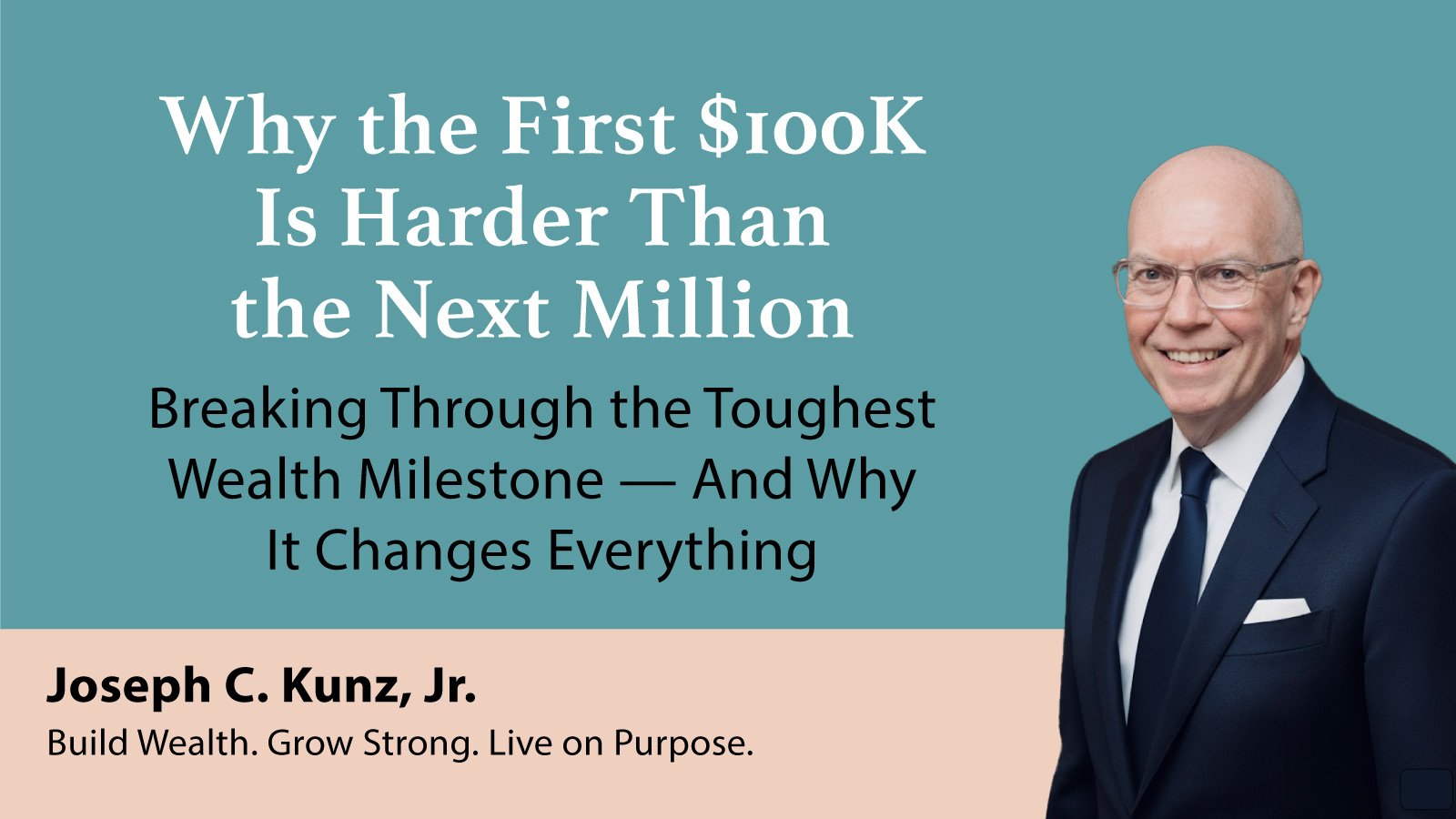
The first $100K is the hardest money you’ll ever make—a grind built on discipline, sacrifice, and grit—but once you cross it, compounding and confidence turn the climb to your next million into a very different game. —Joseph C. Kunz, Jr.
Breaking Through the Toughest Wealth Milestone — And Why It Changes Everything
By Joseph C. Kunz, Jr.
Synopsis
The first $100,000 is the hardest money you’ll ever make—not because the math is difficult, but because the discipline is. In this essay, Joseph C. Kunz, Jr. explains why this milestone is the true proving ground of wealth-building, where habits are forged, excuses are stripped away, and momentum is earned the hard way.
Crossing $100K marks the moment money begins to work alongside you instead of against you. Compounding accelerates, confidence sharpens, and opportunities expand—but only after you’ve paid the price in restraint and grit. This essay reframes the first $100K not as a number, but as the turning point that separates those who grind forever from those who build wealth that grows on its own.
The first $100K is made by your sweat. The next million is made by your money. —JCK
I. Introduction
Most people think becoming a millionaire is the hard part. They’re wrong. The hard part is scraping together your first $100,000.
That first six‑figure milestone feels like pushing a boulder uphill with your bare hands. Every dollar is earned through sweat, sacrifice, and discipline—and yet it barely seems to move the needle. You save $500, then the car breaks down. You put away $1,000, then the property tax bill shows up. It’s a financial version of “two steps forward, one step back.”
But here’s the truth: that struggle is the price of admission to the real wealth‑building game. The first $100K isn’t magic, but it is the tipping point where the math—and your mindset—finally shift in your favor. Before that, money growth depends entirely on your effort. After that, your money starts to work for you.
I remember the moment I crossed $100K in my net worth. It wasn’t fireworks and champagne. It was a quiet spreadsheet update on a Sunday morning. But it felt different. For the first time, my savings weren’t just a fragile pile of cash. They were capital—and capital has power.
II. Why $100K Feels Impossible
The first $100K is hard because you’re fighting against gravity.
• No compounding yet. At $5,000 in savings, even a solid 10% return adds $500—real progress, but not yet the kind that changes your day-to-day life.
• Every dollar is from your sweat. There’s no meaningful passive growth. You’re trading hours for dollars.
• Temptations to quit. It’s always easier to buy the shiny new toy than to save toward a number that feels impossibly far away.
• Lifestyle creep. Friends, family, and culture constantly encourage you to “treat yourself” the moment you get ahead.
• Emotional fatigue. Progress is invisible for months at a time. It’s like going to the gym and not seeing results for the first six months—most people quit.
Early on, you’re saving with nothing but hope and discipline. And hope alone won’t get you to $100K. Discipline will.
III. The Psychological Barrier
Some people call it “the desert” between $10K and $100K. You start with enthusiasm, then hit the long, dry stretch where progress feels painfully slow. This is the danger zone.
Your brain starts whispering: Maybe you’re just not good with money. Maybe this is all a waste of time. Maybe you should enjoy life now and worry about savings later.
This is where most people give up and settle for “good enough”—a few thousand in the bank, maybe a retirement account they occasionally contribute to. And that’s exactly why so few people ever see significant wealth.
If you can survive the boredom, the temptations, and the doubts, you’re halfway there.
IV. Why It Gets Easier After $100K
Once you hit $100K, something changes—and it’s not just psychological.
• Compounding finally kicks in. At $100K, even a conservative 7% return adds $7,000 a year—without you lifting a finger. That’s the equivalent of finding an extra month’s salary in your sleep.
• Bigger opportunities open up. You can buy into investments that have minimum thresholds, or take advantage of deals that smaller sums couldn’t touch.
• Momentum becomes real. Watching your wealth grow from investments instead of just labor is addictive—in the best way.
• Your cushion gives you options. You can take calculated risks, whether that’s a career change, a business venture, or a strategic investment.
The $100K mark is where your money starts pulling its own weight.
V. The Math Behind the Magic
Here’s the simplest way to see it:
• Scenario 1: $100K at 7% annual growth = ~$7,000 in a year.
• Scenario 2: $10K at 7% annual growth = $700 in a year.
Which feels more motivating?
Even better: If you reinvest that $7,000 growth and add another $10K in savings during the year, you’re now looking at $117K. The next year, you’re earning 7% on $117K—about $8,200 in growth. The snowball is rolling.
It’s why doubling from $100K to $200K takes far less time than building the first $100K from scratch.
VI. The Skills You Build on the Way to $100K
The money is one thing—but the skills you develop along the way are the real treasure.
• Budgeting with precision. You know where your money goes, and you make every dollar earn its keep.
• Saying “no” to lifestyle inflation. You stop keeping up with the Joneses — and maybe even lap them.
• Building side income streams. Side hustles, freelance gigs, second jobs—you learn how to make money outside your main paycheck.
• Patience with investments. You stop jumping in and out of the market based on headlines.
• Spotting traps. You get better at avoiding “too good to be true” money schemes.
These habits are the foundation of your next million.
VII. Practical Steps to Reach $100K Faster
• Pay yourself first. Automate savings and investments before you spend a dime.
• Increase income. Promotions, new jobs, side hustles, overtime—income acceleration shortens the journey.
• Kill high-interest debt. Every dollar of interest you avoid is a dollar you keep.
• Invest early. Even small amounts put time on your side.
• Delay lifestyle upgrades. The nicer car, bigger house, and fancier vacations can wait.
There’s no magic trick here. The strategy is simple—the execution is hard.
VIII. The Character Shift After $100K
Crossing $100K doesn’t just change your finances—it changes you.
• You start thinking like an investor, not just a worker.
• You see opportunities others miss because you’re not trapped in paycheck‑to‑paycheck survival mode.
• You stop asking, Can I afford this? and start asking, Will this grow my wealth or my life?
The first $100K forces you to develop grit. The next million lets you use it.
IX. Common Pitfalls After $100K
Reaching $100K isn’t the end of the game—it’s the end of level one.
• Lifestyle inflation. You feel “rich” and start spending like it.
• Overconfidence. You believe you can’t make a bad investment. (You can.)
• Complacency. You think the hard part is over and coast.
The cure? Keep the same hunger, habits, and humility that got you to $100K in the first place.
X. The Ripple Effect
Hitting $100K does more than change your net worth—it changes your trajectory.
• Your family sees an example of financial discipline in action.
• Minor financial setbacks no longer send you into panic mode.
• Wealth building stops feeling like a chore—it becomes a game you’re winning.
It’s the turning point where you stop working only for money… and money starts working for you.
XI. Conclusion
The first $100K is the hardest because it’s where the discipline is forged, the habits are built, and the mindset shifts from scarcity to opportunity.
Once you’ve climbed that hill, the path to $1 million—and beyond—is still a climb, but now you have tools, capital, and momentum working in your favor.
Start today. Even if it’s $20 at a time. The sooner you begin the climb, the sooner you’ll reach the point where the money starts doing the heavy lifting—and where your wealth becomes a living, breathing engine for your future.
$100K isn’t the finish line. It’s the point where the game finally tilts in your favor. —JCK
Related Essays: For Those Ready to Break Through the Hardest Part
If this essay made you nod in recognition, these will push you to climb higher.
1. The First Rule of Wealth: Stop Making Excuses
Excuses are the surest way to stay broke—cut them out if you want to build real wealth.
2. Wealth and Money Mastery: The 10X Principle of Small Wins
Discover how stacking small, disciplined wins creates exponential results in both money and life.
Reader Comment: This essay opened my eyes—it showed me that building wealth isn’t about giant leaps, but about steady, repeatable wins.
Related Book: Stop Crying About How Hard It Is — The First $100K Is Supposed to Hurt
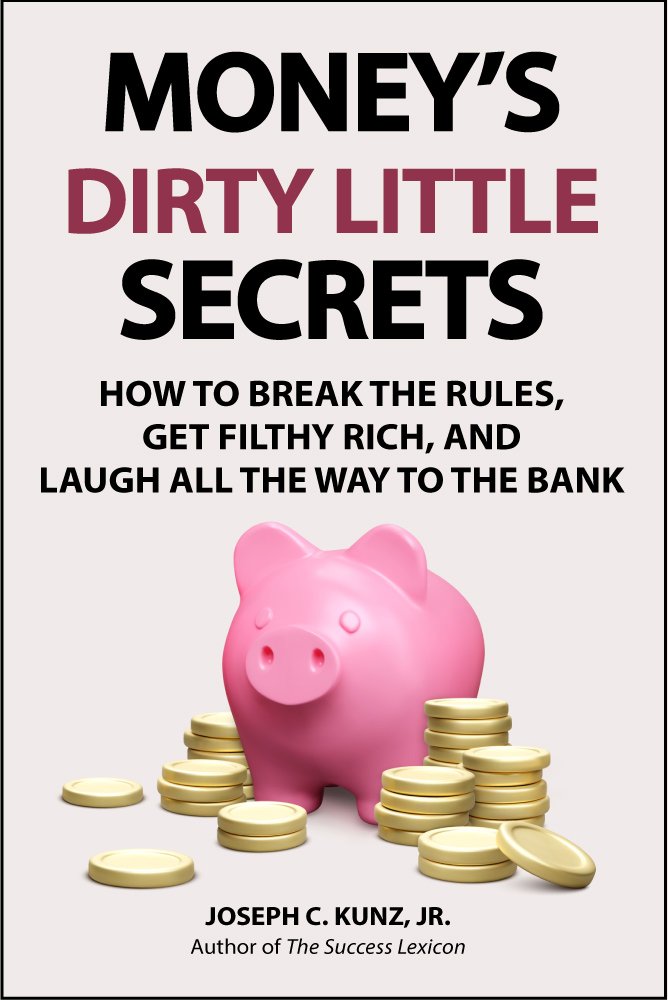
Money’s Dirty Little Secrets
Everybody wants to skip the grind and fast-forward to the millions. Newsflash: you don’t get to cheat gravity.
That first $100K? It’s not just tough—it’s brutal. It’s meant to test whether you’ve got the guts, the discipline, and the backbone to deserve what comes next.
That’s why I wrote Money’s Dirty Little Secrets. Not to pat you on the back with clichés—but to hand you the playbook I bled for.
Every principle inside is a shortcut to avoid the traps, excuses, and nonsense that keep most people broke forever.
Grab your copy of Money’s Dirty Little Secrets and find out how to stop whining, start winning, and build wealth with the kind of unapologetic grit that makes the next million almost inevitable.