Available
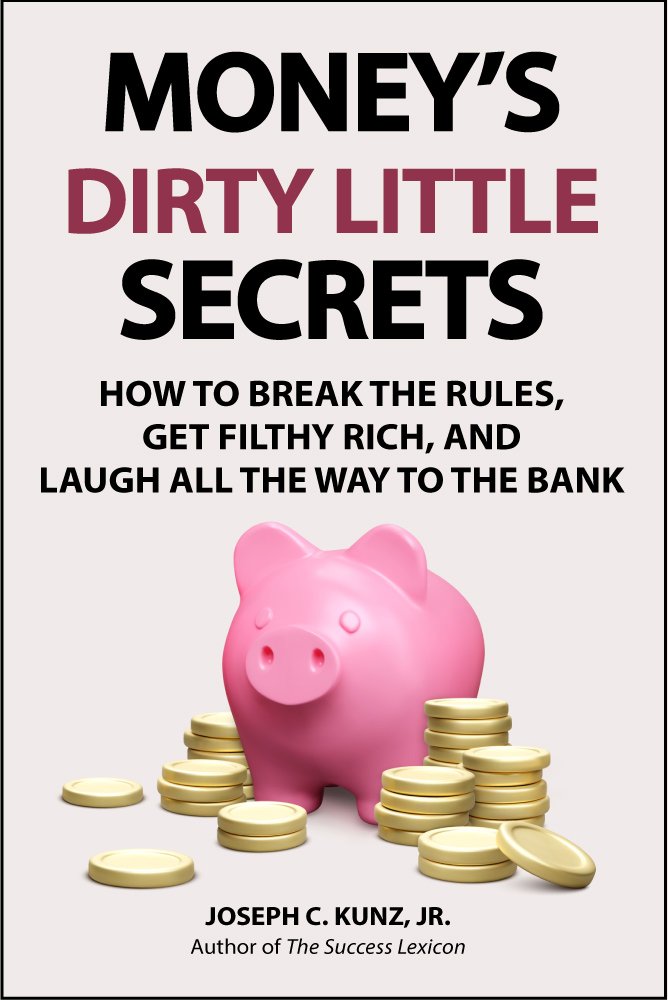
Money’s Dirty Little Secrets
How to Break the Rules, Get Filthy Rich, and Laugh All the Way to the Bank
A Provocative Title. A Serious Argument About Money.
The title is deliberately provocative. The argument underneath it is more serious.
For generations, people have been handed familiar rules about money: work hard, save what you can, avoid risk, stay out of debt, keep your head down, and hope that decades of patience eventually produce financial security.
Some of that advice is useful. Some of it is incomplete. And some of it can become an excuse for never learning how wealth is actually built.
Money’s Dirty Little Secrets challenges readers to examine the assumptions they have inherited about earning, investing, risk, business ownership, financial independence, and wealth.
But “breaking the rules” does not mean abandoning responsibility. It means learning which rules are principles—and which are merely conventions.
About This Book
Money affects almost every important part of life. It affects where you live, how you work, what risks you can take, how much time you control, what opportunities you can pursue, how well you can protect your family, and what you may eventually be able to leave behind.
Yet many people spend decades earning money without ever seriously studying how money works.
Money’s Dirty Little Secrets was written to challenge that pattern.
Across 21 chapters, Joseph C. Kunz, Jr. examines the beliefs, habits, strategies, and decisions involved in building, managing, protecting, and ultimately using wealth. The book begins by challenging common assumptions about money and financial success, then moves into investing, calculated risk, business ownership, multiple income streams, financial education, technology, the psychology of money, credit and debt, passive income, risk management, wealth protection, mentorship, and long-term investing.
But the book does not end with accumulation. Its later chapters ask a larger question:
What is wealth for?
The answer reaches beyond a bank balance. Wealth can create choices. It can provide security. It can allow you to invest in opportunities, protect the people you love, support causes you believe in, help the next generation begin from a stronger position, and gain greater control over your own time.
Money is not the meaning of life. But used wisely, it can become one of the tools with which a meaningful life is built.
What You’ll Find Inside
A Different Way to Think About Money
Examine some of the assumptions people inherit about wealth, work, saving, investing, security, and financial independence—and learn to distinguish useful principles from habits that may deserve reconsideration.
The Psychology Behind Financial Decisions
Explore how fear, scarcity thinking, emotion, confidence, patience, and personal beliefs influence the way people earn, spend, invest, and respond to financial opportunities.
Calculated Risk—not Recklessness
Understand the distinction between intelligent risk-taking and gambling with your future. The book examines risk tolerance, diversification, downside protection, resilience, and the importance of understanding what you are doing before committing money.
Building More Than One Source of Income
Consider entrepreneurship, side businesses, investing, real estate, royalties, online businesses, and other ways people can reduce their dependence on a single paycheck.
Making Money Work Instead of Merely Earning It
Explore investing, compounding, income-producing assets, passive-income strategies, and the shift from thinking exclusively like an earner to beginning to think like an owner and investor.
Credit, Debt, and Leverage
Learn why not all debt serves the same purpose and why borrowed money can be either destructive or useful depending upon what it finances, the risks involved, and whether there is a disciplined plan behind it.
Building—and Protecting—Wealth
Creating assets is only part of the job. The book also explores diversification, inflation, taxes, legal risks, insurance, professional advisors, estate planning, and the importance of protecting what years of work have produced.
Financial Education as a Lifelong Discipline
Markets change. Technology changes. Tax laws change. Opportunities change. The book argues that financial education should continue throughout adult life rather than ending when formal schooling does.
Wealth, Family, and Legacy
One of the book’s most important themes appears near the end:
Passing down money without passing down wisdom is not enough.
The book explores financial education for the next generation, responsible inheritance, values, estate planning, and the difference between leaving assets and leaving a legacy.
Who This Book Is For
Money’s Dirty Little Secrets is for readers who want to think more seriously and independently about money.
It is especially appropriate for:
- People who work hard but wonder why hard work alone has not created financial independence.
- Professionals who want to move beyond earning a paycheck and begin thinking more deliberately about ownership, investing, and assets.
- Entrepreneurs and aspiring business owners who see business ownership as one possible path toward greater independence.
- People beginning to invest who want to understand the larger principles behind risk, diversification, patience, and long-term wealth-building.
- Readers who were never taught much about money and realize that financial education has become their own responsibility.
- Parents and grandparents who increasingly think about what they will teach, build, protect, and eventually pass to the next generation.
And it is for readers who understand that becoming better with money is not primarily about becoming obsessed with money. It is about becoming more deliberate with one of the most powerful tools that passes through your hands.
The Rules Worth Breaking—and the Rules That Should Never Be Broken
The title encourages readers to “break the rules.” That requires an important distinction.
Some rules are merely conventions. You do not necessarily have to depend upon one paycheck. You do not necessarily have to wait until traditional retirement age to achieve greater financial freedom. All debt is not identical. All risk is not foolish. Saving and investing are not the same thing. Owning assets is different from merely earning income. And the path followed by most people is not automatically the path that must be followed by you.
Those are the kinds of rules worth examining.
But other rules are not conventions. They are principles.
Keep your word. Create genuine value. Treat people fairly. Protect your reputation. Understand the risks you take. Accept responsibility for your decisions. Do not sacrifice your family in the name of providing for your family. Do not compromise your character for money.
One of the most important chapters in the book is devoted to building wealth without selling your soul. That is not a contradiction of the book’s rule-breaking philosophy. It is the boundary around it.
Financial independence without character is not success. —JCK
Wealth Is More Than Money
Money matters. Pretending otherwise does not make a person wiser or more virtuous. Lack of money can restrict choices, increase vulnerability, create stress, and make ordinary problems much harder to solve.
But the opposite mistake is equally dangerous: believing that accumulating money is itself the purpose of life.
The deeper argument of Money’s Dirty Little Secrets is that wealth should create capacity. The capacity to make choices. To protect your family. To withstand setbacks. To pursue meaningful work. To invest. To give. To create. To control more of your own time. And eventually, to pass something useful to those who come after you.
That makes wealth part of a larger architecture.
Money should serve the life you are building. The life should not exist merely to serve the money. —JCK
Building Wealth Is Only Half the Job
Accumulating assets receives most of the attention in discussions about personal finance. Keeping them deserves just as much.
As wealth grows, the questions change. How diversified are you? What risks could seriously damage what you have built? Are taxes being considered intelligently? Are your assets properly protected? Do you need professional financial, tax, legal, or estate-planning advice? What happens to the wealth when you are no longer here?
And perhaps the hardest question: Have the people who may inherit what you built also inherited the judgment necessary to handle it?
The book treats wealth preservation and generational responsibility as part of wealth-building itself. A fortune that disappears one generation later was accumulated. It was not successfully passed on.
From Wealth to Legacy
Eventually, every serious discussion about wealth becomes a discussion about time.
You spend years earning. Then building. Then investing. Then protecting. And eventually you confront the fact that you cannot take any of it with you.
At that point, the question changes from: How much did I accumulate? to: What did I build with it?
Did it strengthen a family? Did it create opportunities? Did it help children and grandchildren become more capable—or merely more comfortable? Did you pass down financial knowledge alongside financial assets? Did your money reflect your values? Did it provide freedom without creating entitlement?
Legacy begins long before an estate is distributed. It begins in the habits, conversations, examples, expectations, knowledge, and values transmitted while you are still here to teach them.
That is why the final stages of wealth-building are not merely about preserving money. They are about preparing people.
How to Use This Book
You can read Money’s Dirty Little Secrets from beginning to end as a broad exploration of wealth-building. But it can also be used as a book to return to.
Revisit the chapters on psychology when emotion begins influencing financial decisions. Return to risk management when considering a new opportunity. Review the chapters on debt before deciding whether leverage makes sense. Return to passive income and business ownership when thinking about creating additional sources of income. Study wealth preservation as your financial life becomes more complex. And revisit the chapters on family and legacy as the question gradually changes from building wealth for yourself to deciding what the wealth should accomplish beyond you.
Many chapters include practical action steps designed to move the reader from merely agreeing with an idea to doing something with it.
Knowledge matters. Application matters more.
About the Author
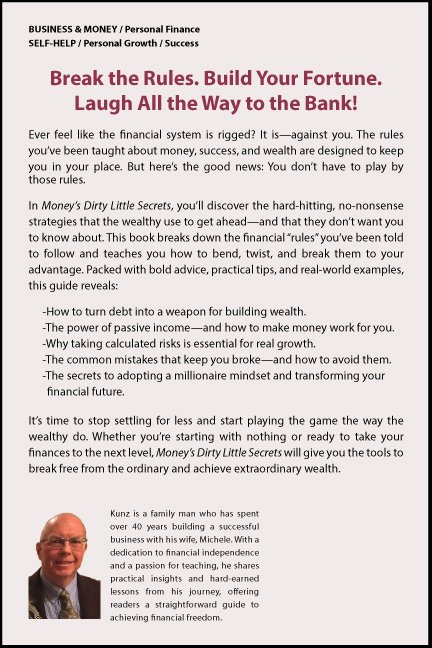
Joseph C. Kunz, Jr. is an author, businessman, publisher, and lifelong student of money, entrepreneurship, responsibility, and independent thought.
Together with his wife, Michele, he built a business from the ground up while raising a family and navigating the ordinary realities that accompany entrepreneurship: uncertainty, long hours, financial decisions, mistakes, risks, setbacks, growth, and responsibility. His writing about money comes from that practical foundation.
He does not view wealth simply as accumulation or consumption. He views it as a tool for independence, family security, meaningful work, greater choice, and legacy.
That perspective forms part of his broader Four Pillars philosophy: Faith, Responsibility, Work & Wealth, and Legacy—the load-bearing forces he believes help shape a well-built life.
Money’s Dirty Little Secrets occupies the Work & Wealth pillar, but its argument eventually reaches the Legacy pillar as well:
Build. Protect. Use wisely. Teach what you learned. And leave the next generation stronger than you found it. —JCK
Book Details
- Title: Money’s Dirty Little Secrets
- Subtitle: How to Break the Rules, Get Filthy Rich, and Laugh All the Way to the Bank
- Author: Joseph C. Kunz, Jr.
- Publisher: Dickson Keanaghan, LLC
- Publication Year: 2025
- Edition: First Edition
- Paperback ISBN: 978-1-933230-28-3
- Ebook ISBN: 978-1-933230-29-0
- Language: English
Make Money Serve the Life You Are Building
There is nothing noble about financial ignorance. There is also nothing noble about making money the center of your existence. The harder task is learning to put money in its proper place.
Earn it honestly. Understand it. Invest it intelligently. Take risks deliberately. Protect what you build. Use it to create choices rather than appearances. Teach the next generation what it took to produce it. And never confuse the size of an account with the size of a life.
Build wealth—but know what you are building it for. —JCK
Buy the Book
Continue the Work & Wealth Library
Starting A Home-Based Business: From A to Z
Build something of your own.Twenty-six practical building blocks for turning an idea into a real home-based business.
The Success Lexicon
Strengthen the principles behind the builder.A plain-English guide to money, mastery, responsibility, success, and a life that compounds.
Educational Note: Money’s Dirty Little Secrets is intended for educational and informational purposes. It does not provide individualized financial, investment, tax, or legal advice. Significant financial decisions should be evaluated in light of your own circumstances and, when appropriate, with qualified professional advisors.