Why I Call Myself a Christian First, Even as a Catholic

Why I Call Myself a Christian First, Even as a Catholic—Faith isn’t a club card, and it sure as hell isn’t a hashtag. —Joseph C. Kunz, Jr.
Beyond Tribes and Titles — Living Faith as The Core of Who We Are
By Joseph C. Kunz, Jr.
Synopsis
Faith is not a label, a tribe, or a public signal—it is the foundation that orders a life. In this essay, Joseph C. Kunz, Jr. explains why he calls himself a Christian first, even as a Catholic: not to reject his heritage, but to place Christ above category, relationship above affiliation.
Drawing from lived experience, family, and faith carried through suffering, the essay argues that real belief is not something worn for identification, but something lived as identity. It is a call to move beyond tribal labels and reclaim faith as the unifying center of life—the truth worth passing down when everything else falls away.
Faith isn’t a crutch that replaces self-reliance—it’s the ground that makes self-reliance possible. —JCK
I. Introduction: Keeping It Simple
I’ve been Catholic all my life, but I don’t usually introduce myself that way. When someone asks about my faith, I just say, “I’m a Christian.” It’s not because I’m embarrassed, and it’s not because I’m trying to water anything down. It’s because, like a lot of little-c conservatives, I’m cautious about what I share with people I don’t know well. Faith and values aren’t bumper stickers—they’re personal, hard-earned, and too important to toss around casually. Saying “Christian” keeps it simple, honest, and focused on the bigger truth: before anything else, I follow Christ.
II. Why I Lead With “Christian”
For me, Christian is the larger, truer word. It reminds me—and anyone listening—that faith isn’t about belonging to a tribe. It’s about belonging to Christ.
When I say “Christian,” I’m not erasing my Catholic identity. I’m just putting first things first: Christ before category. Faith before faction. Labels come and go, but the truth remains.
Most people who ask about faith aren’t looking for a theology lesson. They just want to know what steadies you. And if I only say “I’m Catholic,” I hand them a label that can drag up old baggage—arguments, divisions, bad experiences. But if I say, “I’m a Christian,” the door opens wider. It makes the point: my loyalty isn’t to a club, it’s to Christ.
And honestly, part of it is caution. Many conservatives are private people. We don’t parade our deepest beliefs in front of strangers. We know not everyone deserves the whole story. That’s not fear—it’s prudence. You don’t toss pearls into every conversation.
III. The Weight of Heritage
None of this means I deny or downplay my Catholic faith. It has shaped my entire life. The Mass, the sacraments, the witness of the saints—these are treasures I would never trade away. Catholicism gave me a framework for discipline, reverence, and humility that carried me through some of the hardest seasons of life.
When I was lying in a hospital bed after brain surgery, unable to move half my face, I wasn’t thinking about labels. I wasn’t reciting political slogans. I was leaning on faith. Michele sat beside me in those nights, quiet but unshakable, carrying prayers in her heart that I will never fully know but will always be grateful for.
And in that silence, I felt what I’ve always known deep down: faith isn’t something you put on and take off. It isn’t a crutch that replaces self-reliance—it’s the ground that makes self-reliance possible. My entire life, I’ve fought to stand on my own two feet, to take responsibility, to not lean on others. But even in that, I’ve never stood alone.
My strength, my grit, my stubborn independence—all of it has always been fueled by something deeper: the conviction that Christ and His truth were under me, holding steady. That night in the hospital, when I could do nothing else, I saw it as clearly as ever: before anything else, I am a Christian. That’s the truth that never shifts.
IV. Not Disrespect, But Honesty
So when I say “Christian,” I’m not dodging. I’m not watering down. I’m being honest. I don’t want my first words to sound like a membership card. I want them to sound like an invitation.
A while back, someone asked me straight out if I was Catholic. I said, “I’m a Christian.” They paused, thought for a second, and then nodded. The conversation went forward, not sideways. If I’d led with “Catholic,” we probably would’ve gotten tangled in denominational weeds. Instead, we talked about what faith actually looks like when lived out. That’s why I start simple. It opens doors instead of closing them.
V. A Unity the World Needs
Our culture is addicted to division. Liberal vs. conservative. Rich vs. poor. Rural vs. urban. And even inside the Church, we split into tribes: Catholic, Baptist, Methodist, Orthodox—all talking past each other while the culture burns.
In a world that’s busier dividing people into labels and factions than solving problems, the one thing Christians can’t afford to do is splinter into smaller tribes. Unity in Christ isn’t just timeless—it’s the only antidote to the chaos of this moment.
Look at social media. Christians claw at each other online, trading insults about doctrine while the secular world laughs and moves the cultural needle further away from faith. That’s what happens when labels matter more than the Lord.
We already have an identity bigger than any faction. We belong to Christ. That should mean more than a denominational label, and it should pull us together, not drive us apart.
VI. Passing It Down
This isn’t just about me. It’s about what I want to pass to my children and grandchildren. I don’t want them to think faith is just another badge they wear or another tribe they belong to. I want them to know it as a relationship, a lifeline, and a way of life.
Because faith, at its core, is not separate from the rest of life. It’s the dot on the map that connects every other dot—family, business, work, even the way we handle money and time. Faith isn’t something you take out of the drawer on Sunday morning and then put away until next week. It’s what orders the rest of the map. Without that anchor, all the other dots just float around, disconnected.
I want my kids and grandkids to see that. I want them to know that when we sit around the Sunday dinner table, when we bow our heads before a meal, when we work long hours to keep the business going, when we forgive someone who wronged us—those aren’t separate pieces. They’re all connected by grace. They’re all part of a single story.
Faith isn’t about joining a tribe and learning the secret handshake. It’s about learning how to see life whole—how to draw the line from one dot to the next until the pattern becomes clear. That pattern is where meaning lives. That’s where freedom is rooted. That’s the truth I want to hand down, not as an argument, but as a way of living.
So, when my grandkids ask me about faith someday, I don’t want to hand them a stack of denominational arguments. I want to hand them a simple truth: We are Christians. We belong to Christ. That’s where everything else flows from.
VII. Conclusion: Christ First, Always
So yes—I’m Catholic. I’m grateful for that heritage, and I won’t run from it. But when I speak, I want to start with the foundation that holds it all together: I am a Christian.
Because when my kids, my grandkids, or even a stranger asks me who I am, the clearest, truest answer isn’t about a label. It’s about a relationship. If all you’ve got is a label, you’ve missed the point. What matters is who you belong to. And that belonging isn’t weakness—it’s the only kind of strength that lasts.
Faith isn’t about joining a tribe and learning the secret handshake. It’s about seeing life whole. —JCK
Related Essays: For Readers Who Value Faith Over Labels
If this essay spoke to your instinct to put Christ above categories, these will drive the point home even further.
1. The Best Inheritance Isn’t Money — It’s This
Discover why the values, principles, and faith you pass down matter far more than financial wealth.
Reader Comment: This essay reminded me that my kids are watching what I live, not just what I say.
2. Still Showing Up: How Brain Surgery, Facial Paralysis, and a New Identity Taught Me the Quiet Power of Resilience
An honest look at how faith and perseverance redefine strength when life knocks you flat.
Quote: Resilience isn’t about pretending you’re fine—it’s about showing up anyway. —JCK
Related Book: Drop the Label. Claim the Lifeline.
If you walk away with nothing else, walk away with this: faith isn’t a club card, a hashtag, or a tribal badge. It’s not about checking a box or fitting into someone’s idea of the “right” group.
It’s the lifeline that runs through your family, your work, your grit, and your hope. Labels divide. Christ unites.
Don’t settle for belonging to a category when you were made to belong to Him. Say it out loud. Live it out loud. Teach it at your table. Pass it down with your name.
Because at the end of your life, no one’s going to care what label you wore—they’ll care who you belonged to, and what kind of legacy you left behind.
So, stop hiding behind the tribe. Call yourself what you are: a Christian first. That’s not weakness. That’s the strongest stand you’ll ever take.
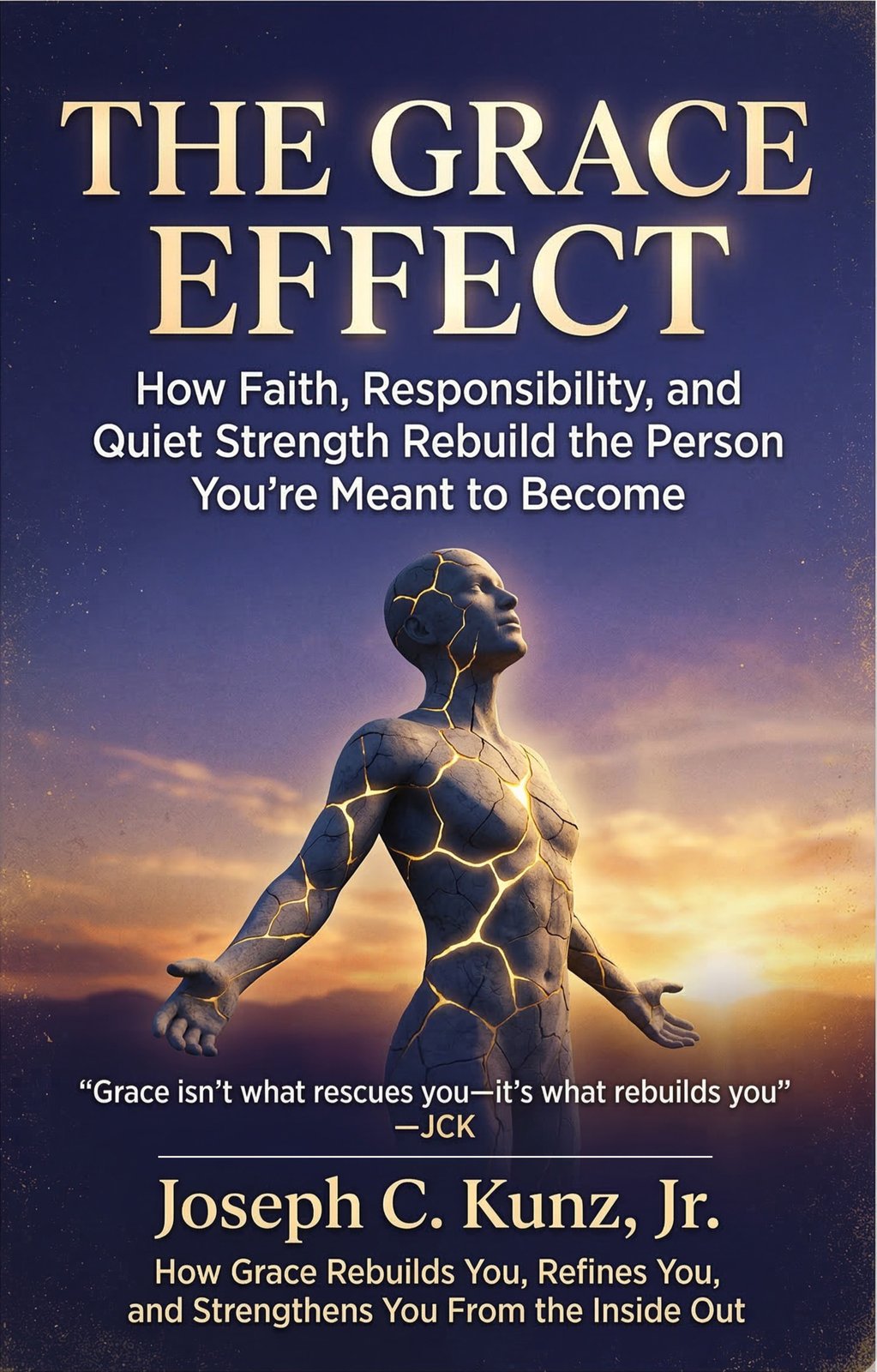
Ready to dive deeper? Grab your copy of The Grace Effect and discover what living your faith with grit, grace, and guts really looks like.
Coming Soon.