Still Showing Up

A powerful reflection on resilience—showing up again and again, even when you feel broken, tired, or unseen. —Joseph C. Kunz, Jr.
How Brain Surgery, Facial Paralysis, and a New Identity Taught Me the Quiet Power of Resilience
By Joseph C. Kunz, Jr.
You don’t need to be loud to be strong. Sometimes the bravest thing you can do is just keep showing up—especially when life tries to silence you. —JCK
Synopsis
This is a personal story—but it isn’t a plea for sympathy. After brain surgery left Joseph C. Kunz, Jr. with facial paralysis and a long, uncertain recovery, he had to face a new kind of loss: not just health and function, but identity, visibility, and confidence. Still Showing Up is about what happens when life changes you in a way everyone can see—and how you keep standing in the room anyway.
With honesty, restraint, and hard-earned clarity, Kunz reflects on the quiet courage of returning to work, serving others while still healing, and learning that resilience isn’t a dramatic comeback—it’s the daily decision to stay present when you feel tired, altered, or unseen. Because sometimes the bravest thing you can do isn’t to “bounce back.” It’s to show up as who you are now—and keep going.
I. Introduction
I didn’t write this to talk about how bad it was. Because in the world of health scares, mine wasn’t the worst. It wasn’t terminal. It wasn’t tragic. But it was personal—and it was visible.
Brain surgery left me with one side of my face paralyzed. I couldn’t blink, couldn’t smile, couldn’t speak clearly. I looked like a stroke survivor—and people looked at me like I was one. For months, I wore an eye patch, couldn’t walk without help, and haven’t driven a car since. I was knocked down—but I kept showing up. For our students, our business, and our life.
And that’s when I learned: healing has less to do with how fast your nerves regenerate, and more to do with how willing you are to keep showing up when things don’t look—or feel—like they once had.
II. When Everything Changes Overnight
Before the surgery, I was healthy. Busy. I ran our training business with my wife Michele, taught classes, drove everywhere, and stayed active. I was deeply embedded in our daily life. Then, almost overnight, I wasn’t.
The neurosurgeon told me the tumor was tiny and the procedure routine—a walk in the park. It was pressing on the nerve that controls balance and hearing. He said, “Get it out while it’s small. You’ll be fine in a few weeks.”
I believed him. I was supposed to fly to Korea and Japan in a few weeks. “No problem,” they said. “You’ll be ready.” So, I did it.
The surgery happened. But the aftermath? That’s where the real story began.
III. Living in a New Body
Waking up with your face frozen is something no one prepares you for. One side of my face drooped and didn’t move. I couldn’t smile. Couldn’t blink. Couldn’t drink without dribbling. I had to tape my eye shut at night and keep it lubricated during the day because it couldn’t blink to protect itself.
I lost my balance. I couldn’t walk without grabbing furniture or a person. The world saw my face—but they didn’t see the exhaustion. The dizziness and loss of depth perception. The fear. Or the quiet resolve every day to say, “I’ll keep going.”
Sixteen months later, I had the first of two facial reanimation surgeries. They placed a tiny weight inside my eyelid to help it close. They lifted skin around my eye. Then they removed a nerve from my leg and grafted it through my face, leaving part of my foot, ankle, and leg permanently numb.
Next comes the second surgery: a muscle transplant from my leg into my cheek. They’ll connect it to the grafted nerve, and then we begin physical therapy so I can learn to smile and speak again.
Yes, I have to learn how to smile.
My 3-year-old grandson summed it up with brutal honesty: “Grandpa, your eye and face are broken.” That hits a man harder than you’d think.
IV. Still Showing Up
But I still showed up to our classes—standing next to Michele, my wife and partner of 40+ years. Students looked at me. Some asked questions. Others didn’t know what to say.
But here’s the thing: our students are nurses and physicians. They’ve seen injury. They’ve seen disfigurement. They understand healing. Many of them have known me for years—long before the surgery. They knew what I looked like before.
To them, I wasn’t just some guy who showed up with a drooping and twisted face. I was me. Someone they respected. Someone they’d spent time with and laughed with.
And here’s what made all the difference: Michele talked about it. With grace, compassion, and just the right dose of humor, she wove my situation into the flow of the class. After all, teaching about patients with neurological conditions—stroke symptoms, facial asymmetry, speech difficulties—is part of what she does every day. And I looked like one of those patients.
So instead of avoiding it, Michele used my presence as a real-world teaching moment. She explained what happened, why I looked the way I did, and what recovery can look like. It wasn’t awkward—it was honest. And it helped the entire room exhale.
For our longtime students, it answered the quiet questions they didn’t know how to ask. For new students, it set the tone: this is a space where we talk about real things, where healing and humor can coexist, and where no one needs to feel uncomfortable.
I didn’t hide. I didn’t explain. I just stood there. Present.
Because sometimes, that’s what healing looks like.
V. You Don’t Need Facial Paralysis to Understand Loss
Let’s be honest—you don’t need facial paralysis to know what it’s like to lose a piece of yourself.
Maybe your loss didn’t show up on an MRI. Maybe it came from a divorce, a failed business, a lost dream, or a diagnosis you didn’t see coming. Maybe it’s the slow unraveling of something you thought was permanent.
We all carry something. And at some point, we will all face a version of ourselves we never expected.
It’s confusing. It’s painful. It’s disorienting. And it’s lonely. And yet, it’s in that unfamiliar space that something new can begin to grow—if we let it.
We all hit walls. We all face moments when our life looks unfamiliar—and we feel unseen, even by ourselves. That’s when the hard work begins. And if you’re still showing up anyway—in your marriage, your work, your parenting, your friendships, your faith—that’s not weakness. That’s grit. That’s resilience. That’s real strength.
But if you stay in that space long enough, you’ll find something growing. Something stronger. Something new.
VI. Conclusion: Here’s What I Learned
• You don’t need to be the strongest person in the room. You just need to stay in the room. Real strength isn’t loud. It’s that quiet decision to keep going when your pride, energy, or hope are running low.
• You don’t need to explain your journey to everyone. The right people already understand. Some people won’t get it—and that’s okay. The ones who do will see your effort, not just your scars.
• You don’t need to go back to who you were. You just need to show up as who you are now. Trying to get “back to normal” can be very tough. Life moves forward—and so must we.
• You don’t need applause to validate your courage. There’s no medal for brushing your teeth while in pain. But those are the wins that matter. That’s where real courage lives.
• You don’t need to wait until everything is perfect to contribute again. The world doesn’t need polished people. It needs real people—scarred, tired, changed—but still willing to show up and serve.
A Note of Thanks to Nurses
To every nurse who looked at me and saw more than a diagnosis—thank you.
You didn’t just help me physically. You helped restore my courage.
You reminded me that healing starts not when someone “fixes” you—but when someone sees you.
And if you’re one of the quiet heroes doing that work, every day, without applause—then I honor you. Because I know what that takes.
Why I Wrote This
I didn’t write this for sympathy. I wrote it for the person who’s quietly, painfully, rebuilding, without a lot of fanfare.
Maybe that’s you.
Maybe you’re showing up to work, to life, to your family—scarred, tired, and different than you once were.
And I want to tell you: that’s enough. You’re doing the hard part. And I see you.
This isn’t just my story. It’s the story of anyone who’s looked in the mirror and thought, “I may not recognize the guy in the reflection—but I’m still standing. And I’m not giving up.”
Especially for men—we’re taught to tough it out. To keep pain private. To never let anyone see the struggle. But real toughness isn’t silence—it’s showing up in the mess. With dignity, not denial. That’s the kind of man I want my children and grandchildren to remember.
If that’s you—keep going.
You don’t need to be fully healed to start helping again. Sometimes the most powerful thing you can do is show up anyway. —JCK
Related Essays: For the Ambitious Individual Ready to Go Deeper
If this one hit home, these will drive it deeper.
1. The Best Advice My Father Never Said Out Loud How silence, absence, and hard truths can shape a man’s character more than words ever could.
Reader Comment: This essay stayed with me for days—raw, honest, and quietly powerful.
2. Who’s in Charge Here — You or the Path? A bold reminder to stop drifting and reclaim control of the direction your life is headed.
Related Book: Want to Go Deeper?
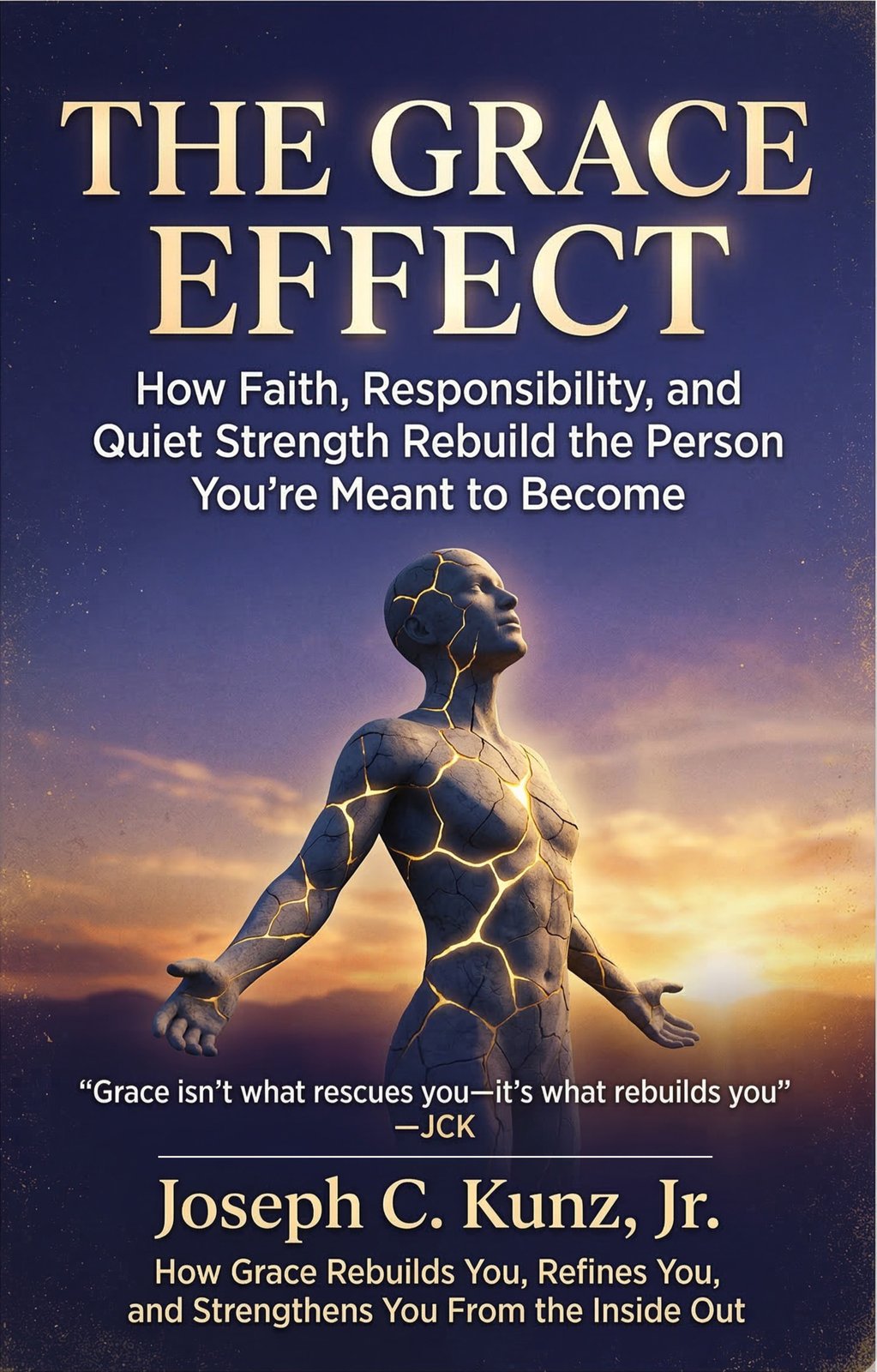
The Grace Effect
If Still Showing Up resonated with you—if you're navigating loss, change, or rebuilding your sense of self—then you may find strength in my book, The Grace Effect.
This book expands on the same themes of courage, identity, and quiet strength—but through a wider lens. It’s not about illness or recovery.
It’s about how we live with grace when life gets messy, uncertain, or downright hard. It's for anyone trying to live well—not perfectly, but meaningfully.
Forthcoming.