When Faith Is Allowed to Correct Us
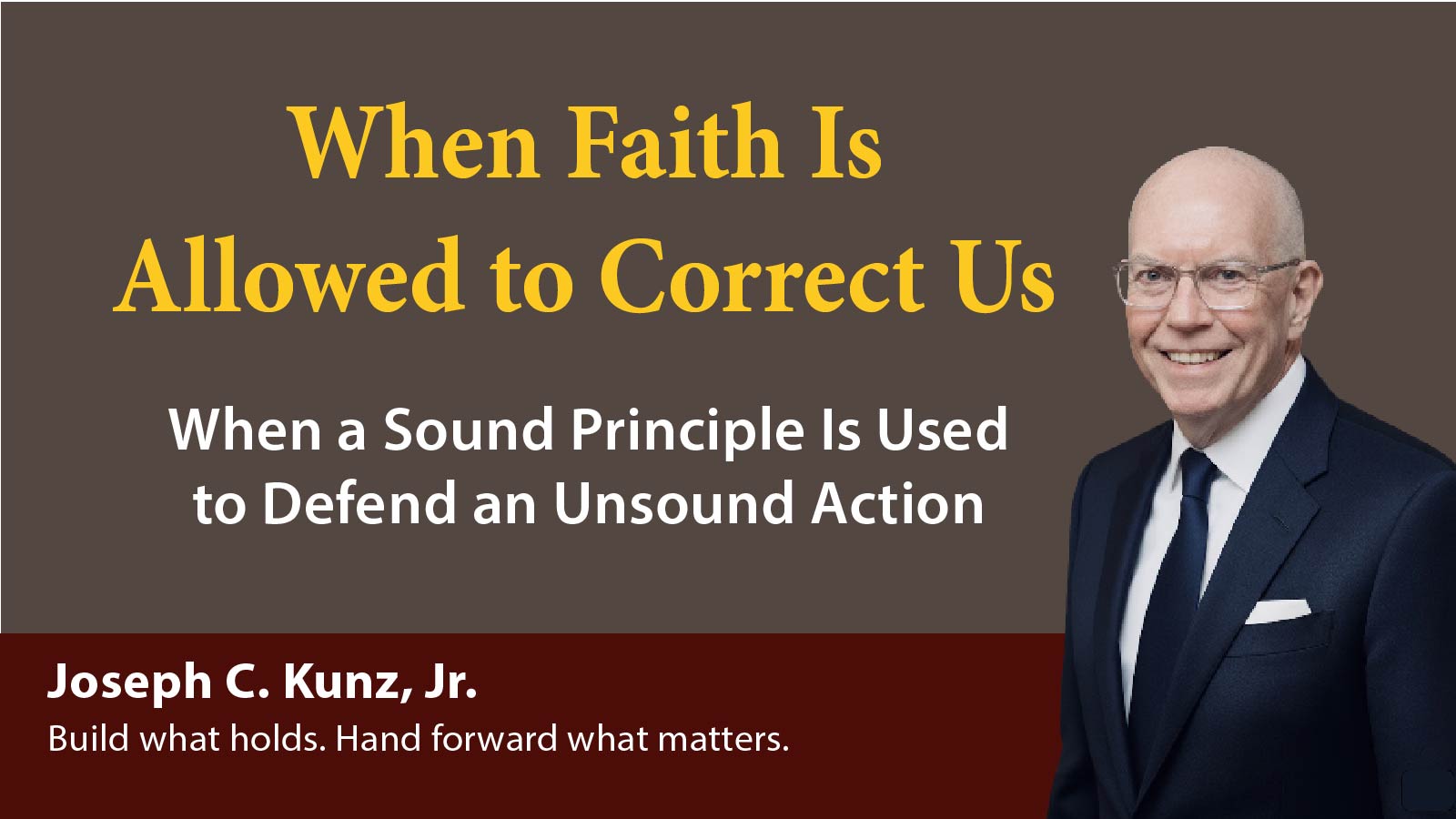
If my faith can never tell me I am wrong, I need to ask what I am calling faith. —Joseph C. Kunz, Jr.
When a Sound Principle Is Used to Defend an Unsound Action
By Joseph C. Kunz, Jr.
Synopsis
We can make a sound decision and still go too far afterward. We can defend an important principle while overlooking the harm we are doing in its name. Faith becomes demanding when it asks us to examine conduct we believe we have already justified.
That does not mean abandoning our standards whenever someone objects. It means asking whether those standards actually support what we are doing. A business owner can protect his company without seeking revenge. Admitting that he went too far can be an act of responsibility, not a retreat from it.
These questions reach into our work, our relationships, and the example we leave our children. How do we recognize when a conviction we defend is being used to excuse something else? And will we accept the answer when it requires us to change?
Faith deserves a place in the decisions I find difficult, not only in the ones that come easily. —JCK
I. Introduction: The Rule and What Followed
Imagine a roofing contractor who has run his company for more than twenty years. He attends Mass regularly and takes his responsibilities seriously. His crews work around customers’ homes and property. He expects honesty, and he makes that expectation clear: stealing from the company will cost an employee his job.
A nineteen-year-old on one of his crews sells company-owned roofing materials without permission and keeps the money. When confronted, he admits it. The owner dismisses him.
The owner has a sound reason for firing him. But he does not stop there.
He repeats the story at the supply house. When he hears that the young man has applied to two other contractors, he calls them. He wants to make sure neither hires him. Soon, making the young man pay has become a project of its own.
The young man’s mother approaches him after Mass. She does not dispute the theft or ask him to give her son his job back. She asks whether he will stop trying to prevent him from finding another one.
The owner answers that he is responsible for his business. He cannot be expected to employ someone who has stolen from him. Hiring requires practical judgment, and being a Christian does not remove that responsibility.
He has answered a question she did not ask.
Her concern is what he has done since the firing. He has been using a justified decision about his company to defend a continuing effort to punish her son.
The owner believes that he depends on God’s mercy through Christ. He has needed forgiveness himself. Now he faces an uncomfortable question: what does that belief require of him here?
Later, he calls the two contractors again. His son, who works with him, is in the truck when he makes the calls.
He does not withdraw the facts or offer a guarantee that the young man can be trusted. He says the theft happened and that he stands by the dismissal. Then he acknowledges something else: he went beyond explaining the incident. He was trying to keep the young man out of work. That was wrong, and the contractors should make their own decisions.
The calls do not settle everything. He still owes the young man an apology, and he cannot know how much damage his earlier words have done. But he has stopped defending the whole course of conduct simply because its first step was justified.
II. What His Faith Asked Him to Reconsider
His Christian belief matters because he understands himself as a man who needs mercy, not merely as a man entitled to enforce consequences. Catholic teaching describes grace as God’s freely given help, something we receive rather than a payment we have earned.1
That belief gives him a reason to question the pleasure he takes in another person’s continuing punishment. He expects accountability from the employee. He has been less willing to examine what he himself is doing.
The mother did not introduce a new teaching. Her question brought a familiar belief into a part of his conduct he had not examined.
The theft remains wrong, and the young man remains responsible for making amends. Other employers may need truthful information about what happened. Christian forgiveness does not require rehiring him, concealing the theft, or allowing further harm. It does rule out revenge. The owner’s task is to stop treating his desire to punish as though it were simply a duty to protect.2
He can keep his standard against theft while admitting that his campaign afterward went too far. Faith corrects what he does in the name of responsibility; it does not make responsibility unimportant.
The principle does not have to change for me to discover that I have applied it badly.
That is why recognizing the error is only a beginning. The owner has already made calls that could influence other people’s decisions. His return calls begin the repair, and an apology to the young man remains his responsibility. Changing his opinion privately would have left the harm unanswered.
III. Who Decides What Faith Requires?
There is a difficulty we should face directly. Someone can tell me that Christianity requires a particular response and still be mistaken. Religious language does not turn a personal opinion into an obligation.
As a Catholic, I receive a faith whose teaching is not mine to invent. Scripture and the faith handed down through the Church provide a standard beyond my preferences. The Church’s teaching authority has the task of interpreting that inheritance faithfully, not replacing it with whatever is convenient.3
Understanding what is taught and deciding how to act remain my responsibility. Conscience does not release me from that work. Catholic teaching says that a person is bound by the certain judgment of conscience, while also recognizing that conscience can be mistaken and needs formation in truth.4
That means asking two different questions. What does the faith teach? What does that teaching require in these circumstances?
In the roofing example, Christian mercy places a real demand on the owner. It does not automatically settle every question about rehiring, references, repayment, or rebuilding trust. Those decisions require attention to facts and to the people who could be affected.
Catholic teaching recognizes legitimate differences among Christians in practical judgments. It also warns against claiming the Church’s authority exclusively for one’s own opinion in such matters.5
But “this requires judgment” cannot become a convenient way to stop listening.
The owner’s first response to the mother was accurate about hiring and irrelevant to her actual request. She was asking him to examine the punishment he continued to impose. He was defending a decision she had not challenged.
Calling something a matter of judgment does not relieve me of the responsibility to judge it well.
I need to identify the actual question, understand the teaching involved, and give reasons for how I apply it. Neither another person’s confidence nor my own discomfort settles the matter.
IV. The Question That Tests My Explanation
There is a question worth asking when I explain why I acted as I did:
Would I still accept this distinction if it required me to change?
The owner distinguishes forgiveness from restoring trust. That is a reasonable distinction. Admitting wrongdoing does not automatically restore a damaged working relationship.
But would he accept the same reasoning if he were the one asking for another chance? Could he accept that someone had forgiven him but still needed evidence that he could be trusted again?
And would he accept the difference between protecting others and pursuing revenge when it required him to acknowledge that his own conduct had gone too far?
A principle should apply to me as well as to the people I judge. If I dismiss every appeal for mercy when holding others accountable, then ask for mercy to escape accountability myself, I am applying different standards.
The same test applies to the reasons I give for my own decisions. Am I defending a principle, or using it to defend something I should correct? What fact would make a difference to my judgment? What would accepting the criticism actually require me to do?
These questions do not assume that the critic is right. They help me examine the criticism rather than simply prepare another defense.
An honest examination may strengthen the conviction I already hold. Changing my mind is not proof of wisdom, and retaining a conviction is not proof of stubbornness. What matters is whether I have seriously considered the reasons offered against my position.
Feeling uncomfortable is not proof that I need to change, either. A manipulative demand can be upsetting too. The question is whether the proposed correction is justified, not how strongly someone insists on it.
A willingness that never permits a changed decision is difficult to distinguish from a polite refusal.
V. Conclusion: What Our Children See
I want my children and grandchildren to inherit convictions that deserve to last. I also want them to see that holding firm convictions does not require pretending I have applied them perfectly.
In my writing, teaching, and business, I am often expected to have an answer. Experience can help me give a better one. It does not remove the responsibility to listen when someone identifies a mistake, even after years of being the one expected to know.
My exploration of Christianity is part of that responsibility. I want to understand more deeply what I profess and what it asks of me. That understanding matters most when it reaches a decision I would rather leave alone.
Once I recognize a wrong, willingness to learn is no longer enough. There may be an apology to make, a claim to withdraw, or damage to repair. The correction needs to appear in what I do next.
The roofer kept his rule against theft. He also acknowledged that his conduct after the firing had become wrong. His son heard that admission and watched him begin to act on it. The apology was still owed, and the damage was not erased. But his father was no longer using a sound principle to defend an unsound action.
A faithful life includes the courage to say, ‘I was wrong,’ and the willingness to live differently afterward. —JCK
Source Notes
1. Catechism of the Catholic Church, paragraphs 1996–2002. Grace as God’s free gift, divine initiative, and the free human response. ↩
2. Pope Francis, Fratelli Tutti (2020), paragraphs 241–242. Forgiveness, legitimate protection, and the rejection of revenge. ↩
3. Second Vatican Council, Dei Verbum (1965), paragraphs 9–10. Scripture, Tradition, and the Church’s teaching authority in service of the word of God. ↩
4. Catechism of the Catholic Church, paragraphs 1790–1794. The obligation to follow a certain conscience, the possibility of error, and responsibility for seeking truth. ↩
5. Second Vatican Council, Gaudium et Spes (1965), paragraph 43. Christian responsibility in practical affairs and legitimate differences in judgment. ↩
Related Essays: When Belief Reaches the Life We Live
Why Self-Reliant People Struggle to Receive What Cannot Be Earned
Why the habits that help us earn, provide, and meet our obligations cannot explain everything about receiving from God.
Reader Comment: Continue here to examine how grace can deepen responsibility without turning faith into another way of earning a reward.
Quote: “The lesson of self-reliance was true. Grace does not erase it. Grace completes it.” —JCK
2. Belief in God Is Not Yet Christianity
Why Jesus Christ Is Not an Optional Add-On to Faith
Why Christian faith involves more than belief in moral order, and why Jesus Christ stands at its center.
Reader Comment: This companion essay explores the beliefs behind the call to correction, with room for the honest questions that understanding Christianity can require.
Quote: “Many men can respect God from a distance. Christianity begins when distance is no longer enough.” —JCK
Related Book: Letting Faith Examine the Life You Have Built
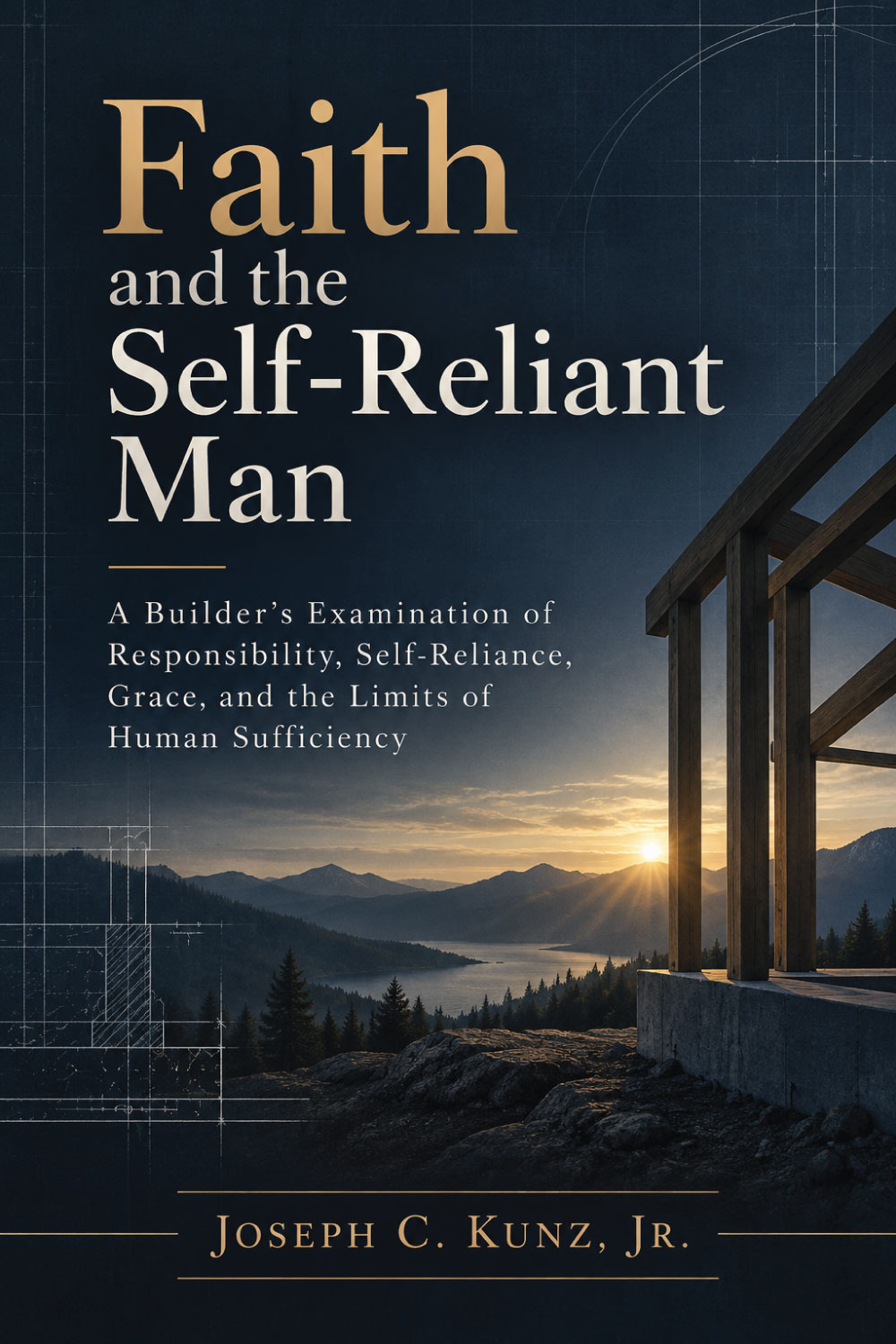
Faith and the Self-Reliant Man
A Builder’s Examination of Responsibility, Self-Reliance, Grace, and the Limits of Human Sufficiency
Years of work and responsibility give us good reasons to value our strengths. They do not settle every question about how those strengths should be used—or what happens when they reach their limits.
I am developing Faith and the Self-Reliant Man to explore those questions. The book examines Christian faith, grace, and dependence on God from the perspective of a man who values preparation, meaningful work, financial responsibility, and caring for his family. It asks how to preserve those commitments while remaining willing to receive what effort alone cannot provide.
For readers who have built a responsible life and are asking what Christianity requires of it, this book continues the examination. Its aim is to help us understand our strengths more clearly, recognize their limits, and remain faithful to the work that is ours to do.
Quote: “Faith does not abolish self-reliance. It puts self-reliance in its proper place.” —JCK
Taking Shape: Faith and the Self-Reliant Man