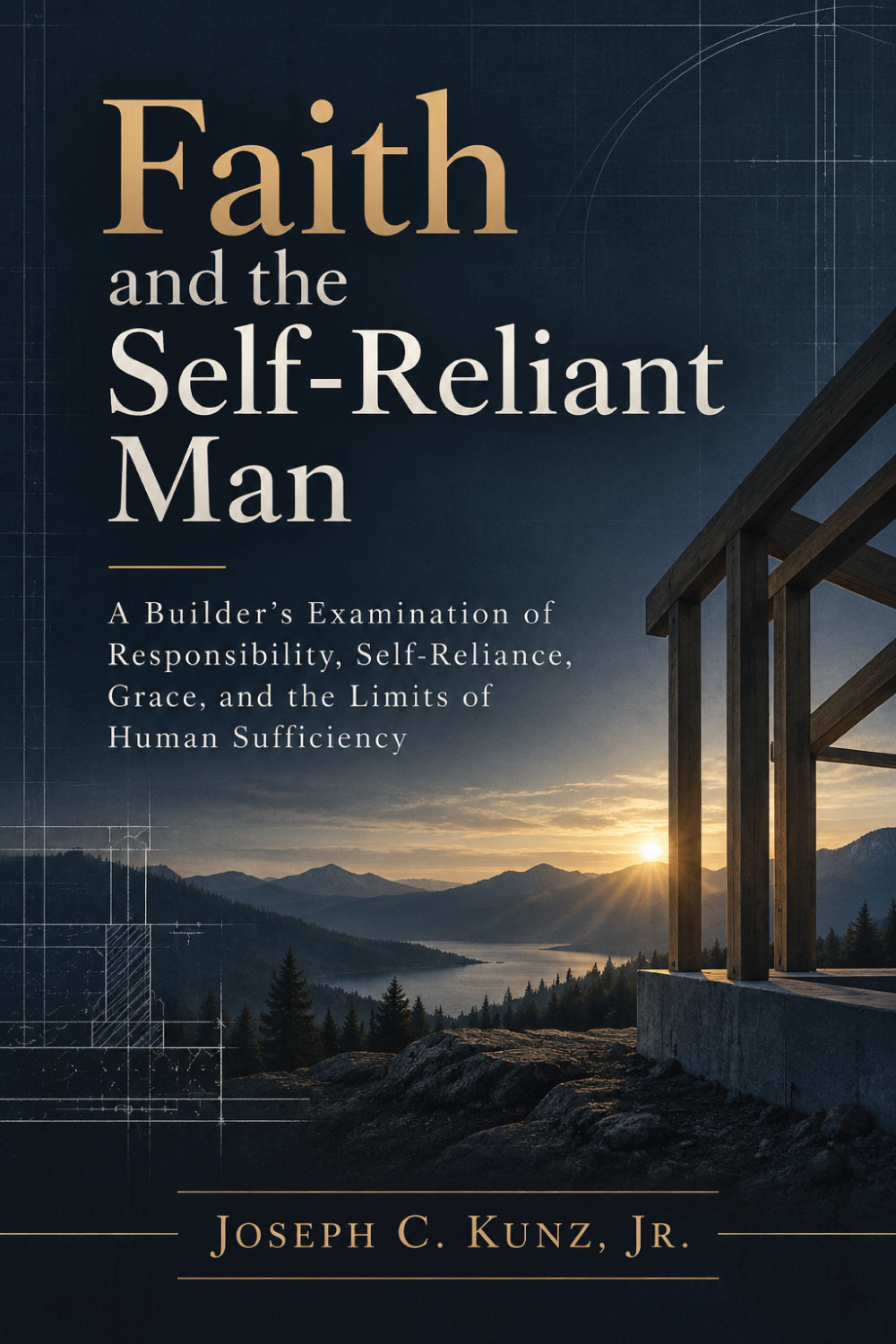
In Development
Self-reliance can help a man build a life. It cannot finally become the foundation beneath one.
What Does Faith Mean to a Man Who Has Learned to Depend on Himself?
Some men learn early that when something breaks, they had better figure out how to fix it.
They learn to work.
To provide.
To prepare.
To solve problems.
To build enough financial strength that an unexpected setback does not become a catastrophe.
To avoid depending too heavily on one customer, one employer, one income source, one plan, or one person.
Over time, self-reliance becomes more than a practical skill.
It becomes part of the way a man understands responsibility itself.
That way of living can serve him extraordinarily well.
It can also make Christian faith surprisingly difficult.
Because Christianity eventually confronts the self-reliant man with a very different question:
What does it mean to depend upon God when experience has repeatedly taught you that depending upon yourself works?
Faith and the Self-Reliant Man grows out of that question.
This is not a book against competence, preparation, work, wealth, responsibility, or self-reliance.
It is an examination of their proper place—and of the point at which genuine human strength can quietly become a belief in human sufficiency.
Overview
I did not learn that I could control life.
Life teaches us fairly quickly that we cannot.
Plans fail.
People disappoint us.
Businesses change.
Markets move.
Illness arrives.
Families face problems nobody anticipated.
The future does not ask our permission before changing direction.
What I learned instead was something more durable:
Whatever happened, I could probably find a way to deal with it.
If Plan A failed, find Plan B.
If something broke, understand the system and repair it.
If circumstances changed, adapt.
If a problem could not be avoided, manage it.
If a setback could not be reversed, find some way to build from what remained.
That confidence helped me become a businessman, husband, father, provider, investor, and builder.
But eventually I began to recognize a deeper question.
What happens when a strength that works remarkably well within its proper limits is asked to become something it cannot be?
Self-reliance can make us capable.
It cannot make us invulnerable.
Preparation can reduce risk.
It cannot guarantee an outcome.
Money can create enormous security.
It cannot eliminate human dependence.
Competence can solve many problems.
It cannot solve mortality.
Responsibility can tell us what is ours to do.
It cannot place the final outcome under our control.
And Christian faith makes an even more difficult claim:
We are not ultimately sufficient unto ourselves.
That is the territory this book will examine.
I did not learn that I could control life. I learned that I could handle it. And that turned out to be a much more complicated obstacle to faith.— JCK
Where Self-Reliance Begins
For me, self-reliance did not begin as a philosophy.
It began as ordinary life.
My father left our family when I was twelve.
My mother worked long hours for little money while raising my brothers and me.
Growing up, I did not regard our circumstances as extraordinary, and I still do not. Many people have carried burdens far greater than anything I have known.
At the time, I did not think much about whether I was becoming independent or resilient.
I was doing what I thought needed to be done.
When we could not afford a heating-oil delivery, I would bring home #2 diesel from a nearby gas station in two five-gallon containers and pour it into the tank.
When running the tank dry clogged the oil-burner nozzle, I taught myself how to clean it and get the heating system running again.
When our old washing machine broke, I learned enough about it to keep it operating for years.
Eventually I was able to buy my mother a new washer and dryer.
None of that felt heroic.
It felt practical.
The heat was off.
The machine was broken.
The bill had to be paid.
Something needed to be done.
So I tried to figure it out.
Long before I knew the language of self-reliance, I was learning one of its most important lessons:
If I can understand the problem, I may be able to do something about it.
When Self-Reliance Becomes a Way of Life
That same instinct later shaped the way I built businesses.
I never wanted one customer to possess enough economic power over us that losing that customer could threaten the entire company.
So we built broadly.
Large clients.
Medium clients.
Small clients.
Thousands of very small repeat customers.
Different sources of revenue.
Different kinds of work.
The business principle was straightforward:
Avoid unnecessary single points of failure.
Diversify.
Build reserves.
Develop alternatives.
Understand the system.
Preserve options.
Reduce vulnerabilities where you reasonably can.
Those are sound principles.
I still believe in them.
But looking backward, I recognize that the business philosophy reflected something larger in me:
If I can handle things myself, I do not have to place myself unnecessarily in the vulnerable position of depending completely upon someone else.
That instinct has served me well.
This book will not pretend otherwise.
The more interesting question is what happens when a sensible desire for independence becomes an assumption that dependence itself is a form of failure.
The Builder Meets What Cannot Be Fixed
Some things can be repaired.
Others can only be cared for.
When I was around twenty, my mother’s dementia began becoming increasingly obvious.
For many years she was still able to work and live a mostly normal life, although the episodes became more frequent and more serious.
I kept a closer eye on her.
Eventually the disease progressed beyond anything I could manage myself, and I helped place her in a retirement community with specialized memory care and around-the-clock assistance.
I could not fix my mother.
I could watch over her.
And when watching over her myself was no longer enough, I could make sure other people were there to care for her.
That taught me something different from repairing an oil burner or solving a business problem:
Not everything entrusted to our care can be repaired.
Sometimes responsibility means fixing what can be fixed.
Sometimes it means remaining faithful to what cannot.
This distinction lies near the center of the book.
Because Christian faith does not begin only after responsibility has been exhausted.
Faith and responsibility can occupy the same moment.
I can do everything that is genuinely mine to do while recognizing that the ultimate outcome was never mine to command.
The Central Problem Is Not Control
It is easy to tell a self-reliant person that he needs to surrender his desire for control.
Sometimes that is true.
But it does not adequately describe the problem I am trying to understand.
I already know that I cannot control everything.
The deeper issue is sufficiency.
A competent person may not believe:
I control everything.
He may believe something subtler:
Whatever happens, I will find a way to deal with it.
And experience may give him decades of evidence supporting that belief.
Christianity therefore has to say something more intelligent than:
Stop relying on yourself.
It must help us distinguish between two very different propositions:
I am capable.
and:
I am sufficient.
The first can be true.
The second eventually reaches a boundary.
That distinction is one of the central arguments of Faith and the Self-Reliant Man.
In This Book, You Will Explore
- How self-reliance is formed through responsibility and lived experience
- Why competence and independence are genuine human goods
- The difference between self-reliance and self-sufficiency
- Why responsibility is not the same thing as control
- Why accepting human limitation does not require becoming passive
- How preparation and Providence can coexist
- Why dependence is not one single thing
- The difference between prudent independence and unnecessary isolation
- Why successful self-reliance can complicate faith more than failed self-reliance
- How financial strength can create real security without creating ultimate security
- Why grace is difficult for people accustomed to earning results
- What Christian surrender does—and does not—require
- Why humility does not mean pretending competence is unimportant
- What happens when the builder encounters something he cannot fix
- How responsibility continues even when control disappears
- What it means to remain faithful to a person or circumstance that cannot be repaired
- Why mortality establishes an unavoidable boundary around human capability
- What it means to trust God without abandoning the work that remains ours to do
- How self-reliance can remain a virtue without becoming the foundation beneath a life
This Book Will Help You
Understand Your Self-Reliance More Clearly
Examine where your independence came from, what it has allowed you to build, and why a strength that has served you well should not be casually condemned.
Distinguish Capability from Sufficiency
Recognize that being able to solve many problems does not require believing that every important problem can be solved through greater competence.
Rethink Dependence
Separate unnecessary dependence, unhealthy dependence, mutual interdependence, human limitation, and Christian dependence rather than treating them as though they were the same thing.
Take Responsibility Without Claiming Sovereignty
Do what is genuinely yours to do without assuming that responsibility gives you authority over every outcome.
Think More Seriously About Grace
Explore why receiving something essential that cannot be earned can be particularly difficult for people whose lives have repeatedly rewarded effort, discipline, work, and competence.
Understand Faith Without Becoming Passive
Consider a form of Christian trust compatible with preparation, judgment, work, prudence, protection, financial responsibility, and decisive action.
Recognize the Limits of What Can Be Fixed
Learn to distinguish problems requiring repair from realities requiring acceptance, care, presence, fidelity, or trust.
Remain a Builder
Preserve strength, usefulness, preparation, competence, and responsibility while placing those virtues within a larger understanding of what a human being is—and is not.
Faith does not abolish self-reliance. It puts self-reliance in its proper place.— JCK
Grace and the Man Who Knows How to Earn
Much of adult life teaches a fairly consistent lesson:
Effort matters.
Work produces results.
Study produces knowledge.
Practice develops competence.
Saving builds capital.
Investment allows capital to compound.
Preparation reduces vulnerability.
A responsible person learns to respect cause and effect.
Then Christianity introduces grace.
Something essential that cannot finally be manufactured, purchased, negotiated, accumulated, or earned.
For the self-reliant builder, that is not a small adjustment.
It challenges an operating system that may have worked almost everywhere else.
Why should a capable man need grace?
What exactly can grace accomplish that discipline cannot?
What does salvation mean to someone accustomed to solving his own problems?
What does it mean to receive rather than produce?
These questions deserve more than religious slogans.
They deserve examination.
Faith and the Four Pillars
Faith asks what the builder ultimately stands on when capability reaches its boundary.
It introduces grace, dependence, humility, Providence, mortality, and the possibility that human beings are participants in a reality they did not create and cannot fully master.
Responsibility asks what remains ours to do.
Faith does not excuse us from judgment, preparation, work, provision, protection, repair, or the consequences of our choices.
Responsibility remains real even when control does not.
Work develops capability.
Wealth can increase margin, independence, security, options, and the ability to protect and provide.
These are legitimate goods.
But capacity is not the same thing as sufficiency.
Money can protect us from many forms of vulnerability while remaining powerless before others.
Legacy asks what our response to these questions teaches the people who come after us.
What do our children learn from watching us carry responsibility?
What do they learn about money? Strength? Faith? Dependence? Asking for help? Endurance?
And what do we hand forward when our own building is finished?
Together, the Four Pillars help place self-reliance within the architecture of a complete life.
Who This Book Is For
Faith and the Self-Reliant Man is written especially for:
- Men who learned early that they had better know how to take care of themselves
- Business owners and professionals accustomed to solving problems and carrying responsibility
- Husbands and fathers who feel a strong obligation to provide and protect
- Men who have built financial security partly because they never want their families to experience financial helplessness
- People whose self-reliance has served them well and who do not want religion to treat that strength as a defect
- Christians who believe but struggle with words such as surrender, dependence, Providence, and grace
- Readers who find “just trust God” intellectually or practically incomplete
- People who want to understand the difference between responsibility and control
- Men who are highly capable and are beginning to recognize the limits of capability
- Anyone asking what remains when something important cannot be fixed
- Women who want to better understand the self-reliant men they love, live with, work with, or depend upon
- Readers seeking a serious Christian examination rather than a conventional devotional
This Is Not a Book Against Self-Reliance
This book will not argue that strength is secretly weakness.
It will not romanticize helplessness.
It will not tell responsible adults to stop preparing for foreseeable problems.
It will not suggest that financial independence is morally suspicious.
It will not turn asking for help into a virtue regardless of circumstance.
It will not claim that every painful event was secretly good because something useful eventually came from it.
It will not tell readers that sufficient faith guarantees the outcome they desire.
And it will not use “trust God” to avoid questions that deserve serious answers.
Instead, the book will make a more difficult argument:
Self-reliance is a genuine virtue whose value depends partly upon understanding its limits.
A man should become capable.
He should prepare.
He should work.
He should provide.
He should develop judgment.
He should build reserves and alternatives.
He should repair what can be repaired.
He should carry what genuinely belongs to him.
But he should not require those virtues to make him something no human being can become:
sufficient for everything.
Remain a builder. Just do not mistake yourself for the foundation.— JCK
A Builder’s Prayer
Lord,
Help me use every ability You have given me well.
Let me prepare intelligently, act decisively, work diligently, repair what I can repair, and adapt when circumstances change.
Give me the courage to carry what is mine to carry and the wisdom to recognize what is not mine to control.
Keep me from mistaking competence for sovereignty, preparation for certainty, achievement for self-sufficiency, or self-reliance for the belief that I have no need of You.
When there is work to be done, help me do it.
When there is a problem I can solve, help me solve it.
When circumstances require me to change direction, give me the judgment and resilience to adapt.
But when I encounter what I cannot fix, understand, reverse, earn, protect against, or turn to my advantage, teach me not to believe that I have failed simply because I have reached the limits of my own abilities.
Help me remember that my responsibility is real, but it is not unlimited.
The work may be mine to do, but the ultimate meaning of my life is not mine to manufacture.
The future is not mine to command.
And I do not have to be sufficient for everything.
Teach me to remain a builder while remembering that I am not the foundation.
Amen.
About the Author
Joseph C. Kunz, Jr. is an essayist, businessman, publisher, husband, father, and grandfather whose work explores Faith, Responsibility, Work & Wealth, and Legacy.
After more than four decades of building businesses, managing money, raising a family, solving problems, and learning how to recover when circumstances change, he has become increasingly interested in the boundary between genuine human capability and the belief that human beings can become sufficient unto themselves.
His essays and books examine those questions through lived experience, careful reasoning, Christian faith, and a willingness to place his own assumptions inside the argument.
His goal is not merely to produce ideas.
It is to pursue wisdom that helps somebody live.
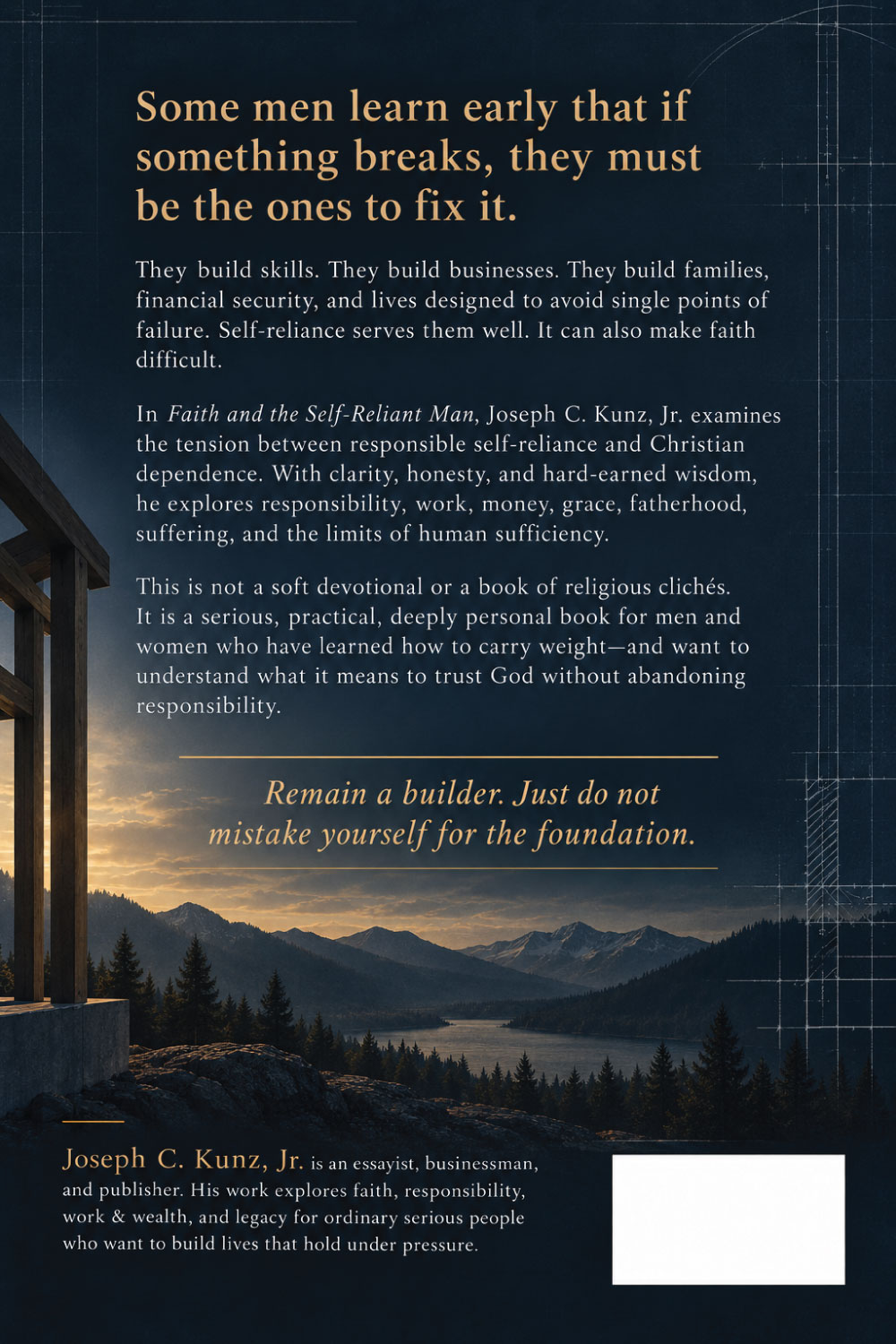
Faith and the Self-Reliant Man is a book about remaining strong without pretending strength is unlimited; remaining responsible without believing every outcome rests upon us; and learning to trust God without abandoning the work that is genuinely ours to do.