The Conservative Mind Holds Tensions Together
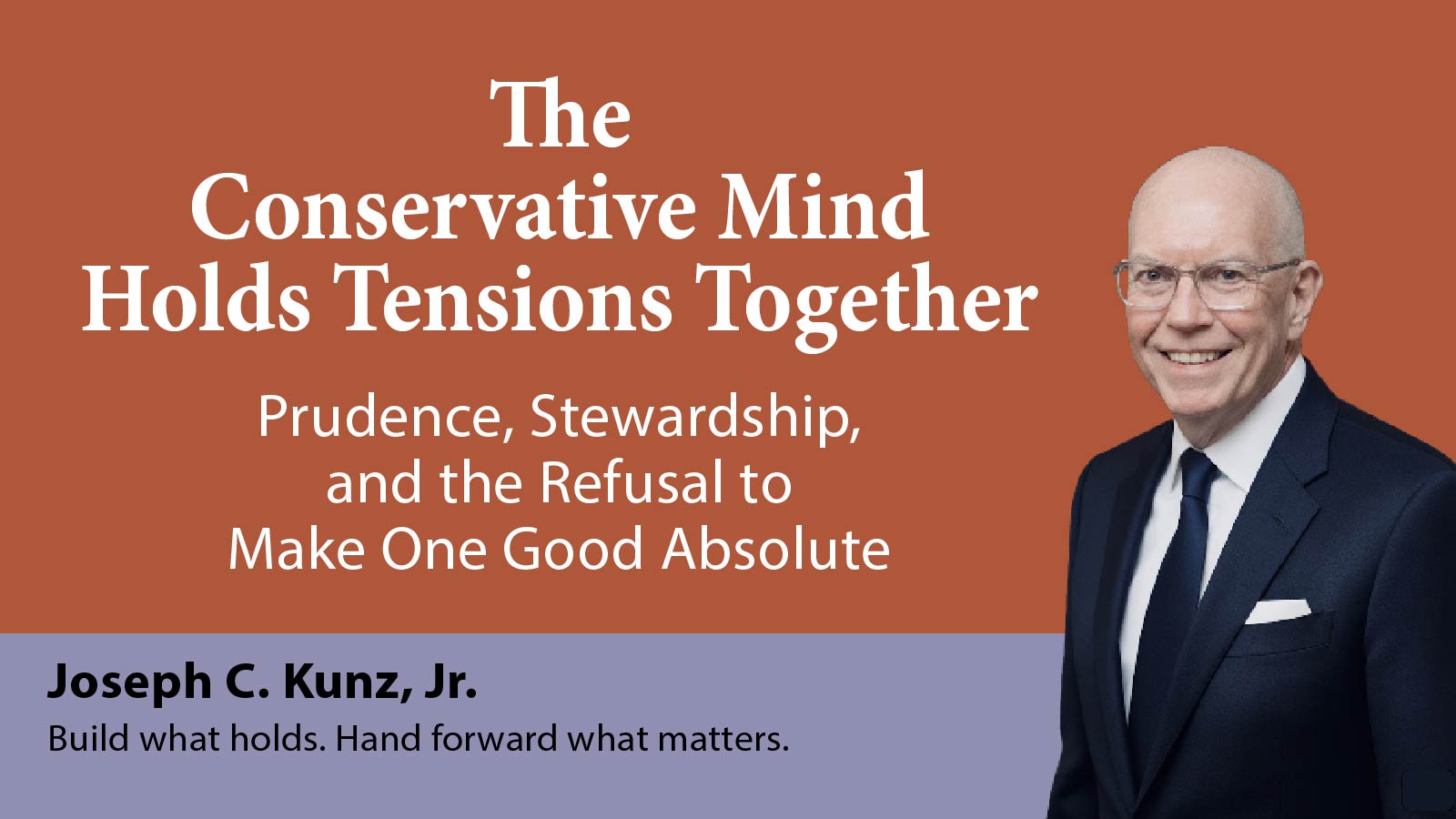
Maturity may consist less in finally choosing one side of every tension than in learning which truths must never be allowed to destroy one another. —Joseph C. Kunz, Jr.
Prudence, Stewardship, and the Refusal to Make One Good Absolute
By Joseph C. Kunz, Jr.
Synopsis
This isn’t an argument for indecision, political centrism, or treating every disagreement as though both sides are equally right. In The Conservative Mind Holds Tensions Together, Joseph C. Kunz, Jr. argues that some of the hardest questions in life arise because two genuine goods can make legitimate claims on us at the same time. The conservative habit of mind is not to erase those tensions for the sake of simplicity, but to judge carefully within them.
Kunz makes the case that permanence and change, freedom and order, independence and obligation, reason and inheritance, and self-reliance and grace are not weaknesses in a coherent worldview. They are tensions that, rightly ordered, keep a life and a society from collapsing into extremes. Drawing especially on Edmund Burke and Russell Kirk, and then bringing the argument into family, business, faith, work, and stewardship, Kunz shows why mature judgment requires attention to principle and circumstance, along with humility and a willingness to learn from what came before.
The conclusion is simple: wisdom does not always ask us to choose one good and destroy another. It asks us to know what must be preserved, what must change, what is ours to carry, what must be received, and what should be handed forward. Receive gratefully. Hold responsibly. Improve humbly. Hand forward faithfully.
Holding tensions together does not mean refusing to choose. It means refusing to choose before understanding what each choice may destroy. —JCK
I. Introduction — The Temptation to Simplify Reality
Some ideas are attractive because they make difficult things seem simple.
If freedom is good, then more freedom must always be better. If tradition is valuable, then change must be dangerous. If self-reliance is a virtue, then needing others must be a weakness. If reason helps us correct mistakes, then inherited wisdom must justify itself before the judgment of the present.
Each of these ideas contains something true.
The problem begins when one truth is treated as though it were the whole truth.
Human life rarely works that way. We live among goods that must exist together: freedom and order, permanence and change, independence and obligation, reason and inheritance, self-reliance and grace.
Very often, both sides matter.
The difficult task is learning how to hold them together.
I have increasingly come to believe that this is one of the defining habits of the conservative mind.
By conservative, I do not simply mean belonging to a political party or agreeing with a list of conservative policies. I mean something deeper: a way of looking at human life that takes experience seriously, recognizes human limitations, respects what has been inherited, and remains suspicious of simple answers to complicated problems.
Edmund Burke understood this especially well.
Burke did not believe that preserving something meant refusing to change it. He understood that institutions sometimes must change in order to preserve what is most important about them. He also understood that inheritance does not require us to leave everything exactly as we found it.
Sometimes our responsibility is to preserve what is good, repair what has weakened, correct what is wrong, and improve what can be improved.
Russell Kirk later described a similar responsibility when he wrote about reconciling permanence and change and maintaining the tension between order and freedom.
The word tension is important.
A tension is not always a problem that must be eliminated.
Sometimes tension is what keeps a structure standing.
Think of a suspension bridge. Different forces pull in different directions, but they work together within a larger structure. Remove those opposing forces and the bridge does not become stronger. It falls.
Human life can work much the same way.
Freedom needs limits if freedom is to survive.
Authority needs limits if authority is to remain legitimate.
Tradition needs renewal if it is to remain alive.
Change needs continuity if it is not to become destruction.
Self-reliance needs humility if competence is not to become pride.
Reason needs inheritance because none of us begins thinking from nothing.
Inheritance needs reason because something does not become wise merely because it is old.
The conservative mind, at its best, resists the temptation to solve these tensions by simply eliminating one side.
That does not mean splitting every disagreement down the middle. Some things are true and some are false. Some actions are right and some are wrong. Some principles deserve to be defended firmly.
Holding tensions together means recognizing that two genuine goods can place legitimate demands upon us at the same time.
A parent wants a child to become independent. But independence does not mean the parent stops teaching, correcting, setting boundaries, or expecting responsibility.
The goal is not freedom instead of discipline.
The goal is freedom developed through discipline.
Ideology often simplifies life by choosing one principle and pushing it as far as possible.
Prudence asks harder questions.
What is good here?
What else is good?
Where does one principle reach its limit?
What happens when a good idea is pushed too far?
What needs to change?
And what must not change?
This kind of judgment is harder than ideology.
But I believe it is closer to the way human beings actually live.
II. Conservatism Is a Habit of Judgment, Not a Formula
One of the easiest ways to misunderstand conservatism is to think of it as a fixed set of answers.
Do this.
Never do that.
Preserve this.
Oppose that.
But life rarely presents us with identical situations.
The same principle can lead to different decisions when circumstances change. That does not necessarily mean the principle has changed. It can mean that judgment has been applied.
Burke understood this.
He distrusted political thinking that began with an abstract principle and then attempted to force every human situation into it. Principles mattered to him, but so did circumstances, history, institutions, and consequences.
Consider honesty.
Honesty is a virtue. But knowing that honesty is good does not automatically tell us exactly what to say, how much to say, when to say it, or how to say it.
A doctor delivering difficult news, a parent speaking to a frightened child, and a businessman correcting an employee may all be committed to honesty.
The principle remains the same.
Its application requires judgment.
That is prudence.
Prudence is sometimes mistaken for caution or timidity. Genuine prudence is neither.
It is the discipline of seeing a situation clearly enough to act well.
It asks what is happening, what matters most, what competing obligations exist, what experience teaches, what consequences are likely to follow, and what cannot morally be surrendered.
This is why conservatism cannot be reduced to a formula.
There is no rule simple enough to relieve us of the responsibility to think.
That principle reaches far beyond politics. It applies to business, parenting, money, marriage, faith, work, and the ordinary decisions through which a life takes shape.
Many important decisions are not choices between something obviously good and something obviously evil. They involve competing responsibilities, incomplete information, imperfect options, and consequences we cannot know with certainty.
That is precisely why judgment matters.
And good judgment requires humility.
Strong convictions do not relieve us of the obligation to understand the situation in front of us.
This is one reason I find Burke so useful. He does not ask us to stop thinking and obey the past. He asks us to think with more than the information the present moment alone can provide.
Experience matters.
History matters.
Institutions matter.
Human nature matters.
Consequences matter.
Inherited wisdom matters.
And circumstances matter.
The conservative habit of mind therefore asks:
What principle is at stake?
What are the actual circumstances?
What have people before us learned about this problem?
What might we destroy while trying to improve something?
What might we preserve merely because we are afraid to change it?
Those are not evasive questions.
They are responsible questions.
And they lead directly to one of the oldest tensions in conservative thought: permanence and change.
III. Permanence and Change — What Must Remain and What Must Be Repaired
Conservatives are often described as people who resist change.
Sometimes they do.
Sometimes they should.
But resistance to change cannot by itself be the meaning of conservatism.
Everything changes.
People age. Families change. Businesses change. Technology changes. Institutions change. Countries change.
Even traditions change in the way they are practiced and understood.
A conservatism that simply says no change would eventually become impossible.
The better question is:
What should change, what should remain, and how do we know the difference?
Burke understood that preservation and change are not necessarily enemies.
Sometimes something must change precisely because we want to preserve what matters most about it.
Consider a family business that has operated successfully for forty years. Customers trust its people, its workmanship, and its honesty.
Then the world changes.
Customers order online. Accounting becomes digital. Advertising changes. Competitors adopt new technology. The next generation enters the business.
If the owner refuses every change because this is how we have always done it, he may eventually destroy the business he is trying to preserve.
But if he discards everything old simply because something new has appeared, he may destroy the character that made the business worth preserving in the first place.
Wisdom lies somewhere else.
Keep the honesty.
Keep the commitment to customers.
Keep the standards of workmanship.
But improve the website. Adopt useful technology. Modernize the accounting. Teach the next generation.
The permanent thing is not necessarily the method. The permanent thing may be the principle behind the method.
Tradition works much the same way.
If we inherit something worthwhile, our responsibility is not necessarily to reproduce every detail exactly as it existed before us.
We must first understand what is essential.
What was this tradition trying to preserve?
What human good did it serve?
Which parts remain true?
Which parts were mistaken?
Which parts must be expressed differently if they are to remain alive?
These questions require both respect and judgment.
Respect without judgment can turn tradition into a museum.
Judgment without respect can turn reform into destruction.
The conservative mind needs both.
This is one reason reform is different from revolution.
Reform begins with the possibility that something valuable may remain even when something else needs correction.
The revolutionary impulse is more likely to treat a serious defect as a reason to condemn the entire structure.
Sometimes institutions truly do become so corrupt that major change is unavoidable. But destruction should never be mistaken for wisdom merely because it is dramatic.
Building is harder.
Repair is harder.
Understanding why something exists before changing it is harder.
That kind of work requires patience and humility.
We should never assume that everything old is wise. People in the past were capable of injustice, selfishness, blindness, and error just as we are.
But the opposite assumption is equally foolish.
People who lived before us were not unintelligent merely because they lived before us.
They made mistakes.
They also learned things.
We inherit both.
Our responsibility is to tell the difference.
That leads to an idea that runs through the rest of this essay:
Inheritance creates responsibility.
What comes into our hands does not automatically become ours to use without regard for what came before or what will come after.
We become stewards of it.
A business.
A family name.
A house.
A community.
A country.
A religious tradition.
An institution.
An idea.
To receive something is to enter a chain that began before us and may continue after us.
The deeper question is not simply whether we preserve or change.
It is:
What condition should this be in when it leaves our hands?
That question contains both permanence and change.
IV. Freedom and Order — Why We Need Both
Few words are more attractive than freedom.
We want the freedom to speak, worship, work, build a business, raise our families, and make meaningful choices about the direction of our own lives.
I value all of these deeply.
But freedom cannot mean simply doing whatever we want.
If everyone were free to drive through every red light, traffic would not become freer.
It would become dangerous.
If contracts could be ignored whenever one party changed his mind, commerce would not become freer.
Trust would disappear.
The point is simple:
Some forms of order make freedom possible.
Russell Kirk understood this when he wrote about maintaining a healthy tension between freedom and order.
We can see the principle clearly in family life.
A good parent wants a child to become free and independent. But a five-year-old is not given the same freedom as a twenty-five-year-old.
Freedom grows as judgment, responsibility, and self-control grow.
Something similar remains true in adulthood.
The person who cannot control his impulses may possess legal freedom while being controlled by appetite.
The person buried beneath debts created by uncontrolled spending may have freely made each purchase, yet find that yesterday’s choices have narrowed tomorrow’s options.
Freedom therefore requires more than the absence of restraint.
It requires self-government.
Some restraints come from outside us: laws, contracts, institutions.
Others must come from within us: conscience, discipline, responsibility, character.
A person who governs himself well does not need someone standing over him every moment.
He keeps his word because he gave it.
He pays what he owes because it is owed.
He accepts responsibility because the responsibility belongs to him.
This is freedom joined to character.
But order can also go too far.
A government could create order by controlling nearly every choice people make. A parent could maintain order by never allowing a child to make a meaningful decision.
The result might look orderly.
But something essential would have been lost.
People need room to act, choose, attempt, fail, learn, build, and become responsible.
Order exists partly to protect that space, not to eliminate it.
This is why freedom and order must correct one another.
Freedom reminds authority that human beings are persons, not pieces to be arranged.
Order reminds freedom that our choices have consequences beyond ourselves.
Freedom says:
Do not control me unnecessarily.
Order answers:
Then govern yourself responsibly.
A free society therefore depends on more than laws protecting individual rights.
It also depends on people capable of using freedom responsibly.
Rights require duties.
Liberty requires restraint.
Power requires limits.
Freedom without sufficient order can become chaos.
Order without sufficient freedom can become oppression.
The conservative task is to preserve the conditions under which both can survive.
V. Independence and Obligation — Self-Reliance Without Isolation
I have long believed in self-reliance.
To me, self-reliance means striving to become capable—to learn how to solve problems, to work, to prepare, and to accept responsibility for the choices we make.
There is dignity in being able to stand on our own feet.
But there is a danger hidden inside that idea.
Self-reliance can slowly become self-sufficiency.
And self-sufficiency can become the belief that because we are capable of taking care of ourselves, we owe very little to anyone else.
That is not self-reliance.
That is isolation.
No human being is actually self-created.
Before we earn anything, we receive.
Life.
Language.
Care.
Education.
Culture.
Knowledge.
Institutions.
Markets.
Technology.
The accumulated discoveries of people we will never meet.
Even when we build a business from nothing, we do not literally build it from nothing.
Someone taught us to read.
Someone built the roads.
Someone developed the tools.
Someone established laws that allow contracts to be enforced and property to be protected.
Personal achievement is real.
So is inheritance.
Recognizing what we received does not require us to deny what we accomplished.
And taking pride in what we accomplished does not require pretending that we did everything alone.
Both things can be true.
That is why independence and obligation must also be held together.
The stronger and more capable we become, the less reasonable it is to believe that our strength exists only for ourselves.
Capability creates possibilities.
It can also create obligations.
Parents have obligations to children.
Business owners have obligations to employees and customers.
Citizens have obligations that accompany citizenship.
Marriage creates obligations.
Knowledge creates opportunities to teach.
Wealth creates possibilities for stewardship.
Our obligations are not identical because our circumstances are not identical.
Nor does another person’s every need automatically become our responsibility.
We still need to distinguish between what belongs to us, what belongs to someone else, and what we genuinely owe one another.
That distinction is one reason self-reliance matters.
When we carry what we reasonably can carry ourselves, families and communities have greater capacity to help those who truly cannot.
Self-reliance and mutual responsibility are therefore not enemies.
The self-reliant person says:
I will carry what is mine to carry.
The responsible member of a family or community adds:
And I will not pretend that only my burdens matter.
That is very different from radical individualism.
Individualism, carried too far, can reduce society to millions of separate people asking:
What am I entitled to do?
A healthy society must also ask:
What do I owe?
Rights matter.
So do duties.
Independence matters.
So does belonging.
The goal is neither dependence nor isolation.
It is responsible independence inside a network of legitimate obligations.
VI. Reason and Inheritance — We Did Not Begin the Conversation
Respecting inheritance does not mean refusing to think for ourselves.
I want to understand why I believe what I believe.
I want ideas to withstand examination.
I want to hear serious objections.
And I want to correct an idea when the evidence or reasoning shows that it needs correction.
Tradition should never become an excuse to stop thinking.
But reason can become arrogant too.
It can tempt us to imagine that anything we cannot immediately explain must be irrational, or that anything inherited from an earlier generation must prove itself before the judgment of the present.
Burke warned against that kind of confidence.
His point was not that our ancestors were always right.
Clearly they were not.
His point was that an individual human being possesses only a small amount of experience compared with the accumulated experience of generations.
That experience deserves to be considered before it is discarded.
A carpenter does not begin each morning by rediscovering woodworking from first principles.
He inherits tools, techniques, measurements, knowledge of materials, and lessons learned by craftsmen who worked long before he was born.
Then experience teaches him more.
Perhaps he improves a method.
Perhaps new machinery allows greater precision.
Perhaps he rejects a technique that no longer makes sense.
But he begins with an inheritance.
Thinking works much the same way.
None of us begins with an empty mind and independently discovers civilization.
We inherit language before we analyze language.
We inherit moral concepts before we debate morality.
We inherit institutions before we fully understand why those institutions developed.
We inherit religious traditions, family practices, laws, customs, stories, habits, and assumptions.
Eventually, we begin examining them.
That examination matters.
Some will survive examination.
Some will become more meaningful because we finally understand the reasons behind them.
Some will need qualification.
Some will need correction.
Some should be rejected.
The important thing is the attitude with which we begin.
The arrogant modern attitude says:
If I cannot immediately see why this exists, it probably has no good reason to exist.
The blindly traditional attitude says:
If we inherited it, we have no right to question it.
Neither is sufficient.
A more responsible approach says:
Before I discard this, I should understand it.
Why did people do this?
What problem was it trying to solve?
What good was it trying to protect?
Are the assumptions behind it still true?
What happens if we remove it?
These are reasonable questions.
They are also humble questions.
The point is not that old ideas deserve automatic obedience.
The point is that our own time does not possess a monopoly on wisdom.
Every generation knows things earlier generations did not.
Every generation also has blind spots, and our own is no exception.
That is one reason serious reading matters to me.
When I read Burke or another writer from another time, I am not looking for someone to tell me what I am required to believe.
I am entering a conversation.
I want to know:
What did he see that I may not have seen?
What part of the argument remains persuasive?
Where do circumstances differ today?
Where does the reasoning require qualification?
What can I carry from this work into my own understanding?
That is how inheritance and reason can work together.
We receive ideas without surrendering judgment.
We question ideas without assuming that questioning makes us wiser than everyone who came before us.
We allow the past to speak.
Then we think.
And if we have done that work seriously enough, perhaps we can add something of our own before handing the conversation forward.
VII. Self-Reliance and Grace — Responsibility Without Self-Sufficiency
Self-reliance teaches us not to surrender too quickly when something becomes difficult.
It encourages us to develop skills, solve problems, make decisions, and carry the responsibilities that properly belong to us.
I believe deeply in those habits.
But self-reliance becomes distorted when it turns into the belief that we are sufficient unto ourselves.
Self-reliance says:
I will try to carry what is mine to carry.
Self-sufficiency says:
I need nothing that I did not create for myself.
The first can be a virtue.
The second is an illusion.
We did not create ourselves.
We did not choose to be born.
We did not invent the language with which we think.
We did not manufacture every ability we possess or arrange every opportunity that came our way.
Recognizing this does not diminish personal responsibility.
It gives personal responsibility its proper place.
Our effort matters.
Our decisions matter.
Our discipline matters.
Our willingness to work matters.
But effort is not the whole explanation for a human life.
Christian faith makes this tension even more demanding.
Christianity does not tell us that effort is meaningless. It does not ask us to become passive, careless, or irresponsible.
But Christianity also insists that some of the most important things cannot be earned as wages for good performance.
Grace is one of them.
That can be difficult for a self-reliant person to accept.
Much of ordinary life teaches us that effort produces results.
Study harder and we may learn more.
Work harder and we may produce more.
Prepare carefully and we may avoid preventable problems.
Practice a skill and we usually become better at it.
Then Christianity introduces something different.
Grace is a gift.
It is not payment for having performed well enough.
It is not a prize awarded to the person who has accumulated enough virtue.
It cannot be demanded because we have worked hard.
This does not eliminate human effort.
It places effort inside something larger.
We can seek.
We can study.
We can pray.
We can repent.
We can try to live better.
We can respond to what we believe God is asking of us.
But we cannot place God in our debt.
Acknowledging grace does not weaken self-reliance.
It keeps self-reliance from becoming something it was never meant to be.
A person can work hard without imagining that work explains everything.
He can take responsibility without believing that everything is under his control.
He can become capable without believing that capability makes him self-created.
He can build without mistaking himself for the foundation.
That is not weakness.
It is humility.
And humility does not require us to deny our abilities.
If years of work have produced something worthwhile, gratitude does not require us to deny the effort involved.
But neither does accomplishment require us to pretend that effort played every part.
Both truths can remain.
I worked for this.
And:
I received much that made the work possible.
Those statements do not cancel one another.
They complete one another.
The lesson of self-reliance is:
Do not abandon the work that belongs to you.
The lesson of grace is:
Do not mistake your work for the source of everything.
We need both.
Self-reliance without grace can become pride.
Grace, misunderstood as an alternative to responsibility, can become an excuse for passivity.
A mature Christian understanding resists both errors.
We work.
We prepare.
We take responsibility.
We develop whatever abilities have been entrusted to us.
And at the same time, we recognize that life contains gifts we did not earn, circumstances we did not arrange, help we did not create, and mysteries we cannot control.
There are things we can build.
There are things we can repair.
There are things we can improve.
And there are things we can only receive.
Learning the difference may be one of the more difficult forms of wisdom.
It also changes the question we ask about our abilities and possessions.
If much of what sustains us has been received, then the question is no longer simply:
What can I accomplish with this?
It becomes:
What am I responsible for doing with what has been placed in my hands?
That is the question of stewardship.
VIII. Stewardship — What We Do With What We Receive
Stewardship brings the central tensions of this essay together.
We receive more than we create.
We inherit families, traditions, institutions, ideas, communities, opportunities, knowledge, and responsibilities that existed before we arrived.
Not everything we inherit is good.
Some inherit mistakes that need correcting.
Some inherit obligations they did not choose.
Some receive institutions that have become weak.
Some inherit traditions containing both wisdom and error.
Inheritance alone does not make something worthy of preservation.
But inheritance does create a question:
What will we do with what has reached our hands?
That is where stewardship begins.
A steward is neither an absolute owner nor a passive caretaker.
A steward has responsibility.
We must understand what has been entrusted to us, protect what deserves protection, repair what has been damaged, improve what can responsibly be improved, and eventually consider what will happen when the responsibility passes to someone else.
This is where Burke’s understanding of society across generations becomes especially useful.
We are connected not only to people living beside us, but also to those who came before us and to people who will live after us.
That changes the way we think about possession.
A business may legally belong to us.
A house may legally belong to us.
Money may legally belong to us.
A book may carry our name.
But ownership does not answer every moral question.
There remains another:
What is our responsibility while this is in our hands?
That question leads me to four simple movements:
Receive gratefully. Hold responsibly. Improve humbly. Hand forward faithfully.
Receive gratefully.
Gratitude begins by recognizing that we did not start everything.
Someone came before us.
Someone taught.
Someone worked.
Someone built.
Someone sacrificed.
Someone preserved something long enough for it to reach us.
Gratitude does not require us to romanticize the past.
It simply requires honesty about our dependence upon it.
Hold responsibly.
What reaches our hands creates responsibilities.
We can neglect an inheritance.
Waste it.
Exploit it.
Or we can treat it as something temporarily entrusted to our care.
Responsibility asks us to consider more than immediate advantage.
Improve humbly.
Improvement requires enough confidence to change something.
Humility requires enough restraint to ask whether we fully understand what we are changing.
Both are necessary.
We should not preserve a mistake merely because it is old.
But neither should we destroy accumulated wisdom merely because we have discovered a new idea.
Improvement becomes more trustworthy when it begins with understanding.
What is this for?
What good does it protect?
Where has it failed?
What needs repair?
What might be lost if we change it?
Humility does not mean refusing to improve.
It means improving without imagining that we are the first intelligent people ever to confront the problem.
Hand forward faithfully.
Eventually everything leaves our hands.
Money.
Property.
Businesses.
Books.
Institutions.
Responsibilities.
Traditions.
Even our influence within our own families.
The question is not whether we will hand things forward.
Time guarantees that we will.
The question is what condition they will be in when we do.
That is where stewardship becomes legacy.
Legacy is sometimes discussed as though it were mainly about being remembered.
I think that makes it too small.
The more important question is not:
Will people remember my name?
It is:
Will anything be stronger, clearer, wiser, more useful, or more durable because it passed through my hands?
A parent may hand forward character.
A teacher may hand forward knowledge.
A craftsman may hand forward standards.
A business owner may hand forward a healthy enterprise.
A writer may hand forward an idea.
A grandparent may hand forward a story or an understanding of responsibility that shapes a child decades later.
This is stewardship across time.
The conservative mind therefore looks in more than one direction.
It looks backward with gratitude but not blindness.
It looks at the present with responsibility but not arrogance.
And it looks forward with concern for people who are not yet here to defend their interests.
We receive from people we never met.
And we may owe something to people we will never meet.
We are not the beginning of the story.
We will not be its end.
For a time, some part of it passes through our hands.
Our responsibility is to carry that part well.
IX. Conclusion — The Discipline of Holding Things Together
The more I think about conservatism, the less interested I am in understanding it merely as a list of positions.
Positions matter.
Principles matter.
Politics matters.
But beneath all of them is a more basic question:
What kind of judgment allows us to live responsibly in a complicated world?
I believe part of the answer is learning to hold legitimate tensions together.
Permanence and change.
Freedom and order.
Independence and obligation.
Reason and inheritance.
Self-reliance and grace.
These are not always arguments in which one side must defeat the other.
They are often relationships that must be kept in proper order.
That does not mean every issue has two equally valid sides. It does not mean avoiding difficult decisions or compromising for its own sake.
There are moments when judgment requires a firm yes or a firm no.
But many of the deepest questions of human life are difficult precisely because they involve more than one legitimate good.
Freedom is good.
So is order.
Independence is good.
So is obligation.
Tradition can contain wisdom.
So can reform.
Human effort matters.
So does grace.
The mistake is allowing one good to become so absolute that it destroys another.
Freedom without responsibility can consume the conditions that make freedom possible.
Order without freedom can become domination.
Tradition without examination can preserve error.
Change without inheritance can destroy wisdom that cannot easily be rebuilt.
Self-reliance without humility can become self-sufficiency.
Reason without inheritance can become arrogant.
Inheritance without reason can become blind obedience.
The conservative mind does not escape these tensions.
It accepts the responsibility of judging within them.
That requires prudence, experience, humility, and a willingness to learn from people who came before us without surrendering our own obligation to think.
It requires enough confidence to act and enough humility to reconsider.
This way of thinking does not promise to solve every human problem.
In fact, it often makes our responsibility more difficult.
Once we acknowledge that two things can be true at once, we lose the comfort of pretending that one principle automatically answers every question.
We must think.
We must distinguish.
We must judge.
And sometimes we must live with tensions that cannot be permanently resolved.
Perhaps that is part of maturity.
A child naturally wants simple rules.
Ideology often promises them.
Life eventually teaches us that wisdom usually requires something more.
Strength can coexist with humility.
Conviction can coexist with openness to correction.
Independence can coexist with gratitude.
Achievement can coexist with grace.
Tradition can coexist with improvement.
And love of what we have inherited can coexist with the determination to leave it better than we found it.
We have received much.
Some of it deserves protection.
Some of it needs repair.
Some of it requires deeper understanding.
Some of it needs correction.
And some of it deserves to be improved before it passes from our hands.
That is not a rejection of inheritance.
It is one way of honoring it.
Receive gratefully. Hold responsibly. Improve humbly. Hand forward faithfully.
Those words describe more than a conservative attitude toward politics or institutions.
They describe a way of approaching a life.
We receive what came before us.
We take responsibility for what is now in our care.
We try to understand before we discard.
We repair what needs repair.
We improve where improvement is possible.
We recognize the limits of our knowledge and power.
And eventually we hand everything forward.
The task is not to eliminate every tension.
The task is to become wise enough to know which tensions are holding the structure together.
A life is not well built because every tension has disappeared. It is well built when the right tensions are carrying weight together. —JCK
Related Reading: For Readers Ready to Go Deeper Into What We Carry and What We Receive
This essay brings several tensions together. These two companion essays explore two of its most personal questions more deeply: what a self-reliant person must learn to receive, and what an inheritor is responsible for handing forward.
Why Self-Reliant People Struggle to Receive What Cannot Be Earned
A deeper examination of the tension between responsibility and grace—and why the habits that help us become capable can also make it difficult to receive what effort cannot earn.
Reader Comment: Read this next because it takes the self-reliance and grace section of this essay to its deepest conclusion: strength is not abandoned when we learn to receive; it is finally placed in its proper order.
Quote: “The hands that know how to carry must also learn how to receive.” —JCK
2. The Inheritance I Never Received Is the One I’m Trying to Leave
Why I’m Finally Explaining the Dots I’ve Been Connecting All My Life
A personal reflection on inheritance, family, stewardship, and the responsibility to make the deeper structure of a life clear enough for the next generation to understand and carry forward.
Reader Comment: This is the natural companion to the stewardship section because it moves the question from what we inherit to what we are responsible for making clearer, stronger, and more useful before it leaves our hands.
Quote: “I spent a lifetime connecting the dots. Now I write so the people I love can see the picture.” —JCK
The Book Behind This Essay: Build a Life That Can Hold More Than One Truth

The Four Pillars of a Well-Built Life
A Field Manual for Faith, Responsibility, Work, and Legacy
The tensions in this essay do not remain in philosophy.
They appear in the structure of an actual life.
Faith asks us to act responsibly while recognizing that we are not self-sufficient.
Responsibility asks us to become capable without pretending that we live only for ourselves.
Work & Wealth asks us to build, provide, and prosper while remembering that what we possess also carries obligations.
Legacy asks us to receive what came before us, care for what passes through our hands, and think seriously about what will remain after us.
That is the larger architecture of The Four Pillars of a Well-Built Life.
This essay examines one important habit of mature judgment: learning how to hold legitimate tensions together without allowing one good to destroy another. The book takes the next step. It asks what happens when faith, responsibility, work & wealth, and legacy are understood not as separate compartments, but as parts of one life that must strengthen, correct, and support one another.
If you want a faith that deepens responsibility rather than replacing it, this book goes further.
If you want freedom joined to discipline, independence joined to obligation, and achievement joined to stewardship, this book goes further.
If you want to understand not merely what you believe, but how those beliefs should shape what you build, protect, improve, and hand forward, this book goes further.
The goal is not a perfectly balanced life.
It is a life whose parts are strong enough, ordered enough, and connected enough to carry real weight.
Taking Shape: The Four Pillars of a Well-Built Life