What We Inherit Is Not Ours to Preserve Unchanged
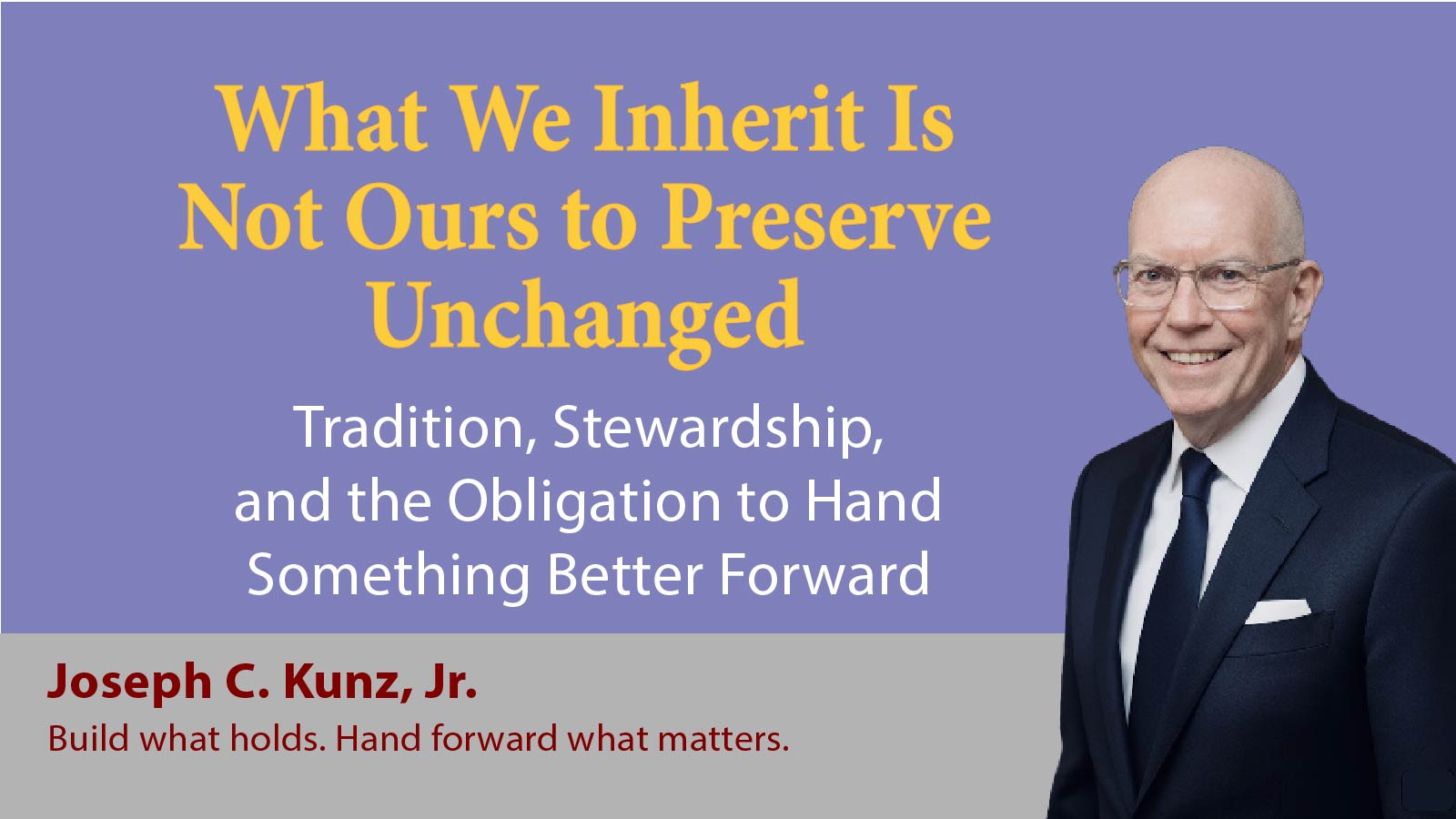
What comes into our hands eventually leaves them. The question is what condition it will be in when it does. —Joseph C. Kunz, Jr.
Tradition, Stewardship, and the Obligation to Hand Something Better Forward
By Joseph C. Kunz, Jr.
Synopsis
This isn’t an argument against tradition, and it isn’t permission to reshape everything we inherit according to our preferences. It is an argument that inheritance creates responsibility. We receive possessions, institutions, knowledge, habits, beliefs, reputations, opportunities, and obligations from people who came before us. Some should be preserved carefully. Others need repair. Some require adaptation. And some things should never be handed forward at all.
Kunz makes the case that preservation and stewardship are not the same thing. A good steward does not ask only, “How do I keep this exactly as I received it?” He asks, “What is valuable here? What is permanent? What has been damaged? What has merely become outdated? What am I authorized to change, and what truth is not mine to rewrite?” That distinction matters in families, businesses, faith, property, culture, and every serious form of legacy.
The conclusion is simple: we honor those who came before us neither by consuming their inheritance nor by embalming it. We receive it gratefully, judge it carefully, repair what we can, preserve what must endure, and hand forward something capable of carrying its weight into another generation.
Inheritance is not merely something we receive. It is a responsibility to know what must be preserved, what must be repaired, and what should go no farther. —JCK
I. Introduction: We Arrive in the Middle of Things
None of us begins with an empty table.
By the time we are old enough to understand the world, much of it has already been built.
Someone gave us a name. Someone taught us a language. Someone built the house, started the business, planted the tree, established the parish, wrote the book, developed the craft, saved the money, fought the battle, made the mistake, repaired the mistake, or failed to repair it.
Even the person who says, “I built everything myself,” did not invent the alphabet, electricity, property law, the banking system, the roads, the tools of his trade, or the accumulated knowledge that made his work possible.
We all arrive in the middle of a story.
That is what inheritance really means.
It includes money and property, certainly, but those are only the easiest things to see. We inherit customs, standards, opportunities, obligations, reputations, knowledge, beliefs, institutions, family stories, ways of working, ways of treating people, and assumptions about what a good life should look like.
Some of those inheritances are priceless.
Some are useless.
Some are damaged.
Some are dangerous.
Most are mixed.
And eventually they come into our hands.
That is where the moral question begins.
Receiving something does not automatically tell us what to do with it.
The easiest answers sit at opposite ends.
One says:
It is mine now. I can do whatever I want with it.
The other says:
I received it this way. My duty is to keep it this way.
Both answers can avoid the harder work.
The first mistakes ownership for moral independence.
The second mistakes preservation for fidelity.
Neither is enough.
A serious inheritance requires something more demanding:
stewardship.
II. To Inherit Something Is to Receive a Responsibility
Legal ownership answers one question:
Whose is it?
Stewardship asks another:
What should be done with it?
Those are not the same question.
Suppose a man inherits his grandfather’s house.
He may own it outright. The deed may have his name on it. No one else may have any legal claim.
But if the roof leaks, the wiring is dangerous, and water is destroying the foundation, nobody would call him a faithful grandson because he refused to alter the house.
“I wanted to preserve it exactly as Grandpa left it” would sound ridiculous.
The house requires work precisely because it matters.
The same is true of a set of tools.
If your father leaves you the tools with which he built half the furniture in your childhood home, you can hang them on a wall and admire them. That might be appropriate.
Or you can clean them, sharpen them, replace a broken handle, learn how to use them, and one day put them into the hands of someone who knows what they are for.
Which act preserves more?
The object?
Or the inheritance?
A thing can survive after its meaning has died.
A tradition can also survive after everyone has forgotten why anyone follows it.
We have all seen families perform customs nobody enjoys, understands, or believes in because “that’s the way we’ve always done it.”
Sometimes that sentence carries wisdom.
Sometimes it is simply an admission that nobody has thought about the matter for forty years.
Age alone does not turn habit into wisdom.
But neither does modern discomfort turn inherited wisdom into stupidity.
The responsible inheritor must do something harder than worship the past or dismiss it.
He needs to understand it.
III. Preservation Is Not the Same as Stewardship
This may be the most important distinction.
A preserver tends to ask:
How do I keep this from changing?
A steward asks:
What has been entrusted to me, what is valuable in it, and what does it require from me now?
Sometimes those questions produce exactly the same answer.
There are things we should preserve with great care.
Truth does not become false because it is old.
A promise does not expire because keeping it becomes inconvenient.
The dignity of another human being is not a custom we are free to modernize away.
The Christian faith is not raw material from which each generation invents a religion more suited to current tastes.
Some inheritances place us under discipline precisely because they are not ours to remake.
But other things are forms rather than foundations.
A family business can preserve its honesty while changing its software.
A school can preserve demanding standards while changing how it teaches.
A craftsman can preserve workmanship while replacing a tool that no longer does the job well.
A family can preserve the importance of gathering even if Sunday dinner no longer happens at the same house, at the same hour, around the same table used in 1962.
The form changed.
The thing worth preserving did not.
That is why the phrase “hand something better forward” needs care.
Better does not mean newer.
It does not mean more fashionable.
It does not mean easier.
It does not mean stripping an inheritance of every feature that makes the present generation uncomfortable.
And it certainly does not mean treating ourselves as wiser than everyone who lived before us.
Sometimes “better” means restored.
Sometimes it means strengthened.
Sometimes it means translated.
Sometimes it means protected from our own impatience.
Sometimes the best thing we can hand forward is something we had enough humility not to improve.
That is stewardship too.
The question is not whether we changed it.
The question is whether we were faithful to what made it worth inheriting.
IV. The Hard Part: What Must Be Kept, What Must Be Changed
This is where slogans stop helping.
“Honor tradition” is not enough.
“Embrace change” is not enough.
Both can be excuses for avoiding judgment.
The real work is distinguishing between principle and practice, substance and form, inheritance and clutter, wisdom and habit.
Consider a family business.
The founder may have built it on a simple code:
Keep your word.
Do excellent work.
Treat customers fairly.
Pay your bills.
Do not take money you did not earn.
Those principles may be fifty years old.
They may also be completely current.
Now suppose the founder also kept every customer record in metal filing cabinets, answered every order by telephone, refused credit cards, and advertised in the local newspaper.
Would loyalty require his grandchildren to do the same?
Of course not.
In fact, insisting on the old methods could eventually destroy the business and take the founder’s principles down with it.
The job of the next generation is not to preserve the filing cabinet.
It is to preserve what the filing cabinet once served.
That sounds obvious when we talk about office equipment.
It becomes harder when we talk about family customs, institutions, education, faith, money, or culture.
We become emotionally attached to forms because forms are visible. They give memory a shape.
That is not foolish.
Human beings need symbols, places, rituals, objects, and repeated practices. We are not disembodied minds.
But a symbol exists to point beyond itself.
If we polish the symbol while losing the thing it represents, we have preserved the shell and misplaced the inheritance.
It is how a church can keep the architecture and lose the faith.
It is how a business can keep the founder’s photograph in the lobby and abandon everything he stood for.
It is how a country can repeat noble words long after its citizens have forgotten the habits those words require.
Possession proves very little.
Stewardship shows itself in what remains alive.
V. We Inherit Failures Too
There is another sentimental mistake we should avoid.
We do not inherit only achievements.
Every family, institution, business, community, and generation hands forward some unfinished work.
We inherit debts along with assets.
Conflicts along with loyalties.
Blind spots along with wisdom.
Bad habits along with good ones.
Sometimes we inherit silence around things that should have been confronted years earlier.
Sometimes we inherit waste.
Sometimes neglected property.
Sometimes poor systems.
Sometimes damaged relationships.
Sometimes an idea that was understandable in one generation but should never become a commandment for the next.
Respect for our predecessors does not require pretending they were flawless.
They knew they were not flawless.
At least the wise ones did.
If we genuinely respect previous generations, we should grant them the dignity of being human rather than turning them into plaster saints.
Our parents made mistakes.
Their parents made mistakes.
We will make mistakes.
Our children will eventually notice ours.
That is not betrayal.
It is reality.
The question is what happens next.
If a generation discovers a crack in the foundation, its duty is not to paint over it because Grandfather poured the concrete.
Its duty is to determine whether the crack matters and, if it does, repair it.
That is not disrespect for the builder.
That is respect for the building.
There are occasions when fidelity requires correction.
There are even occasions when something inherited should stop with us.
A destructive family pattern does not become sacred because it is multigenerational.
An old resentment does not deserve grandchildren.
A lie repeated for thirty years does not acquire truth by seniority.
An irresponsible practice does not become tradition merely because everyone remembers it.
There is a form of legacy that consists in saying:
This came to me, but it will go no farther.
That too can be an act of stewardship.
VI. The Future Also Has a Claim on Us
Inheritance usually makes us look backward.
Who owned this?
Who built it?
Where did it come from?
Those are important questions.
But stewardship turns our head in the other direction too.
Who comes next?
That may be the more demanding question.
We are temporary holders of nearly everything.
The house eventually belongs to someone else.
The business eventually belongs to someone else.
The savings are spent, transferred, donated, or inherited.
The books move to another shelf.
The tools enter another pair of hands.
Even our stories survive only if someone remembers them.
We spend our lives saying “mine” about things that will eventually demonstrate how temporary the word really was.
That should not make ownership meaningless.
It should make ownership serious.
There is a difference between owning something and imagining that our wishes are the final measure of its value.
We stand between generations.
Behind us are people who built under conditions we did not have to face.
Ahead of us are people who will live with decisions they had no opportunity to influence.
That position creates obligations in both directions.
We owe gratitude backward.
We owe responsibility forward.
Those duties will not always be comfortable together.
Perhaps an inherited business must be radically reorganized so that there is a business left to inherit.
Perhaps property must be sold because preserving it would consume resources the family needs for something more important.
Perhaps a tradition must be simplified so that its purpose survives instead of collapsing under its own formality.
Perhaps an institution must recover an old discipline that recent generations abandoned.
Stewardship cannot be reduced to “keep” or “change.”
It asks a harder question:
What decision gives what is genuinely valuable the best chance of remaining valuable after I am gone?
That question requires humility because the future cannot argue with us.
People not yet born cannot protest the debts we leave them.
They cannot challenge the institutions we weaken.
They cannot ask us to maintain the knowledge we allow to disappear.
They cannot remind us that convenience is not always a sufficient reason to consume capital built over several generations.
They simply receive the result.
Just as we did.
Legacy is therefore not primarily what people say about us after we die.
It is what remains usable because we were here.
VII. The Christian Meaning of Stewardship: Nothing Is Merely Mine
Christianity presses the argument deeper.
The modern idea of ownership often begins with rights.
Christian stewardship begins with reception.
What do you have that you did not, in some meaningful sense, first receive?
Your life?
Your abilities?
Your years?
Your opportunities?
The people who taught you?
The world you were born into?
Even the ability to work hard is exercised with a mind and body you did not manufacture.
This does not erase personal achievement.
A man who works for forty years has done something the man who refused to work did not do.
Effort matters.
Discipline matters.
Choice matters.
Responsibility matters.
But Christianity prevents achievement from becoming self-creation.
We are builders working with materials we did not make.
That changes how a person thinks about inheritance.
The question stops being merely:
What am I allowed to do with this?
It becomes:
What is the faithful use of what has come into my hands?
Scripture repeatedly returns to the language of stewardship: things are entrusted, responsibilities are given, work is expected, and eventually an accounting is made.
The servant is entrusted with something.
Time passes.
Then comes the accounting.
The pattern is difficult to misunderstand.
The Christian steward does not bury what was entrusted to him merely to keep it safe. Neither does he consume it as though there will never be an accounting. He is expected to act.
What we receive is not simply ours to consume, neglect, or preserve without thought. We are responsible for what we do with it.
Yet Christian stewardship also places limits on our ambition to improve everything.
We are not authors of truth.
We do not receive the faith as a rough draft.
We do not improve the commandments by making them easier.
We do not modernize human dignity.
We do not edit reality whenever it frustrates us.
There are truths we receive precisely so that they can correct us.
The steward therefore needs two forms of humility:
the humility to change what requires repair,
and the humility not to change what is not his to rewrite.
That is harder than nostalgia.
It is harder than rebellion.
It is harder because it requires judgment.
VIII. Conclusion: Hand Forward What Matters
One day, almost everything now around us will be in somebody else’s hands.
The question is not whether we will hand something forward.
We will.
The only question is what condition it will be in.
Some people will receive money from us.
Some will receive property.
Some will receive a business.
Some will receive knowledge.
Some will receive a family name.
Some will receive habits they watched us practice for years without realizing they were learning them.
Some will receive confidence because we taught them how to stand.
Some will receive faith because they saw that ours survived contact with real life.
And some will receive problems we could have repaired but chose to ignore.
That is legacy too.
We should therefore be careful with the word preserve.
There are things worth preserving even when preservation is costly.
There are other things whose preservation can become an excuse for refusing the work that stewardship requires.
The task is not to freeze the past.
The task is not to escape it.
The task is to receive it honestly.
Learn what it is.
Understand why it mattered.
Separate principle from habit.
Protect what is true.
Repair what is damaged.
Strengthen what is weak.
Correct what should not continue.
Change the form when necessary without casually destroying the substance.
And remember that someday another person will stand where we stand now, examining what came from us.
He may hold an object we owned.
He may run a business we built.
He may live in a house we repaired.
He may repeat a lesson we taught.
He may practice a faith we helped him understand.
Or he may spend years repairing something we were too proud, too careless, or too comfortable to confront.
We do not honor the past by refusing to touch it.
We do not honor the future by consuming everything before it arrives.
We stand between them.
That is the responsibility.
Receive gratefully. Judge carefully. Build responsibly. Hand forward what matters.
A worthy legacy is not measured by what we leave untouched, but by what we hand forward faithfully. —JCK
Related Reading: What We Hand Forward Is Never Just Ours
The question of inheritance does not end with what we receive. It continues through what we carry, what we repair, what we explain, and what another generation eventually receives from us.
Every generation passes something forward—strength or disorder, preparation or debt, reconciliation or resentment—and responsibility requires us to carry what is ours before it becomes someone else’s burden.
Reader Comment: What We Inherit Is Not Ours to Preserve Unchanged asks what faithful stewardship requires after something enters our hands. The Weight We Transfer approaches the same generational boundary from the other direction: what happens when we refuse to deal with what is already ours to carry.
Quote: “What we refuse to carry becomes part of someone else’s world. What we carry faithfully can become part of someone else’s strength.” —JCK
2. The Inheritance I Never Received Is the One I’m Trying to Leave
A reflection on why the strongest inheritance is not merely property or money, but the understanding, judgment, faith, and moral structure that help another generation use what it receives wisely.
Reader Comment: An inheritance can contain valuable things and still leave the recipient without a map. This essay explores the responsibility to make the structure underneath a life more understandable—so the next generation receives not only what was built, but some understanding of why it was built that way.
Quote: “I spent most of my life building the structure before I had the language to explain the blueprint.” —JCK
The Book Behind This Essay: A Life Has to Hold Before It Can Be Handed Forward

The Four Pillars of a Well-Built Life
A Field Manual for Faith, Responsibility, Work, and Legacy
Legacy does not suddenly appear when a man writes a will, divides his property, or begins thinking about what people will remember after he is gone. By then, much of the inheritance has already been created.
It has been created in what he believed, what he carried, how he worked, how he handled money, what he repaired, what he neglected, what he taught, what he tolerated, and what the people closest to him learned simply by watching.
The Four Pillars of a Well-Built Life grows from four questions that have gradually come to organize my larger body of work:
Faith: What do I ultimately stand on?
Responsibility: What is mine to carry?
Work & Wealth: What should I build, and what should the things I build serve?
Legacy: What deserves to be handed forward?
What We Inherit Is Not Ours to Preserve Unchanged stands where those four questions meet.
Faith reminds us that not everything we receive is ours to rewrite.
Responsibility requires us to act upon what has genuinely been entrusted to us.
Work gives us the ability to build, maintain, repair, and strengthen.
Wealth can preserve the value of past work and expand what becomes possible for those who follow.
And Legacy asks the final question:
What condition will all of this be in when it leaves our hands?
If you want to think about inheritance as more than money and possessions—
If you want responsibility to mean more than simply keeping what you received—
If you want to understand the difference between preserving something, improving it, repairing it, and knowing when not to change it—
If you want to build a life whose strongest parts remain useful after you are gone—
then this is the larger structure behind those questions.
A worthy inheritance does not begin with what we leave.
It begins with how we live while it is still ours to shape.
Taking Shape: The Four Pillars of a Well-Built Life