The Clean Break: Growing Up Without a Father’s Presence
When a father leaves early, the break may look clean from the outside. But silence still has weight, and a son still has to decide what kind of man will be built in the empty space. —Joseph C. Kunz, Jr.
How Silence Became the Space Where Manhood Had to Be Built
By Joseph C. Kunz, Jr.
Synopsis
This isn’t a rage piece about deadbeat fathers, and it is not a motivational speech pretending that abandonment becomes useful just because a man survives it. In this essay, Joseph C. Kunz, Jr. argues that when a father leaves early and stays gone, the wound is different from growing up under daily chaos—but it is still a wound.
A clean break can spare a son from ongoing conflict, daily dysfunction, and the constant need to react against a bad example. But it also removes something a boy was meant to receive: a model, a reference point, a form of masculine instruction, and the quiet proof that he was worth staying for. Kunz reflects on how the same father’s absence shaped three brothers differently, showing that fatherlessness is never a one-size-fits-all wound.
The conclusion is simple: a father’s absence may clear the field, but it does not build the house. A son still has to decide what he will construct in the silence—resentment, drift, hardness, or a life ordered by responsibility, grace, and the refusal to repeat what broke him.
A clean break may remove the daily shadow, but it does not give a boy the blueprint. That still has to be built. —JCK
I. Introduction: The Silence After the Exit
Some fathers leave damage behind.
Others leave silence.
No dramatic blowups you remember clearly. No long goodbye. No final conversation that explains everything. No daily war you can point to and say, “That is what I had to survive.”
One day he is there.
Then he is not.
And if you are young enough, the absence becomes part of the atmosphere before you even have the words to describe it.
That kind of fatherlessness creates a strange landscape. From the outside, it can look cleaner than other forms of brokenness. There is no ongoing chaos to dodge. No father coming home drunk, angry, violent, reckless, cruel, or unstable. No daily performance of failure inside the house. No fresh wound every time the door opens.
In one sense, there is relief in that.
But relief is not the same as wholeness.
A clean break is still a break.
When a father leaves early and stays gone, a boy does not spend his life outrunning the daily shadow of a bad example. But he does spend his life learning how to build without a blueprint.
How does a man handle pressure?
How does a man lead without dominating?
How does a man work, provide, discipline himself, protect his family, control his anger, admit fault, respect his wife, keep his word, and stand steady when life becomes heavy?
A boy is supposed to learn some of that by watching.
When there is no father to watch, the silence becomes a classroom.
But silence does not teach in complete sentences.
II. What Makes the Break “Clean”
The phrase “clean break” can be misunderstood.
It does not mean painless.
It does not mean healthy.
It does not mean the absence was good.
It means the break was not followed by years of ongoing daily entanglement.
Some sons grow up with a father whose failures remain constantly present. The father may be unstable, selfish, violent, addicted, manipulative, cruel, irresponsible, or emotionally destructive. In those homes, the son often grows up in reaction mode. He is constantly measuring himself against what he refuses to become.
That kind of wound has its own damage.
But there is another kind.
When a father leaves early and stays gone, the son does not grow up reacting to a daily storm. He grows up in the silence after the storm has already passed.
No ongoing argument.
No constant re-injury.
No fresh disappointment at the dinner table.
No daily example of what not to become.
But also no daily example of what to become.
That is the trade most people do not see.
You are not trapped under the shadow.
But you are also not guided by the pattern.
You are not dodging the bad example.
But you are also not receiving the good one.
You are not being actively shaped by a destructive presence.
But you are being shaped by absence.
And absence shapes.
Quietly.
Indirectly.
Deeply.
III. The Missing Blueprint
A father’s absence is not merely the absence of a man in the house.
It is the absence of ordinary transmission.
That is what makes it so serious.
A boy does not only need lectures. In fact, lectures are often the smallest part of formation. He needs a pattern to observe. He needs to see a man live inside responsibility long before anyone explains responsibility to him.
He needs to watch how a man comes home from work.
How he speaks to his wife.
How he handles money.
How he fixes what breaks.
How he carries disappointment.
How he apologizes.
How he deals with fear.
How he governs his temper.
How he treats people who cannot do anything for him.
How he leads when no one is applauding.
That is the kind of teaching a father gives even when he is not trying to teach.
When the father is gone, that whole curriculum disappears.
The son is left to assemble manhood from fragments: a neighbor’s steadiness, a boss’s fairness, a customer’s dishonesty, a teacher’s correction, a coach’s expectations, a relative’s example, a stranger’s kindness, a mother’s endurance, a brother’s response, a book, a job, a mistake, a wound.
That can still form a man.
But it is harder.
And it is easier to form the wrong conclusions.
A boy may learn strength, but not tenderness.
He may learn work, but not rest.
He may learn responsibility, but not trust.
He may learn self-control, but not emotional honesty.
He may learn how to survive pressure, but not how to receive love without suspicion.
That is why fatherlessness cannot be reduced to excuses or outcomes.
It is not an excuse for failure.
But it is a real structural loss.
IV. Same Father, Same House, Different Wounds
Here is the part that still matters to me.
Fatherlessness did not land on my brothers and me in the same way.
Same father.
Same last name.
Same house.
But not the same wound.
As the oldest, I had several years with my father. Enough to remember. Enough to observe. Enough to recognize certain patterns. Enough to feel the before and after. Enough to understand, eventually, that something had changed and he was not coming home.
That gave me one kind of wound.
It also gave me one kind of responsibility.
When it became clear that he was gone, I felt the weight settle on me in a way I did not fully understand at the time. Not because anyone gave a speech. Not because I became a man overnight. Not because I was ready.
Because I was the oldest.
There are burdens oldest children often feel before they can name them. The house is under pressure, the mother is carrying too much, the younger ones are watching, and suddenly the oldest child feels an unspoken command:
Help carry this.
My middle brother had a different experience. He had fewer memories to work from, fewer pieces to interpret, and a different path toward understanding what had happened and what it meant.
And my youngest brother had almost no time with our father at all.
He was still little.
For him, the absence was not mainly a memory of what had been lost. It was a question that kept looking for an answer.
I can still hear his small voice asking:
“When is Dad coming home?”
That question carries more weight than many adult speeches.
Because a small child is not asking for sociology. He is not asking for a theory of fatherhood. He is not asking for a framework.
He is asking for his father.
And the answer, whether spoken or not, changes something.
That is what people need to understand. Fatherlessness is not one wound with one meaning. It lands differently depending on age, memory, temperament, role in the family, and what each child needed from the father who left.
The oldest may feel pressure.
The middle child may feel confusion.
The youngest may feel absence as pure waiting.
And all of them may spend years building answers to questions they never should have had to ask.
V. The World Becomes the Classroom
When there is no father-model at home, the world becomes the classroom.
That classroom is uneven.
Some lessons are generous.
Some are brutal.
Some are clear.
Some are dangerous.
I learned from men who treated me fairly. They paid what they promised. They looked me in the eye. They respected work. They did not need to dominate anyone to prove they were strong. They did not lecture me about character. They modeled it.
Those men mattered.
A fatherless boy notices fairness.
He notices when a man’s word holds.
He notices calm authority.
He notices competence without arrogance.
He notices strength that does not need to humiliate.
He notices when someone expects him to be reliable instead of treating him like a victim.
Those examples become borrowed beams in the structure of his life.
I also learned from men who showed me what not to become.
Men who lied.
Men who cut corners.
Men who tried to take advantage.
Men who confused power with character.
Men who exposed, without meaning to, the ugliness of selfishness in adult form.
They taught me too.
Not by imitation.
By warning.
Sometimes a fatherless son has to gather manhood from both directions: the men he admires and the men he refuses to resemble.
That is not ideal.
But it is real.
VI. The Gaps You Discover Late
One of the hidden difficulties of growing up without a father is not knowing what you do not know.
Some gaps do not appear when you are young.
They appear later.
They appear when you are under pressure and realize you were never shown how to carry pressure without becoming harsh.
They appear when conflict comes and you realize you were never given a model for disagreement that does not become domination, withdrawal, sarcasm, or silence.
They appear when you begin making money and realize no one taught you how to think about money with calm responsibility instead of panic, fear, or overreaction.
They appear when you become a husband and discover that marriage requires more than loyalty and work. It requires humility, repair, patience, emotional honesty, and the willingness to be corrected.
They appear when you become a father and realize that presence is not only physical. You can be in the house and still fail to give attention, instruction, tenderness, discipline, blessing, and time.
They appear when you become a grandfather and understand that legacy is not what you announce. It is what people absorb from your life.
That is the humbling part.
A man without a blueprint has to keep inspecting the structure.
He has to ask:
What am I missing?
What did I never learn?
Where am I overcompensating?
Where has strength become control?
Where has responsibility become anxiety?
Where has silence become my default language?
Where have I mistaken provision for presence?
That kind of self-examination is not weakness.
It is maintenance.
And every builder knows that what is never inspected eventually fails under load.
VII. Absence Is Not an Advantage
I would not call fatherlessness an advantage.
That sounds too neat.
It sounds like trying to make the wound justify itself.
The absence was not good.
The abandonment was not good.
The unanswered questions were not good.
The pressure placed on children was not good.
The pain my brothers carried was not good.
But God can bring formation out of what was not good.
That distinction matters.
A wound does not become good because a man grows from it.
A failure does not become noble because someone else learned courage afterward.
A father’s absence is not redeemed by pretending it was secretly a gift.
It is redeemed only when grace prevents the damage from having the final word.
That is different.
The empty space can become an excuse.
It can become resentment.
It can become hardness.
It can become drift.
It can become a lifelong demand that other people pay for what one man failed to give.
Or, by responsibility and grace, it can become a workshop.
Not because the emptiness was good.
Because the man decides not to waste what remains.
That decision does not erase the wound.
It orders the response.
VIII. The Grace I Did Not Understand Back Then
When I was young, I thought I was doing it alone.
I thought it was grit.
Willpower.
Pressure.
Survival.
Work.
Refusal to quit.
All of that was part of it.
But it was not the whole story.
Looking back, I can see another layer beneath the struggle.
I can see a mother who kept standing when the math did not work.
I can see brothers who were carrying their own versions of the same absence.
I can see decent adults who treated a working kid fairly.
I can see warnings that kept me from admiring the wrong kind of man.
I can see moments of protection I did not recognize as protection.
I can see the strange mercy of not becoming what I could have become.
Back then, I did not call it grace.
I called it getting through.
But now I can name it more honestly.
Grace was not God making fatherlessness painless.
Grace was not the removal of the wound.
Grace was not a clean explanation that made everything easy to accept.
Grace was the strength to carry the absence without letting it become bitterness.
Grace was the quiet protection that kept pressure from turning into cruelty.
Grace was the light that helped me see responsibility not as punishment, but as a path.
Grace was the mercy that kept the missing father from becoming the whole story.
That is why this essay cannot end in grit alone.
Grit can help a man stand.
Grace helps him stand without turning to stone.
IX. Becoming the Man Who Stays
One of the deepest responsibilities of fatherlessness is the decision not to repeat the pattern.
That sounds simple until life tests it.
Being present is not merely staying in the house.
Presence means attention.
It means patience.
It means correction.
It means affection.
It means steady work.
It means apology.
It means showing your children what responsibility looks like before they have words for it.
It means giving them a father they do not have to spend their adulthood interpreting through silence.
That is a heavy calling.
But it is also a privilege.
When a fatherless son becomes a father, he has a choice. He can make his children live downstream from his wound, or he can let responsibility and grace interrupt the inheritance.
That is how legacy changes.
Not all at once.
Not through speeches.
Through days.
Through meals.
Through work.
Through discipline.
Through staying.
Through answering questions.
Through keeping promises.
Through refusing to disappear emotionally even when life is tiring, stressful, disappointing, or hard.
A father’s absence changed the meaning of childhood.
A father’s presence can change the meaning of a family name.
That is not a small thing.
X. Conclusion: No Shadow, No Blueprint, Still a Choice
A father’s early absence can leave a strange kind of open field.
No daily shadow to outrun.
No constant dysfunction to dodge.
No ongoing damage to untangle from.
But an open field is not a finished home.
It still has to be built.
And if no blueprint was handed to you, then the work becomes harder. You have to look more carefully. You have to learn more deliberately. You have to ask better questions. You have to fill gaps you did not create. You have to choose models wisely. You have to reject bitterness when it feels justified. You have to receive grace instead of worshiping grit.
That is the real work.
A father’s absence can explain part of a man’s story.
It cannot be allowed to write the ending.
The man who left is not the final authority over the man who remains.
You did not choose the silence.
You did not choose the unanswered questions.
You did not choose the missing model.
But you do choose what gets built in the empty space.
And if you are willing to do the hard work of responsibility, humility, faith, repair, and presence, then the silence does not get the last word.
The life you build does.
You did not get to choose the man who left. But by responsibility and grace, you can become the man who stays. —JCK
Companion Note
If this essay names the silence, the missing blueprint, and the strange open field left by a father’s early absence, read Becoming the Man You Needed as a Boy as the larger umbrella essay on turning old wounds into new standards. Then read No Father, No Excuses for what that absence looked like under real-world pressure—bills, work, standards, and the early weight of responsibility. Finish with The Best Advice My Father Never Said Out Loud to see how silence itself became instruction, and how grace can turn what a man did not receive into what he refuses to repeat.
Related Essays: For Those Building in the Empty Space
These essays continue the fatherlessness trilogy by moving from silence, to pressure, to the hard wisdom a son can draw from what was never said.
This essay shows how fatherlessness became real-world pressure—work, bills, responsibility, and the early decision to build instead of drift.
Reader Comment: Read this after The Clean Break because it turns the missing blueprint into the practical training ground of work, standards, and responsibility. Quote: A man is not responsible for the father he did not receive, but he is responsible for the man he becomes in response. —JCK
2. The Best Advice My Father Never Said Out Loud
This essay explores how absence can become a negative instruction, teaching a man what not to repeat and what kind of legacy must be built instead.
Reader Comment: This is the final meaning-layer of the trilogy because it turns silence into discernment and pain into a deliberate standard.
Quote: Sometimes the clearest instruction comes from watching what you refuse to become. —JCK
Related Book: For the Man Building Without a Blueprint
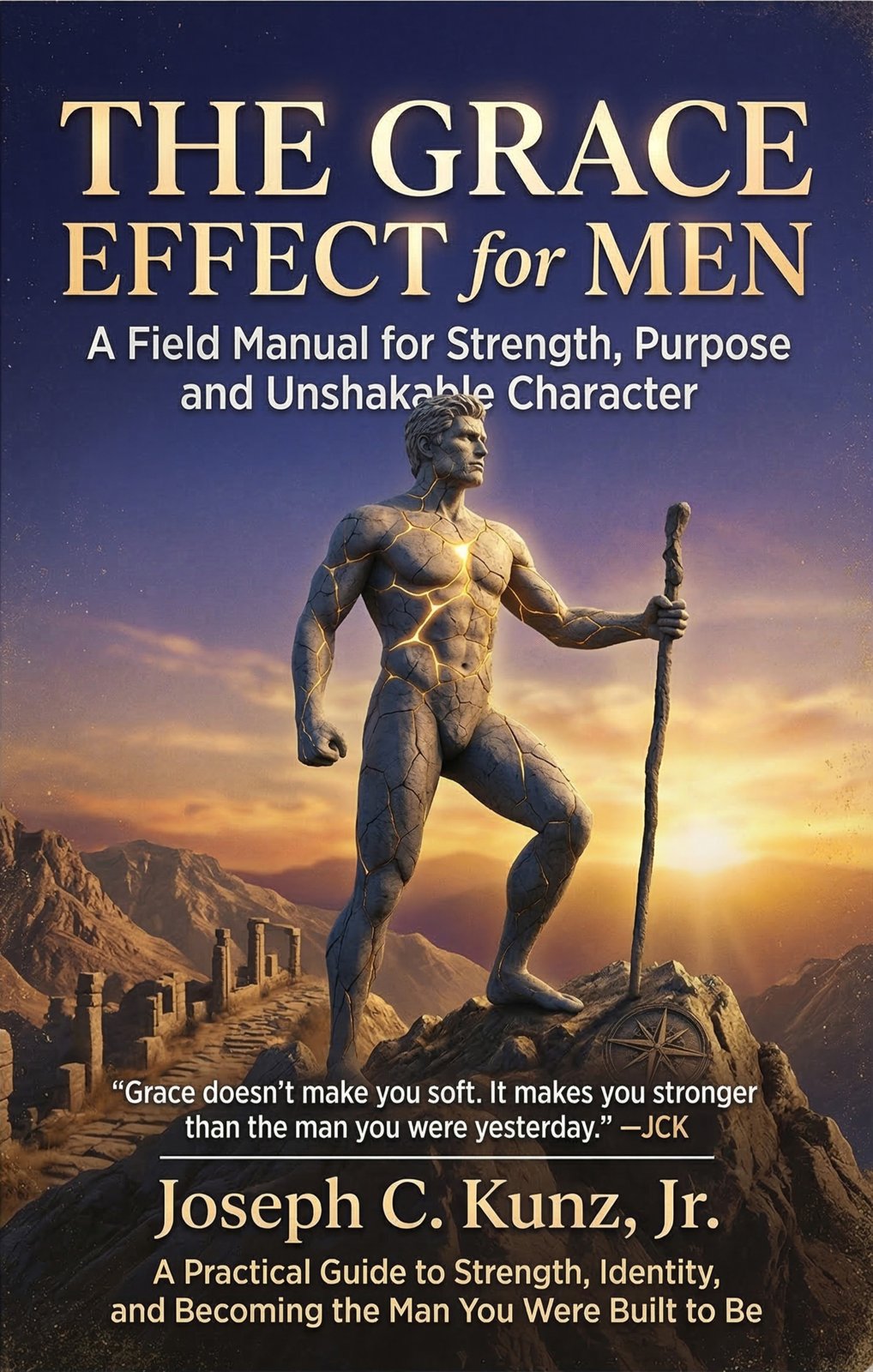
Some men are not formed by clean instruction. They are formed by silence, pressure, missing models, and questions no child should have to ask. They learn to study the world carefully because no one handed them the blueprint. They become workers, watchers, providers, fighters, builders—and sometimes they confuse survival with wholeness.
The Grace Effect for Men is being written for the man who wants more than toughness. Toughness may help a man survive, but it cannot teach him how to love without fear, lead without control, work without resentment, or build a legacy without handing forward the wound that shaped him.
If you grew up without the model you needed, this book is for you.
If you learned to carry pressure early and are still learning how to carry it without becoming hard, this book is for you.
If you want to become the kind of husband, father, grandfather, worker, and witness who gives others what you did not receive, this book is for you.
You cannot change the silence behind you. But you can decide what your life says from here.
In Formation: The Grace Effect for Men