No Father, No Excuses
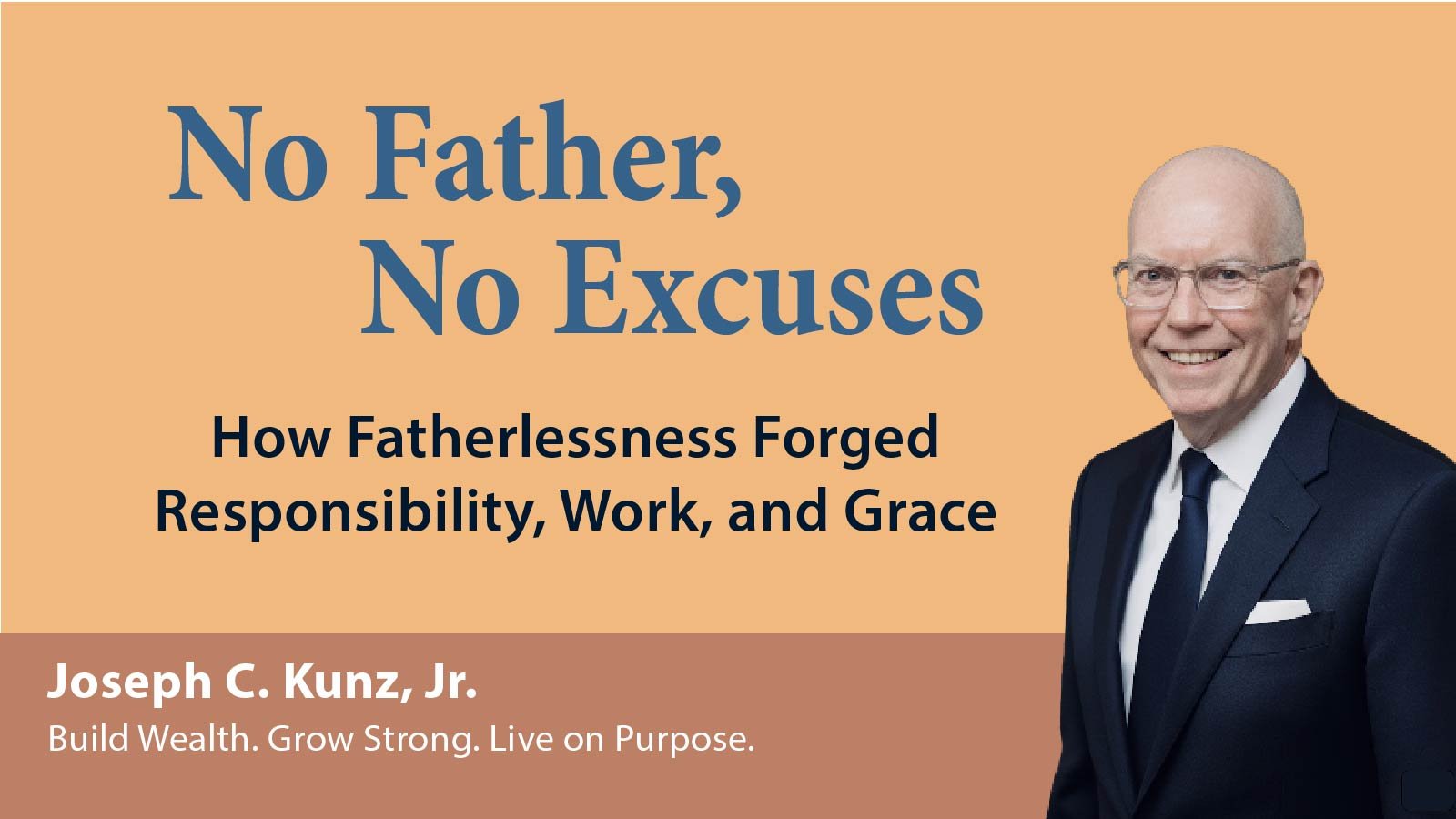
An absent father leaves a mark. But a mark is not a verdict, and pain is not permission to stop becoming responsible. —Joseph C. Kunz, Jr.
How Fatherlessness Forged Responsibility, Work, and Grace
By Joseph C. Kunz, Jr.
Synopsis
This isn’t a sentimental fatherhood lament, a soft excuse for male failure, or a tough-guy speech pretending that fatherlessness does not wound a boy. In this essay, Joseph C. Kunz, Jr. argues that growing up without a father is real, painful, and formative—but it does not have to become the final explanation of a man’s life.
Fatherlessness does more than remove a man from the house. It removes protection, guidance, correction, example, and the quiet pattern a son studies before he even knows he is studying it. But when that absence is met with responsibility instead of self-pity, work instead of drift, discernment instead of bitterness, and grace instead of hardness, the wound can become a proving ground rather than a prison.
The conclusion is simple: a boy may not choose the absence he inherits, but a man must choose the legacy he leaves. No father is a wound. No excuses is a decision. And grace is what keeps that decision from turning into anger, pride, or a heart made of stone.
A man is not responsible for the father he did not receive, but he is responsible for the man he becomes in response. —JCK
I. Introduction: The Bills Don’t Care
Winter does not care that you are a kid.
The oil tank does not care that your father left.
The electric company is not moved by a backstory.
That is one of the blunt lessons of growing up without a father. People can discuss fatherlessness in emotional, psychological, sociological, and political terms. Some of that discussion is necessary. Some of it is true. Some of it is even compassionate.
But a boy living inside it does not first experience it as a theory.
He experiences it as pressure.
Food still has to be bought.
Heat still has to be paid for.
The lights still have to stay on.
The house does not pause because a father disappears.
My mother worked low-paying jobs and carried more weight than anyone should have to carry. She did what she could. She kept standing. She kept trying. She kept moving. And because I was the oldest, I felt the pressure early.
Not in some dramatic movie-scene way.
In the ordinary way.
The grocery bill. The heating oil. The natural gas for cooking. The electric bill. The small emergencies that are not small when money is tight. The quiet tension in a house when everyone knows the math is not working.
That was not hustle culture.
That was survival.
That was love with responsibility attached.
And somewhere in that pressure, without anyone sitting me down and explaining it, I learned a lesson that has stayed with me for the rest of my life:
Excuses do not keep a house standing.
That does not mean the wound was not real.
It was real.
It does not mean fatherlessness is harmless.
It is not harmless.
It does not mean boys should have to figure out manhood by wandering through pressure, absence, trial, and consequence.
They should not.
But life does not always ask what should have happened before it demands what must happen next.
So I learned early:
No father.
No pity.
No drifting.
No excuses.
Not because the loss was small.
Because the responsibility was large.
II. What Absence Removes
A father’s absence is not only the absence of a person.
It is the absence of a pattern.
A boy learns from what he sees. He studies tone, posture, restraint, courage, anger, work, money, marriage, discipline, prayer, repair, and consequence long before he can explain what he is learning.
He watches how a man enters a room.
He watches how a man treats a woman.
He watches how a man handles bills, pressure, frustration, fatigue, insult, failure, and fear.
He watches whether a man keeps his word.
He watches whether strength protects or dominates.
He watches whether authority serves or consumes.
When the father is gone, that daily instruction is gone too.
That is the part people sometimes miss.
Fatherlessness is not merely emotional sadness. It is structural loss. Something that should have been present in the architecture of a boy’s life is missing. The foundation may still be built, but the builder has to work without materials that should have been there.
And when you are young, you do not always know what is missing.
You only know you have to figure things out.
So you watch other men. You watch neighbors, bosses, customers, teachers, relatives, strangers, and the men you meet at work. You study them without admitting you are studying them. You notice who is steady and who is weak. Who carries weight and who performs strength. Who keeps promises and who hides behind words.
When you do not have a father-model at home, the world becomes your classroom.
That classroom teaches.
But it does not always teach gently.
III. Thrown In — and Told to Swim
I was not handed a map.
I was not given long father-son talks about manhood, work, money, women, leadership, discipline, marriage, or faith.
What I had was a mother doing her best, younger siblings watching, and the quiet understanding that pressure does not wait for a boy to feel ready.
So I watched.
I worked.
I paid attention.
I studied people the way other kids studied sports statistics. I noticed who kept their word and who did not. Who showed up and who disappeared. Who respected effort and who exploited it. Who built something and who only talked.
That became part of my education.
Not the kind that comes with a diploma.
The kind that comes with consequences.
I learned early that confidence is not something you are given. It is something you earn through repeated proof. You do the work. You show up. You make mistakes. You correct them. You do not quit because no one applauded. You do not collapse because no one explained everything first.
That kind of life can make a young man strong.
It can also make him hard.
That is the tension.
Early responsibility can form character, but it can also deform the heart if it becomes bitterness, control, resentment, or contempt for weakness. A boy who learns too early that help may not come can become capable, but he can also become suspicious of needing anyone. He can learn to carry weight, but he can also begin to think that carrying weight is the same as being safe.
It is not.
That is why grit alone is not enough.
Grit can get a man moving.
It cannot save his soul.
IV. Pressure Builds Something — But Not Always Strength
People love saying pressure makes you stronger.
That is only half true.
Pressure makes you something.
It may make you disciplined.
It may make you bitter.
It may make you watchful.
It may make you resentful.
It may make you responsible.
It may make you proud.
It may make you useful.
It may make you unable to rest.
Pressure does not automatically produce virtue. It has to be governed. It has to be interpreted. It has to be carried under some higher truth, or it can turn into anger with a work ethic.
I know why some boys without fathers become angry.
I know why some drift.
I know why some harden.
I know why some spend years looking for approval from people who cannot give them what they are really missing.
But I also know this: pain may explain some things, but it cannot be allowed to govern everything.
At some point, a man has to stop asking only, “What happened to me?” and start asking, “What am I building from here?”
That question changed everything.
Being the oldest meant I felt the weight early. Not the dramatic kind. The quiet kind. The kind where you carry more than you say because you do not want to add to your mother’s load.
I learned that leadership is not a title. It is often the moment you stop asking what is fair and start asking what needs to be done.
That is where my definition of manhood began:
A man reduces pressure on the people he loves.
That sentence is not complete enough to explain all of manhood, but it is a good beginning.
A man does not make his weakness everyone else’s emergency.
A man does not vanish and leave others to pay the bill.
A man does not call selfishness freedom.
A man does not confuse resentment with strength.
A man carries what is his to carry and learns, with God’s help, not to become cruel while carrying it.
V. Learning Manhood in Public
Work became one of my first training grounds.
I made money any way a kid could make money: odd jobs, lawns, snow, paper routes, low-paying work, small tasks, whatever was available, whatever helped.
The work mattered.
But the people mattered even more.
The Decent Ones
Some adults treated a working kid fairly.
They paid what they promised. They did not play games. They did not talk down to me. They respected effort, even when the effort came from young hands and a young face.
They did not give lectures about character.
They modeled it.
That mattered more than they probably knew.
A boy without a father notices decent men. He notices fairness. He notices calm authority. He notices someone who does not need to dominate others to feel strong. He notices when a man’s word means something.
Those people taught me that real strength does not need theater.
A real man keeps his word and handles his business.
The Shady Ones
I also met the other kind.
The ones who tried to short you.
The ones who moved the goalposts after the work was done.
The ones who treated a kid’s labor like something they could cheapen because they assumed he would not push back.
They taught me too.
Not by example.
By warning.
They taught me boundaries. They taught me discernment. They taught me that being polite is not the same as being weak. They taught me that “nice” is not always honorable, and that if you do not respect your own effort, some people will treat it as disposable.
That is a hard lesson for a boy.
But it is a useful one.
The world is not made only of mentors. Sometimes the man you become is shaped by people you refuse to imitate.
The Ones Who Trusted Me
And then there were the rare ones who did something even more formative than paying fairly.
They trusted me.
They gave me responsibility. They expected me to show up. They treated reliability like a standard, not a compliment.
That kind of expectation does something to a young man.
It tells him:
You are capable.
You are accountable.
You are not a victim.
That is how confidence is actually built.
Not through slogans.
Through evidence.
VI. The Danger of Becoming Your Own Father
There is another part of fatherlessness that has to be named.
When no father is there, a boy may try to father himself.
In one sense, that is necessary. He has to learn. He has to observe. He has to develop judgment. He has to build habits. He has to become more deliberate than other boys may need to be.
But there is a danger in it.
A man who fathers himself may begin to believe he owes nothing to anyone. He may start thinking that because he had to become strong without the right help, everyone else should do the same without complaint. He may confuse resilience with isolation. He may confuse toughness with emotional distance. He may confuse self-government with self-sufficiency.
That is not strength.
That is an old wound wearing work boots.
I had to learn that responsibility is not the same as hardness. Discipline is not the same as emotional shutdown. Strength is not the same as never needing help. And manhood is not proven by pretending absence did not hurt.
It did hurt.
But hurt does not get the final vote.
That distinction matters.
To say “no excuses” is not to say “no wounds.”
It is to say the wound is not sovereign.
It is to say my father’s absence may have shaped me, but it does not own me.
It is to say I will not hand my future to the person who failed to show up.
That is not denial.
That is refusal.
VII. The Woman Who Stood Beside Me
Later in life, when it mattered most, I met a woman who did not need saving and was not impressed by talk.
Michele respected work. She respected standards. She respected follow-through. She had her own strength, her own discipline, her own seriousness, her own calling, and her own backbone.
That is why we fit.
Not because we were perfect.
Not because life was easy.
Not because either of us needed a fairy tale.
We shared the same operating system: show up, do what needs to be done, build what lasts.
She was not a substitute for what I missed.
That would be too much weight to put on any wife.
A wife is not a repair shop for a man’s childhood. She is not responsible for healing every wound he refuses to face. She is not there to mother the boy he used to be while he avoids becoming the man he is called to become.
Michele did not rescue me from responsibility.
She reinforced it.
And I hope I did the same for her.
That is one of the great gifts of a strong marriage. Two people do not erase each other’s burdens. They help each other carry life in a better order. They strengthen the household. They steady the children. They build habits, businesses, routines, memories, and a shared moral atmosphere.
We did not “complete” each other.
We built with each other.
There is a difference.
When two people share values and discipline, life stops being a series of emergencies and starts becoming a long build: marriage, family, work, commitment, sacrifice, faith, and the steady refusal to drift.
That is not luck.
That is character meeting character.
VIII. Work, Wealth, and the Dignity of Provision
Because money was not abstract when I was young, I never saw work as merely a career topic.
Work was stability.
Work was food.
Work was heat.
Work was light.
Work was one way love became visible.
That is why I cannot separate fatherlessness from work and wealth. A father’s absence often creates emotional wounds, but it also creates practical pressure. The missing father is not only missing at the dinner table. He is missing from the bills, the repairs, the instruction, the protection, the planning, the example, and the household frame.
So work became more than a way to earn.
It became a way to participate in keeping life from collapsing.
That early lesson stayed with me. It helped form my respect for business, money, provision, competence, and independence. Not greed. Not materialism. Not money worship.
Provision.
There is dignity in being able to help carry a household.
There is dignity in learning how money works.
There is dignity in becoming useful.
There is dignity in building enough strength that the people you love are less exposed to chaos.
A man should not make money his god.
But he should not pretend money does not matter when his family depends on heat, food, shelter, transportation, medicine, education, and stability.
Growing up without a father taught me that moral language without practical responsibility is too thin.
Love has bills attached.
That does not make love less holy.
It makes responsibility part of love’s proof.
IX. Grace Was There Before I Had the Word
Here is the part I did not understand when I was young.
I thought it was all grit.
I thought I was doing it alone.
I thought strength was something I manufactured out of sheer stubbornness.
Looking back, I can see more now.
I can see a mother who kept standing when the math did not work.
I can see brothers who understood more than we said out loud.
I can see decent people who treated a working kid fairly.
I can see lessons hidden inside pressure.
I can see protection from paths I could have taken but did not.
I can see how easily I could have become bitter, hard, reckless, resentful, or hollow.
Back then, I did not call that grace.
I called it survival.
But age gives a man better language if he is willing to receive it.
Now I can name it more honestly.
Grace was not the removal of the load.
Grace was the strength to carry the load without letting the load turn me into someone I did not want to become.
Grace was not softness.
Grace was restraint.
Grace was not escape.
Grace was formation.
Grace was not a sentimental feeling floating above reality.
Grace was mercy operating inside reality, keeping bitterness from becoming identity and keeping pain from becoming permission.
That is why grit is not the whole story.
Grit can make a man tough.
Grace can keep him human.
X. What I Refuse to Hand Forward
Legacy is where this essay finally lands.
Because the real question is not only what fatherlessness did to me.
The real question is what I chose not to pass on.
I cannot change the father I did not receive.
I cannot rewrite the silence.
I cannot go back and create the conversations that never happened.
I cannot make absence into presence by force of memory.
But I can decide what my children and grandchildren receive from me.
Presence instead of disappearance.
Responsibility instead of evasion.
Work instead of drift.
Faith instead of emptiness.
Grace instead of bitterness.
Standards instead of excuses.
A name that means something more than pain.
That is the cleanest answer to fatherlessness I know.
Not revenge.
Not endless analysis.
Not self-pity.
Not pretending it did not matter.
A different legacy.
The strongest answer to an absent father is not a speech about how badly he failed.
The strongest answer is becoming the kind of man who does not repeat the failure.
That does not make the wound good.
It makes the response meaningful.
XI. Conclusion: No Father, No Excuses
People sometimes treat fatherlessness like a life sentence.
It is not.
But neither is it nothing.
Absence leaves a mark. It shapes a boy’s questions, instincts, fears, ambitions, and understanding of manhood. It can create pressure too early and silence where guidance should have been. It can make a boy grow up fast in some ways while remaining unfinished in others.
That is why the answer cannot be shallow.
“No excuses” does not mean “nothing happened.”
It means what happened does not get to become my master.
It means I will not build an identity around abandonment.
It means I will not turn pain into permission.
It means I will not make my wife, children, grandchildren, brothers, friends, readers, or future responsible for a wound they did not cause.
I did not get a father-model of manhood.
So I built toward one through work, observation, discipline, consequences, marriage, faith, mistakes, correction, and the decision to keep showing up.
I would not choose that kind of pressure for any kid.
But I also will not pretend it has to destroy him.
Because it does not.
No father.
No excuses.
Just responsibility.
Just work.
Just grace.
Just the lifelong duty to become the man you once needed—and to leave behind something better than what you were handed.
Manhood is not given by absence or guaranteed by presence. It is built through responsibility, tested under pressure, softened by grace, and proven by what a man refuses to repeat. —JCK
Companion Note
If this essay is the pressure and formation layer of the series, read Becoming the Man You Needed as a Boy as the broader umbrella essay on how old wounds can become new standards. Then read The Clean Break: Growing Up Without a Father’s Presence for the silence, missing blueprint, and different ways fatherlessness can shape sons inside the same house. Finish with The Best Advice My Father Never Said Out Loud for the meaning-layer: how silence becomes warning, how pain becomes instruction, and how grace keeps the wound from becoming the inheritance.
Related Essays: For Those Who Turn Absence Into Formation
These essays deepen the fatherlessness trilogy by showing how absence, silence, responsibility, and grace can shape a man without owning him.
1. The Clean Break: Growing Up Without a Father’s Presence
This essay examines the emotional and psychological landscape of fatherlessness—the absence, the silence, the missing pattern, and the decision to build without letting the wound define the whole life.
Reader Comment: Read this after No Father, No Excuses because it moves from the outer pressure of responsibility to the inner terrain of identity. Quote: Absence may shape the room, but it does not have to own the house. —JCK
2. The Best Advice My Father Never Said Out Loud
This essay shows how a father’s silence can become a negative instruction—a warning about what not to become and what not to pass forward.
Reader Comment: This is the meaning-layer of the trilogy because it turns absence into moral discernment and legacy into a deliberate act of refusal.
Quote: Sometimes the clearest instruction you ever receive comes from watching what you refuse to repeat. —JCK
Related Book: Build the Man the Wound Couldn’t Break
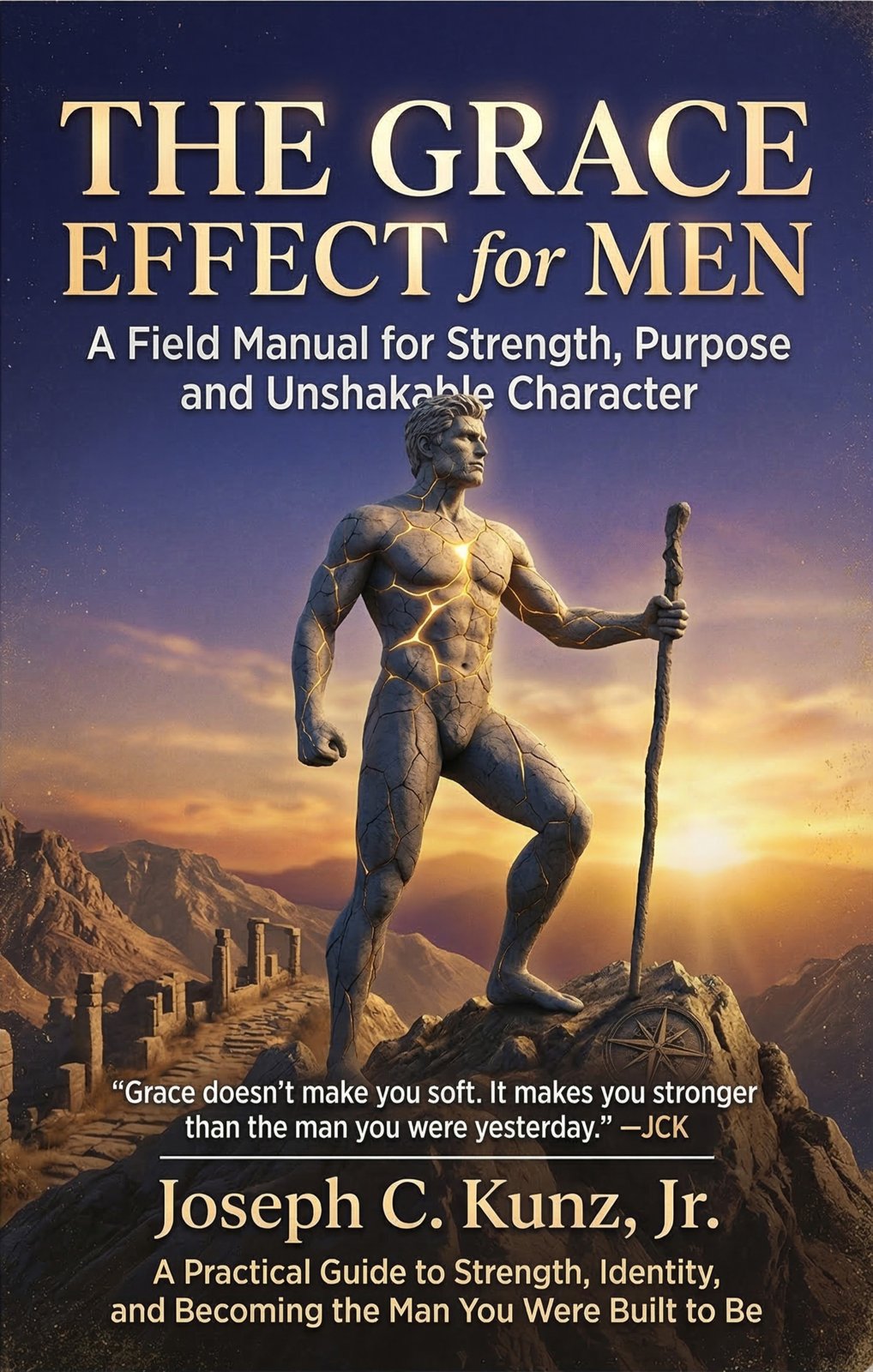
Some men are not handed a roadmap. They are handed absence, pressure, silence, and bills that still have to be paid. They learn early that no one is coming with a perfect explanation, a clean rescue, or a fatherly script for how to become strong. So they work. They watch. They carry. They make themselves useful. And if they are not careful, they become hard while calling it strength.
The Grace Effect for Men is being written for that man. Not the man looking for slogans. Not the man looking for excuses. The man who knows pain is real, but refuses to make it king. The man who wants strength without cruelty, discipline without pride, responsibility without resentment, and faith strong enough to govern what grit alone cannot heal.
If you grew up without the guidance you needed, this book is for you.
If you learned to carry weight early and are still learning how not to become hard, this book is for you.
If you want to become the kind of husband, father, grandfather, worker, builder, and witness who does not repeat the failures he inherited, this book is for you.
You cannot change who left. But you can decide who stays, who builds, who loves, who leads, and who hands forward something better.
In Formation: The Grace Effect for Men