Why Moral Weakness Feels Normal in a Godless Culture
Moral weakness becomes normal the moment a culture forgets God—because without the sacred, nothing demands strength, sacrifice, or self-control. —Joseph C. Kunz, Jr.
How a Culture Without God Slowly Loses Its Spine
By Joseph C. Kunz, Jr.
Synopsis
We’re living in an age where fragility is praised, excuses are pre-approved, and conviction is treated like a character defect. In this essay, Joseph C. Kunz, Jr. argues that moral weakness feels normal because a culture without God loses the reasons—and the strength—to pursue virtue. When God is removed from the center, the “why” behind responsibility, courage, restraint, and sacrifice collapses. What rushes in isn’t neutrality, but a softer moral atmosphere where appetite replaces discipline and feelings replace duty.
Kunz exposes how a sentimental, autonomy-first worldview rewards passivity and punishes backbone, leaving adults thin-skinned, families unanchored, and leaders unwilling to bear weight. He ends with a builder’s warning and a builder’s call: a society doesn’t drift upward on its own—it defaults downward unless people choose higher ground.
Remove God from a culture, and you don’t get freedom—you get permission for weakness. —JCK
I. Introduction: The Quiet Collapse No One Wants to Name
For years now, people have been whispering the same observation:
Why does everyone seem so thin-skinned, unsteady, and morally soft?
We see adults who crumble under pressure, leaders who fold at the slightest resistance, families without anchors, and a society where “Do whatever you feel” replaced “Do what is right.” The erosion is everywhere, but few want to admit what caused it.
Because here’s the truth most won’t touch:
Moral weakness isn’t a mystery. It’s the predictable result of a culture trying to live without God.
When a society tears down its own sacred foundations, it doesn’t drift into neutrality. It drifts into softness. Into confusion. Into emotionalism. Into a kind of moral gravity where everything heavy, everything demanding, everything noble sinks.
Without a higher authority, people naturally migrate to the least demanding version of themselves. Weakness feels normal because nothing sacred calls them higher. Human nature doesn’t improve on its own; it defaults downward unless lifted upward. And without a moral North Star, even the strongest men and women lose their bearings.
This essay isn’t about politics.
It’s about the architecture of the soul—and what happens when the load-bearing walls are removed.
II. Why Godless Cultures Produce Weak People
A. When Nothing Is Sacred, Nothing Is Demanding
A Godless worldview promises liberation:
No rules.
No judgment.
No accountability.
No boundaries.
No moral demands.
It’s a seductive promise. It sounds like freedom—until you try to live inside it.
Because when nothing is sacred, nothing is expected. And when nothing is expected, weakness becomes socially acceptable.
Virtue takes work.
Self-control takes work.
Sacrifice takes work.
Courage takes work.
But in a world without God, there is no transcendent reason to work. No higher standard to reach for. No sense of calling that pushes a person past their comfort.
So, people stop trying.
They drift toward comfort, convenience, and emotional indulgence.
And eventually, weakness doesn’t feel like failure—it feels like normal human behavior.
The tragedy is this:
Most people never notice what they’ve lost because they’ve forgotten what strength even looks like.
B. Secularism Replaces Virtue With Feelings
A culture without God must invent a replacement morality.
It chooses emotion.
Are you upset? Then you must be right.
Do you feel something? Then it must be true.
Is it hard? Then don’t do it.
This emotionalized worldview treats discomfort as injustice and discipline as oppression. It rewards fragility because fragility is easier to manage than strength. Weak people don’t challenge the system—they depend on it.
But feelings make terrible leaders.
A culture built on feelings will always produce:
• fragile people
• inconsistent principles
• collapsing families
• drifting communities
• leaders who rule by fear of disapproval instead of conviction
When emotion becomes truth, weakness becomes wisdom and strength becomes offensive. The culture becomes allergic to backbone.
III. The Consequences: A Society That Treats Strength as a Threat
A. Strong People Expose Weak People — And They Hate It
In a God-centered culture, strong people are admired.
In a Godless culture, strong people are resented.
Why?
Because moral strength exposes moral weakness.
It reminds people of everything they’ve avoided:
Responsibility.
Discipline.
Sacrifice.
Duty.
Courage.
Strength forces people to acknowledge their own softness. And instead of rising, they attack the person who stood up.
So, the culture flips the script:
Strength becomes “toxic.”
Conviction becomes “judgmental.”
Discipline becomes “rigid.”
Leadership becomes “controlling.”
Weakness is no longer a liability—it’s a virtue.
And people who stand tall in a fallen age are told to shrink themselves.
This isn’t accidental.
It’s the survival instinct of a culture that abandoned its spine.
B. Families Become Fragile Because Leaders Become Fragile
When families lose their sacred center, they become a group of individuals negotiating feelings instead of living out duty.
A marriage without God becomes a contract of convenience.
Children without moral formation grow into adults who can’t carry weight.
Emotional instability becomes normal because no one expects growth.
Strength is inherited—but so is weakness.
If the father folds, the home folds.
If the mother carries everything, resentment grows.
If neither stands firm, the children watch the collapse in real time.
A Godless culture steals strength one generation at a time, until entire families resemble emotional sandcastles—beautiful at a distance, but defeated by the slightest wave.
C. Tribalism and State Worship Fill the Vacuum Left by God
A society that turns away from God never becomes neutral.
It becomes tribal.
Human beings are wired for belonging, accountability, and authority.
If they don’t find it in the sacred, they search for it in substitute gods:
• political tribes
• ideological movements
• celebrity “thought leaders”
• government programs
• identity groups
• online mobs
These groups offer something faith once provided: a sense of certainty, moral direction, and communal identity.
But here’s the problem:
Tribalism demands loyalty, not virtue.
Government demands compliance, not character.
When a culture no longer looks upward for direction, it looks sideways—toward the loudest crowd—or downward, toward the easiest authority. And instead of cultivating inner discipline, people outsource their judgments to the group.
And a people who no longer answer to God eventually start answering to the state.
Freedom dies not through force, but through surrender—one small compromise at a time.
Not because government grew stronger but because the people grew weaker.
In a Godless society:
• People outsource moral courage to political movements.
• They outsource responsibility to bureaucracies.
• They outsource accountability to groupthink.
The tribe becomes their identity.
The government becomes their shepherd.
The self becomes their god.
And strength becomes nearly impossible to develop,
because people no longer stand alone before a holy God—
they hide inside a crowd, comforted by its noise.
This is why godless cultures always drift toward:
• collectivism
• conformity
• ideological fanaticism
• dependency
• division
• and eventually—violence
Violence is not the starting point.
It is the final stage of a culture that has forgotten the sacred.
Because when a society no longer believes the human soul carries divine worth, it inevitably loses its hesitation to harm the body.
When transcendence disappears, human life becomes negotiable.
And once human dignity collapses, coercion and force always rush in to fill the void.
Tribalism replaces belonging.
Government replaces guidance.
Group identity replaces moral identity.
And violence replaces virtue.
A culture that forgets God doesn’t just lose its strength.
It loses its restraint.
IV. The Psychology of Godlessness: Why Weakness Feels “Normal”
A. Without God, People Lose the Reason to Grow Up
Growing up is not about age—it’s about responsibility.
God commands adulthood.
Secularism celebrates adolescence.
So now we see:
• adults who avoid commitment
• men who fear leadership
• women forced to shoulder everything alone
• people who blame instead of build
• families without structure
• communities without backbone
A culture without God doesn’t produce villains.
It produces unfinished people—adults with the emotional resilience of teenagers.
Weakness becomes normal because maturity becomes optional. And optional maturity is always rejected.
B. The Disappearance of Accountability
You cannot have moral strength without accountability.
And you cannot have accountability without authority.
Remove God, and the entire structure collapses:
No God
• no objective morality
• no personal accountability
• no moral struggle
• no pursuit of virtue
• no strength
A culture with no God cannot discipline itself.
It cannot grow.
It cannot endure.
It cannot produce strong men and women.
It simply negotiates its collapse.
Everything becomes negotiable because nothing is sacred.
V. What Moral Strength Really Requires
A. Strength Requires a Standard Higher Than Your Feelings
You cannot become strong while worshipping your emotions.
You cannot become resilient while avoiding discomfort.
You cannot become mature while centering yourself as the moral authority.
Strength comes from submission—to God, to truth, to discipline, to responsibility, to the quiet daily work of becoming better even when your feelings protest.
Strength is built through friction.
Weakness is built through ease.
Modern people want the rewards of virtue without the effort of virtue.
They want the identity of strength without the sacrifice of strength.
A Godless worldview offers them exactly that illusion.
B. Strength Requires the Willingness to Carry Weight
God calls people to carry burdens—willingly, courageously, faithfully.
The Godless worldview calls people to avoid them.
But the weight you carry is what forms you.
Responsibility increases capacity.
Duty increases resilience.
Sacrifice increases strength.
Commitment increases courage.
A man who carries nothing becomes nothing.
A culture that avoids weight collapses under the slightest pressure.
And a society without God has no reason to lift anything heavier than its own feelings.
VI. The Turning Point: How Ordinary People Rebuild What the Culture Destroyed
You don’t need to change the entire world.
You change the world by becoming a person the world can’t weaken.
Strength begins here:
1. Refuse to bow to feelings.
You have emotions. They are not your leaders.
2. Choose responsibility before convenience.
Convenience builds comfort.
Responsibility builds character.
3. Hold yourself to a standard higher than the culture.
The culture rewards weakness.
God builds warriors.
4. Protect your home from moral drift.
A strong home withstands a weak society.
5. Anchor your identity in God—not approval, not comfort, not trends.
Only then will you become unshakable.
Strength is not complicated.
It is simply rare.
And rare things look strange in a fallen age.
Be willing to look strange.
VII. Conclusion: A Culture Can Lose Its Strength, But You Don’t Have To
We aren’t weak because Americans suddenly stopped believing in God—most haven’t. The real problem is quieter and far more dangerous: the culture-shapers of our age behave as if God is irrelevant, and the rest of us are too busy raising families, building businesses, and keeping life together to notice how much of that worldview we’ve absorbed.
When a society forgets the One who gives life meaning, it doesn’t collapse overnight. It softens. It drifts. It trades discipline for convenience, virtue for approval, courage for comfort, and sacrifice for self-expression. And because the decline feels gradual, we mistake it for normal.
That’s how moral weakness becomes the default setting.
But here’s the part the culture never tells you:
You don’t need to live by their script. You don’t have to outsource your convictions to the people who profit from your confusion. And you absolutely don’t have to apologize for believing that faith, family, duty, and courage still matter.
If anything, these are the only things keeping the country from sliding off the cliff.
So no—the problem isn’t that Americans have abandoned God. It’s that the culture has, and we’ve let that amnesia train us to lower our expectations of ourselves.
And that’s where the rebuild begins.
Not by waiting for the culture to rediscover its spine. But by strengthening your own—one choice, one conviction, one act of courage at a time.
Because when a culture forgets God, the people who remember Him become the ones who hold the line.
Strength doesn’t come from the culture you live in—it comes from the God you answer to. —JCK
Related Essays: For Readers Who Are Done Apologizing for Their Convictions
If this essay stirred something awake, these will sharpen your backbone even further.
1. Faith Isn’t a Crutch — It’s a Competitive Edge
Learn why faith doesn’t weaken you—it sharpens clarity, courage, and the resilience to stand firm when others fold.
Reader Comment: This essay made me realize faith isn’t passive—it’s power.
2. Men Must Be Builders in Every Generation
A call for men to resist drift and embrace their duty to build families, businesses, and legacies that endure.
Quote: A man who refuses to build leaves his children to inherit the ruins. —JCK
Related Book: Stop Overthinking Your Life — Start Living It With Grace That Actually Costs You Something
If you read this essay and felt something pulling at you—a quiet tug, a nudge, a whisper you’ve been trying to ignore—stop pretending it was nothing.
That wasn’t sentiment. That wasn’t coincidence. That was meaning calling you out.
That’s the battle between who you are and who you’re supposed to be. And make no mistake: the gap between those two selves is where most lives get lost.
Here’s the part most people never face:
Reason will take you far—far enough to build a résumé. But only grace will take you deep—deep enough to build a life.
Reason explains. Grace transforms. Reason calculates. Grace commits. Reason keeps you safe. Grace forces you to grow.
If you feel stuck somewhere between clarity and courage, between knowing and doing, it’s because you’ve been trying to think your way into a meaningful life. You can’t.
Meaning begins where self-protection ends. Grace begins where excuses die.
But grace isn’t passive. It isn’t soft. It isn’t a poetic word to sprinkle on holidays.
Grace is the demand for courage you can’t sidestep. Grace is the invitation to rise when staying low feels easier.Grace is the light that exposes the smallness you’ve settled for—and refuses to let you stay there.
If you’ve been waiting for life to “feel right” before you take the next step… If you’ve been numbing yourself with busyness, overthinking, or endless self-analysis… If you keep telling yourself that “one day” you’ll start living up to your potential…
Then hear this clearly:
One day is how people waste decades. Grace is how people reclaim them.
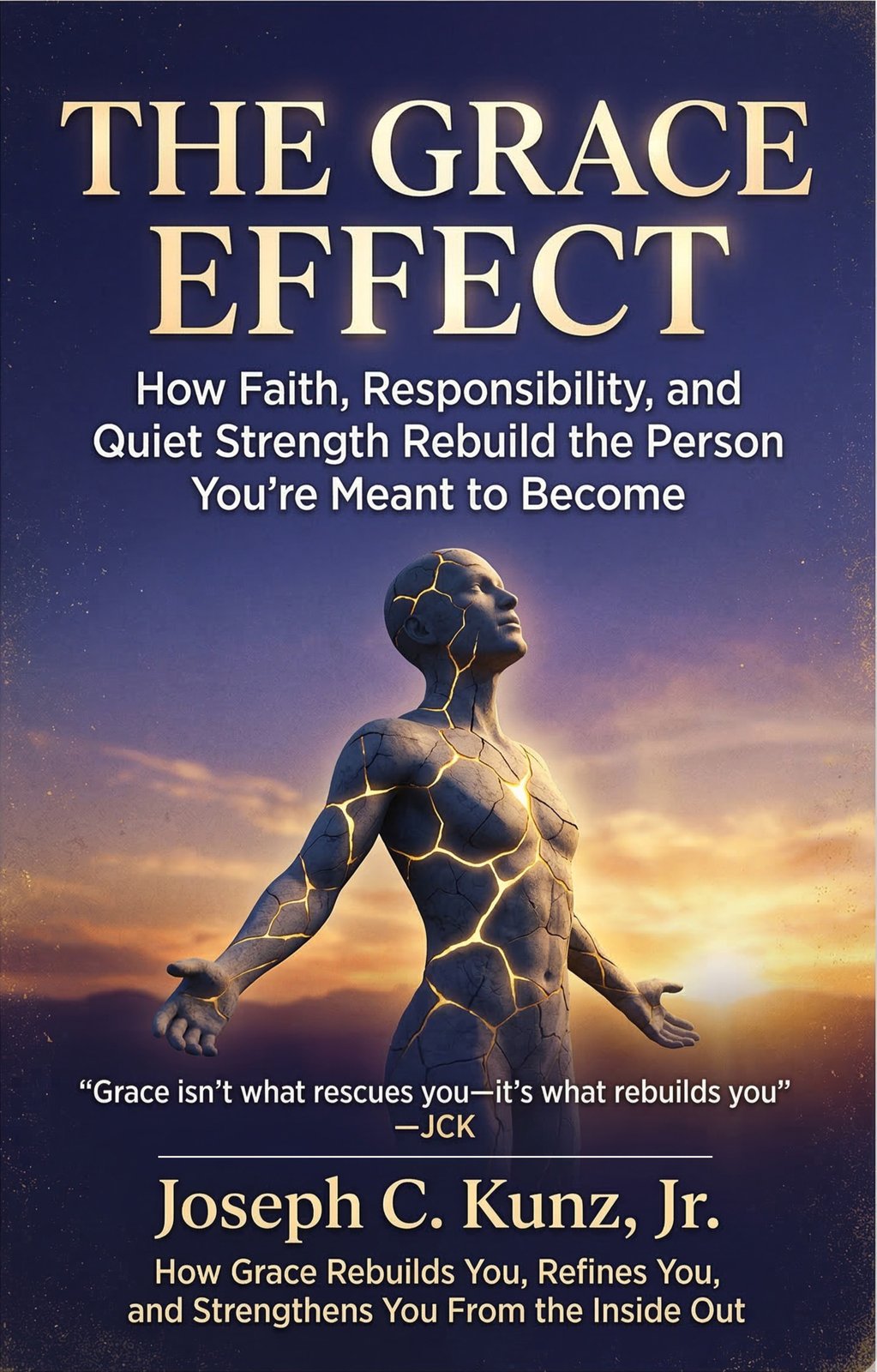
The Grace Effect is not a book about being nicer or quieter or more agreeable. It’s a book about becoming dangerous in the right direction—a person whose courage lifts others, whose kindness has authority, whose presence carries weight.
It will confront you. It will steady you. It will call you to rise in ways you’ve avoided for years.
If you’re tired of drifting… If you’re tired of feeling like your life is happening “around you” instead of through you… If you’re tired of living below the level of strength God built into you…
Then don’t think your way out of this moment.
Move. Grow. Choose grace. Become the person your life has been waiting for.
Read The Grace Effect and start living a life that finally matches the depth you feel inside.
Coming soon.