The Lie of Balance
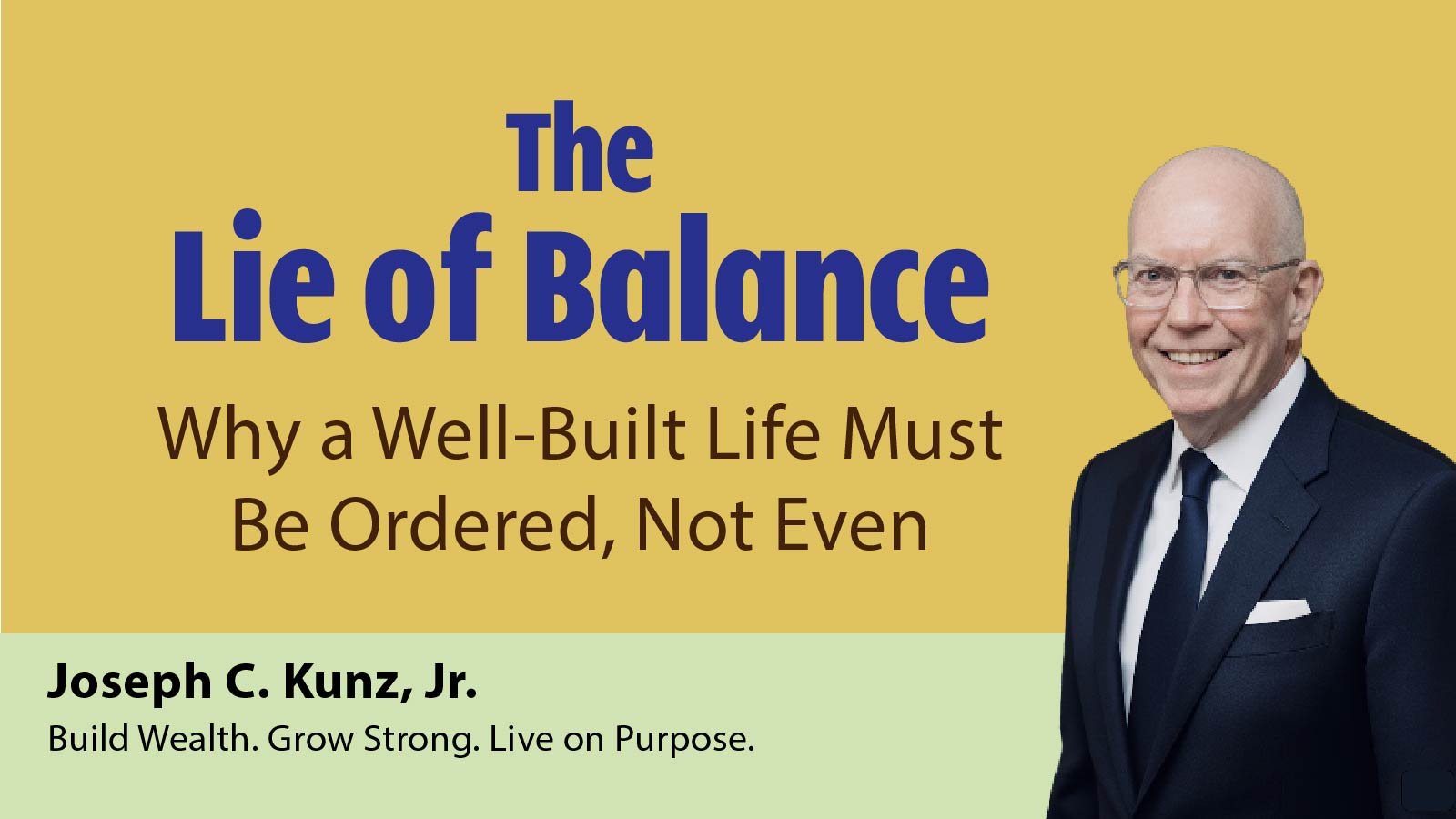
A serious life is not built by giving everything equal weight. It is built by giving the right things first claim. —Joseph C. Kunz, Jr.
Why a Well-Built Life Must Be Ordered, Not Even
By Joseph C. Kunz, Jr.
Synopsis
This isn’t an attack on rest, health, marriage, faith, family, or the need for limits. It is an attack on the shallow modern idea that a serious life can be built by giving every demand equal weight and calling that wisdom. In this essay, Joseph C. Kunz, Jr. argues that the better word is not balance. The better word is order.
Modern balance language often treats every part of life as if it belongs on the same shelf: faith, work, marriage, children, money, health, comfort, hobbies, entertainment, and appetite. But life does not work that way. A well-built life requires hierarchy, sacrifice, seasons, discipline, and the courage to disappoint lesser things so greater things can be protected. The goal is not to keep every plate spinning. The goal is to know which plates are sacred, which are useful, and which never belonged in your hands in the first place.
The conclusion is simple: greatness is not built by equal attention to everything. It is built by ordered devotion to what matters most.
Balance sounds peaceful until you realize it often means refusing to choose. —JCK
I. Introduction: The Word Sounds Wise Until Life Gets Heavy
We have all heard it.
You need more balance.
It sounds mature. Responsible. Reasonable. Almost impossible to argue with.
And sometimes, it is true. A person can work too much. A father can neglect his children. A husband can confuse provision with presence. A business owner can become so obsessed with growth that he loses the people he claimed he was building for. A believer can talk about duty while avoiding rest, gratitude, humility, and the quiet disciplines of the soul.
So let’s be clear from the start.
I am not arguing for chaos. I am not defending burnout. I am not saying health does not matter, marriage can wait, children will understand, or faith can be squeezed in after the empire is built.
That is not strength.
That is disorder wearing work boots.
But the modern obsession with “balance” has its own problem. It often takes a serious life and flattens it. It treats every demand as if it deserves equal attention. It tells you to keep everything in the air, make everyone happy, stay emotionally available to every request, and somehow build something meaningful without disappointing anybody.
That sounds nice.
It is also nonsense.
Nobody builds a strong marriage, a serious faith, a durable business, a healthy family, real wealth, or a lasting legacy by giving everything equal weight.
A serious life is not balanced.
It is ordered.
II. Balance Is Often the Polite Name for Avoiding Hard Choices
Balance has become one of those words people use when they do not want to admit that choices must be made.
It sounds wiser to say, “I’m trying to find balance,” than to say, “I have not decided what matters most.”
That is the deeper problem.
Balance can become a hiding place. It gives a person the appearance of thoughtfulness without requiring commitment. It allows him to stay available to everything while being devoted to nothing. He can keep adjusting the calendar, reorganizing the schedule, moving pieces around, and still never answer the most important question:
What has first claim on my life?
That is the question balance avoids.
Because once you answer it, certain things move down the list. Certain people get disappointed. Certain opportunities get declined. Certain habits get cut off. Certain comforts lose their authority.
That is where life gets real.
A man says his family matters, but his phone gets his first attention.
He says faith matters, but his calendar proves otherwise.
He says health matters, but he treats his body like a rented machine.
He says work matters, but he wastes the best hours of his day on distraction.
He says legacy matters, but he has never asked what he is actually handing forward.
That is not a balance problem.
That is an order problem.
III. A Well-Built Life Needs Hierarchy
A house does not become strong because every part gets equal attention.
The foundation matters more than the paint. The frame matters more than the decorations. The wiring matters more than the furniture. The roof matters more than the landscaping.
That does not mean the smaller things do not matter. It means they need to know their place.
A life works the same way.
Faith is the foundation. It tells you what you stand on when life shakes.
Responsibility is the frame. It tells you whether you can govern yourself.
Work and wealth are the engine. They turn effort into provision, independence, stability, and stewardship.
Legacy is the destination. It tells you what all of it is for.
Those four things cannot be treated as equal items on a to-do list. They are not floating pieces. They are architecture.
That is why the language of balance is too small.
You do not balance a foundation.
You build on it.
You do not balance a frame.
You stand inside it.
You do not balance an engine.
You maintain it and make sure it serves the right destination.
You do not balance legacy.
You live in such a way that something worth handing forward remains after you are gone.
A life without hierarchy becomes a life of constant reaction. Every noise sounds urgent. Every demand feels important. Every interruption receives moral authority. The result is not peace. It is fragmentation.
And fragmented people are easy to exhaust, easy to confuse, and easy to control.
IV. The World Sells Balance Because It Fears Commitment
Modern life loves the word balance because balance rarely threatens anything.
A balanced person is manageable.
He works enough to stay productive. He rests enough to keep functioning. He consumes enough to stay distracted. He believes enough to feel decent. He commits enough to appear responsible. But he never becomes so ordered, focused, and convicted that he becomes difficult to manipulate.
That may sound harsh.
Good.
Some truths should scrape a little on the way down.
The modern world does not mind if you are busy. It does not mind if you are tired. It does not mind if you are entertained, opinionated, distracted, over-scheduled, and emotionally stretched thin.
What it does mind is a person who has decided what matters.
Because that person becomes harder to sell to.
Harder to shame.
Harder to distract.
Harder to flatter.
Harder to frighten.
Harder to move off his post.
A man with ordered priorities is a dangerous man in the best sense. He knows what he serves. He knows what he protects. He knows what he refuses. He knows what price he is willing to pay.
Balance says, “Try to keep everything even.”
Order says, “Put first things first, and let lesser things take their proper place.”
That is a very different life.
V. Tradeoffs Are Not a Defect. They Are the Price of Building.
Everything meaningful has a cost.
A strong marriage costs something.
Faith costs something.
Raising children costs something.
Building a business costs something.
Building wealth costs something.
Caring for your health costs something.
Writing serious work costs something.
Leaving a legacy costs something.
The question is not whether you will sacrifice. You will. The only question is whether your sacrifices will be chosen with wisdom or stolen by drift.
When Michele and I started our business, we were not talking about balance. We were working long days, raising children, reinvesting money, carrying pressure, and trying to build something that could support our family and last. It was not tidy. It was not glamorous. It was not some polished entrepreneurial story with perfect lighting and a motivational soundtrack.
It was work.
Real work.
And yes, it cost us things.
But those sacrifices were not random. They were attached to a duty. We were building provision. We were building independence. We were building a future. We were trying to create enough strength under our family that the people we loved had something solid beneath them.
That is not the same as worshiping work.
Work is the engine. It is not the god.
If work devours faith, marriage, health, children, and peace, then the problem is not that you rejected balance. The problem is that you lost order.
The mature life is not all work.
It is not all rest.
It is not all family.
It is not all money.
It is not all contemplation.
It is not all service.
It is all of those things placed in the right relationship to one another.
That is the difference between a busy life and a well-built one.
VI. False Guilt Keeps People Weak
One of the worst parts of balance language is the guilt it creates.
You always feel behind.
You feel guilty when you are working because you are not resting.
You feel guilty when you are resting because you are not working.
You feel guilty when you are with family because the business needs attention.
You feel guilty when you are building the business because family matters.
You feel guilty when you say yes.
You feel guilty when you say no.
That is not peace.
That is emotional whiplash.
But here is the important distinction: not all guilt is false.
Sometimes guilt is a warning light. Sometimes it tells you that you have neglected something sacred. Sometimes it tells you that ambition has become vanity, that work has become escape, that comfort has become laziness, that busyness has become avoidance, or that you are calling selfishness “self-care” because it sounds cleaner.
That kind of guilt should not be ignored.
But false guilt is different.
False guilt punishes you for having priorities.
False guilt tells you that every disappointed person is proof you did something wrong.
False guilt tells you that every missed event, declined invitation, unanswered message, or closed door is a character flaw.
No.
Sometimes saying no is the price of protecting your yes.
Sometimes disappointing people is the cost of staying faithful to your duty.
Sometimes dropping the ball is not failure. Sometimes it means you finally stopped carrying balls that were never yours.
That is freedom.
Not the freedom of doing whatever you feel like.
The freedom of knowing what you are responsible for and what you are not.
VII. Seasons Matter
A serious life does not look the same in every season.
This is another reason the balance conversation is too shallow.
There are seasons when work demands more.
There are seasons when family must come first in an urgent and undeniable way.
There are seasons when health can no longer be ignored.
There are seasons when grief slows everything down.
There are seasons when faith becomes less about words and more about endurance.
There are seasons when building wealth requires intensity.
There are seasons when preserving what you built requires wisdom, restraint, and patience.
A young couple starting a business will not live the same way as grandparents thinking about inheritance, wisdom, and what remains. A father with small children will not live the same way as a man whose children are grown. A person recovering from surgery will not live the same way as someone in a season of expansion.
That is not hypocrisy.
That is stewardship.
Being all-in does not mean giving the same intensity to the same thing forever.
It means being faithful to the highest duty of the season without losing sight of the whole life.
This matters.
Because some people use “balance” to avoid intensity, and others use “all-in” to avoid wisdom.
Both are wrong.
The point is not to be balanced.
The point is to be rightly ordered.
VIII. Intentional Living Requires Renunciation
A well-built life requires the courage to give things up.
Not because those things are always evil.
Because they are not always yours.
Some opportunities are good but wrong for your life.
Some friendships are pleasant but draining.
Some hobbies are harmless until they become escape.
Some ambitions look impressive but would quietly damage your home.
Some business opportunities produce money but cost peace, integrity, or time you cannot get back.
Some distractions are not dramatic enough to look dangerous, which is exactly why they are dangerous.
This is where people get stuck.
They want a meaningful life, but they do not want to renounce anything.
They want wealth, but not discipline.
They want health, but not restraint.
They want faith, but not surrender.
They want marriage, but not sacrifice.
They want legacy, but not responsibility.
They want freedom, but not self-government.
That is not a serious life.
That is a wishlist.
A serious life requires a man or woman to say:
This matters.
That does not.
This gets protected.
That gets released.
This deserves my best.
That gets what is left, or nothing at all.
There is no way around this.
You cannot build a life of weight by treating everything as weightless.
IX. The Question Is Not “Am I Balanced?”
The better question is not:
Am I balanced?
The better questions are:
What has first claim on my life?
What am I protecting?
What am I building?
What am I neglecting and excusing?
What am I calling necessary that is really just comfortable?
What am I calling balance that is really fear?
What am I calling ambition that is really avoidance?
What am I handing forward to my children, grandchildren, readers, students, family, and community?
Those questions are harder.
That is why they are better.
Balance lets you stay vague.
Order forces you to tell the truth.
For me, that meant choosing business strategies that gave my family strength and breathing room.
It meant saying no to shiny distractions that could have pulled us away from the long game.
It meant showing up in a marriage that required presence, patience, forgiveness, endurance, and the daily humility to keep building.
It meant teaching my children and grandchildren that success is not only about money, achievement, or applause. It is about becoming the kind of person who can carry responsibility without collapsing, complaining, or selling out.
None of that was perfectly balanced.
But it was intentional.
And in the end, intentional matters more.
X. Conclusion: Stop Chasing Balance. Start Building Order.
Balance sounds comforting.
Order is stronger.
Balance asks, “How can I keep everything even?”
Order asks, “What matters most, and what must be arranged around it?”
Balance often tries to reduce guilt.
Order builds peace.
Balance wants the calendar to look fair.
Order wants the life to be faithful.
Balance keeps asking whether everything got a turn.
Order asks whether the right things received the right devotion.
That is the life I trust.
Not a tidy life.
Not a soft life.
Not a life where every demand gets equal access to your soul.
A well-built life is ordered around what matters most.
Faith first.
Responsibility next.
Work and wealth in service of duty.
Legacy as the destination.
Everything else must find its place beneath that structure.
The conclusion is simple: balance is too weak a word for a serious life. You do not need everything even. You need everything ordered.
A life that gives everything equal weight will eventually be ruled by whatever screams the loudest. —JCK
Related Essays: Two Essays That Deepen This One
These are the two strongest pairings I would use now.
Modern life teaches people to divide faith, work, money, family, responsibility, and legacy into separate compartments, but a well-built life requires those pieces to be ordered into one whole person.
Reader Comment: This essay gave me language for something I felt but could not explain: I was not just busy. I was divided.
Quote: A fragmented life does not collapse all at once. It comes apart one compartment at a time. —JCK
2. Who’s in Charge Here — You or the Path?
A direct challenge to stop drifting through life and decide whether your habits, pressures, and assumptions are leading you—or whether you are finally taking command of the path.
Reader Comment: This one felt like a hard shove in the right direction.
Quote: Your life does not drift toward strength. You either lead the path, or the path leads you. —JCK
Related Book: Stop Balancing a Life That Needs to Be Built

The Four Pillars of a Well-Built Life
You have been told to find balance, as if life were a neat little scale you could keep perfectly level. But life does not work that way. Faith, family, work, money, responsibility, health, and legacy do not all carry the same weight. Some things are foundational. Some things are structural. Some things are useful. Some things are distractions dressed up as opportunities.
The Four Pillars of a Well-Built Life is being built for people who are tired of drifting, reacting, apologizing, and calling confusion “balance.” It gives language and structure to what serious people already sense: a strong life needs faith as its foundation, responsibility as its frame, work and wealth as its engine, and legacy as its destination.
If you are tired of trying to keep every plate spinning, this book is for you.
If you know your life needs more order, not more noise, this book is for you.
If you want a framework strong enough to guide your family, your work, your money, your faith, and your future, this book is for you.
Being Built to Hold: The Four Pillars of a Well-Built Life