The Four Pillars of a Life That Holds
This essay reveals the four unbreakable pillars—faith, responsibility, work, and legacy—that every strong, meaningful, and prosperous life must be built on. —Joseph C. Kunz, Jr.
Why Every Strong Life Rests on Faith, Responsibility, Work, and Legacy
By Joseph C. Kunz, Jr.
Synopsis
Most lives don’t collapse because of one big disaster. They collapse because the structure underneath them was never strong enough to carry real weight. In The Four Pillars of a Life That Holds, Joseph C. Kunz, Jr. lays out the simple architecture behind every meaningful, resilient, and prosperous life—four load-bearing pillars that don’t bend with trends or feelings: Faith, Responsibility, Work, and Legacy.
Drawing from four decades of building a business, raising a family, enduring hardship, and watching what holds up under pressure, Kunz argues these aren’t motivational “categories.” They’re the beams that determine whether your life stands or slowly starts to sag. Faith gives meaning when life hurts. Responsibility builds strength and moral spine. Work creates independence and provision. Legacy gives direction—so you don’t just live, you build something that outlives you.
This is the blueprint behind Kunz’s entire body of work—and a practical framework for anyone tired of drifting, ready to rebuild with clarity, and determined to construct a life that actually holds.
A meaningful life is not discovered. It is built—pillar by pillar, choice by choice, year by year. —JCK
I. Introduction: The Long Road to Clarity
I didn’t invent the Four Pillars.
I discovered them—the same way a man discovers the structure of a house he’s lived in for forty years. By walking through its rooms in the dark. By stumbling into corners. By rebuilding after storms. By hearing what creaks and what holds. By noticing which beams take the most weight.
Most people assume wisdom arrives all at once, like a revelation or a lightning bolt. My experience was the opposite. It arrived slowly, quietly, without permission—one scar, one mistake, one early morning, one small victory at a time.
And after four decades of working, building a business with Michele, raising children, navigating setbacks, running payrolls, facing illness, regaining balance, and watching what truly lasts and what collapses under pressure—I began to see the pattern beneath everything.
Every strong life rests on four unbreakable pillars:
1. Faith, Grace, and Meaning – the foundation you stand on.
2. Responsibility, Discipline, and Moral Agency – the backbone of strength.
3. Work, Wealth, and Building a Future – the engine of prosperity.
4. Legacy, Fatherhood, and the Builder’s Life – what outlives you.
You can change the names if you want.
But you can’t escape the structure.
These four forces show up in every person who builds a life that holds—and they are painfully absent in every life that collapses.
This essay is the blueprint behind every essay I’ve ever written.
It’s not advice.
It’s not theory.
It’s not motivational fluff.
It is simply what forty years taught me about building a life that lasts.
Why Four Pillars? Why Not Two? Or Seven? Or Twelve?
People have tried to divide life into every number imaginable:
• The Greeks had four virtues.
• The Stoics had four disciplines.
• Psychologists have five traits.
• Business gurus have seven habits.
• Self-help authors create twelve rules.
All useful in their own ways.
But here’s the truth: most of these systems are maps without terrain.
They are conceptual, not lived.
They explain life without requiring you to build anything.
My Four Pillars emerged from the opposite direction—not conceptually, but practically. Not from books but from bruises. Not from theory but from work.
I didn’t want a framework that sounded smart.
I wanted one that held up under pressure.
And what held up was always the same:
• Faith distinguished meaning from noise.
• Responsibility separated adulthood from drifting.
• Work separated prosperity from wishful thinking.
• Legacy separated living from merely existing.
Every life—mine, yours, anyone’s—rises or falls on these four beams.
You can try to escape them.
Ignore them.
Rearrange them.
Reject them.
But you cannot replace them.
II. Pillar One: Faith, Grace, and Meaning — The Foundation of Everything
I don’t mean abstract belief.
I don’t mean vague spirituality.
I don’t mean the “I’m a good person at heart” nonsense that evaporates the moment life hits hard.
I mean a real foundation—the deeper structure beneath your life.
Faith answers the first question any serious person must face:
What is this all for?
If you don’t answer that question, something else will answer it for you:
• money
• comfort
• culture
• comparison
• ego
• distraction
• fear
Faith is not a crutch.
Faith is the compass.
Without it, responsibility becomes performance.
Work becomes drudgery or addiction.
Legacy becomes ego or guilt.
With it, responsibility becomes purpose.
Work becomes contribution.
Legacy becomes stewardship.
Faith is the only foundation capable of holding a human life—because it is the only foundation strong enough to outlast the storms.
And storms always come.
III. Pillar Two: Responsibility, Discipline, and Moral Agency — The Backbone of Strength
I learned something early in my adult life—something true of every strong man and every strong woman I’ve ever known:
Strength is not inherited. It is chosen.
Every day.
In small ways.
In unglamorous ways.
Without applause.
Without hashtags.
Without permission.
Responsibility is not the restriction of your freedom.
Responsibility is your freedom.
The irresponsible man thinks responsibility limits him.
But he is the most trapped man alive—trapped by impulses, excuses, moods, distractions, and the opinions of others.
Discipline liberates you from the tyranny of your weaker self.
Moral agency—the ability to choose the good even when you don’t feel like it—is what divides a builder from a bystander.
Our culture is allergic to responsibility.
It rewards drifting, complaining, outsourcing blame, outsourcing meaning, outsourcing thought.
But the truth remains:
You cannot build a meaningful life if you refuse to carry weight.
Responsibility is the backbone of the builder’s life.
It is the pillar that keeps you from collapsing inward.
IV. Pillar Three: Work, Wealth, and Building a Future — The Blueprint for Prosperity
Most people want wealth.
Few people want work.
That’s why so few people ever experience either.
Wealth is not an event.
Wealth is a consequence.
A consequence of:
• disciplined effort
• intelligent risk
• long-term thinking
• small wins
• steady habits
• emotional control
• refusing excuses
• honoring commitments
• building systems
• protecting capital
• serving others
• solving real problems
The culture lies to people constantly:
“You don’t need to work hard.”
“You don’t need discipline.”
“You can have overnight success.”
“You deserve comfort.”
“You should be rich already.”
All lies.
All poison.
Work is not punishment.
Work is dignity.
Work is identity.
Work is your first capital.
Work is the engine that drives your entire life forward.
And wealth—real wealth—is not greed.
It is a moral duty.
Because wealth gives you:
• margin
• independence
• choices
• safety
• contribution
• stability
• the ability to help others
• the ability to leave something behind
Work builds the future.
Wealth protects it.
This pillar carries the blueprint for prosperity—not the lottery ticket.
V. Pillar Four: Legacy, Fatherhood, and the Builder’s Life — What Outlives You
Legacy is not a speech people give when you’re gone.
Legacy is the echo of your choices.
It is the long shadow of your character.
It is the imprint of your habits.
It is the memory of your presence.
It is the residue of your courage.
It is the structure your children and grandchildren will either stand on—or crawl out from under.
Legacy is not sentimental.
It is structural.
Men misunderstand this constantly.
They think legacy is:
• reputation
• wealth
• a name
• accomplishments
But what actually outlives you is far smaller and far bigger:
It is the way you lived.
The way you carried weight.
The way you treated people.
The way you kept your word.
The way you faced suffering.
The way you loved your family.
The way you held your faith.
The way you showed up.
The way you stayed when it was easier to leave.
Legacy is the fourth pillar because it is the test of the other three.
Faith → gives meaning to legacy.
Responsibility → gives strength to legacy.
Work → gives provision to legacy.
Legacy → proves whether you lived wisely or foolishly.
Legacy is what remains when the noise is gone.
VI. How the Four Pillars Emerged: The Long Apprenticeship of Building a Life
People often assume a framework comes from study, analysis, or a neat intellectual moment.
This one didn’t.
It came from:
• sitting in hospital rooms
• lying on more surgery tables than I ever expected to see
• building a business from nothing
• raising children
• wrestling with faith
• running into obstacles that didn’t care about my feelings
• learning what actually breaks and what holds
• living through storms that tested every part of my character
• failing
• recovering
• standing again
• watching others crumble because they lacked one of these pillars
• watching others rise because they had them
I eventually realized:
These weren’t “my” four pillars.
These were the four pillars that exist whether any of us acknowledges them or not.
A man doesn’t choose whether the pillars are real.
He only chooses whether to build on them.
VII. What Makes This Framework Different From All the Others
You can find “pillars” everywhere:
• in Stoicism
• in Buddhist philosophy
• in psychology
• in leadership books
• in self-help frameworks
• in religious traditions
But most pillar systems:
• describe character
• describe behavior
• describe virtues
• describe skills
• describe motivation
What makes this framework different is simple:
It describes the architecture of an actual life.
Not a mindset.
Not a philosophy.
Not a personality type.
Not a productivity system.
A life.
One you can walk around in.
One you can test in storms.
One that doesn’t collapse under weight.
This is why the framework resonates so deeply with builders—men and women with:
• grit
• scars
• responsibilities
• families
• businesses
• faith
• debt
• obligations
• dreams
• regrets
• resolve
Builders don’t need inspiration.
They need structure.
This is the structure.
VIII. What I Want This Framework to Do for You
I didn’t spend forty years gathering these truths to impress anyone.
I don’t care about sounding smart.
I don’t care about intellectual points.
I don’t care about trends, or algorithms, or branding tricks.
I care about clarity.
About truth.
About building something real.
About helping ordinary people build lives that hold.
If these four pillars give you:
• direction
• strength
• focus
• courage
• a framework
• a foundation
• a blueprint
…then they’ve done their job.
If they give you the ability to look at your life and say:
I know what’s missing. I know what needs to be strengthened. I know what comes next.
…then the pillars are working.
Because a strong life isn’t built by accident.
It doesn’t happen through luck.
It doesn’t happen through wishful thinking.
It doesn’t happen through drifting.
A meaningful life is built the way you build anything that matters:
on purpose, with weight, over time.
IX. Conclusion: What You Build Will Outlive You — So Build Wisely
If you remember nothing else from this essay, remember this:
The pillars are not optional.
They are structural.
Ignore them, and life collapses.
Honor them, and life holds.
Faith gives meaning.
Responsibility gives strength.
Work gives future.
Legacy gives direction.
These are the four beams every strong life is built on.
Not my opinion.
Not my invention.
Not my theory.
Just the truth I learned from forty years of living, building, failing, rising, and paying attention to what actually holds a life together.
Build wisely.
Build steadily.
Build with faith.
Build with strength.
Build with purpose.
Build for the people who will come after you.
Because the world doesn’t need more men and women who drift.
It needs builders.
And if you’re reading this, you’re one of them.
You don’t rise to the level of your ambitions—you rise to the strength of the pillars you build your life on. —JCK
Related Essays: For the Reader Ready to Build, Not Drift
If this essay gave you clarity about the structure of a strong life, these two will sharpen the beams and strengthen the frame.
1. Men Must Be Builders in Every Generation
A call for men to resist drift and embrace their duty to build families, businesses, faith, and legacies that endure.
Quote: If you don’t build, something else will — and you won’t like the result. —JCK
Reader Comment: This essay hit me like a punch to the chest — I realized I’ve been reacting to life instead of constructing anything that will outlive me.
2. Mindset, Grit, & Personal Responsibility
Why success is rooted in daily discipline, accountability, and the toughness to shoulder the weight that weak men avoid.
Related Book: If This Hit You, You’re Ready for the Blueprint
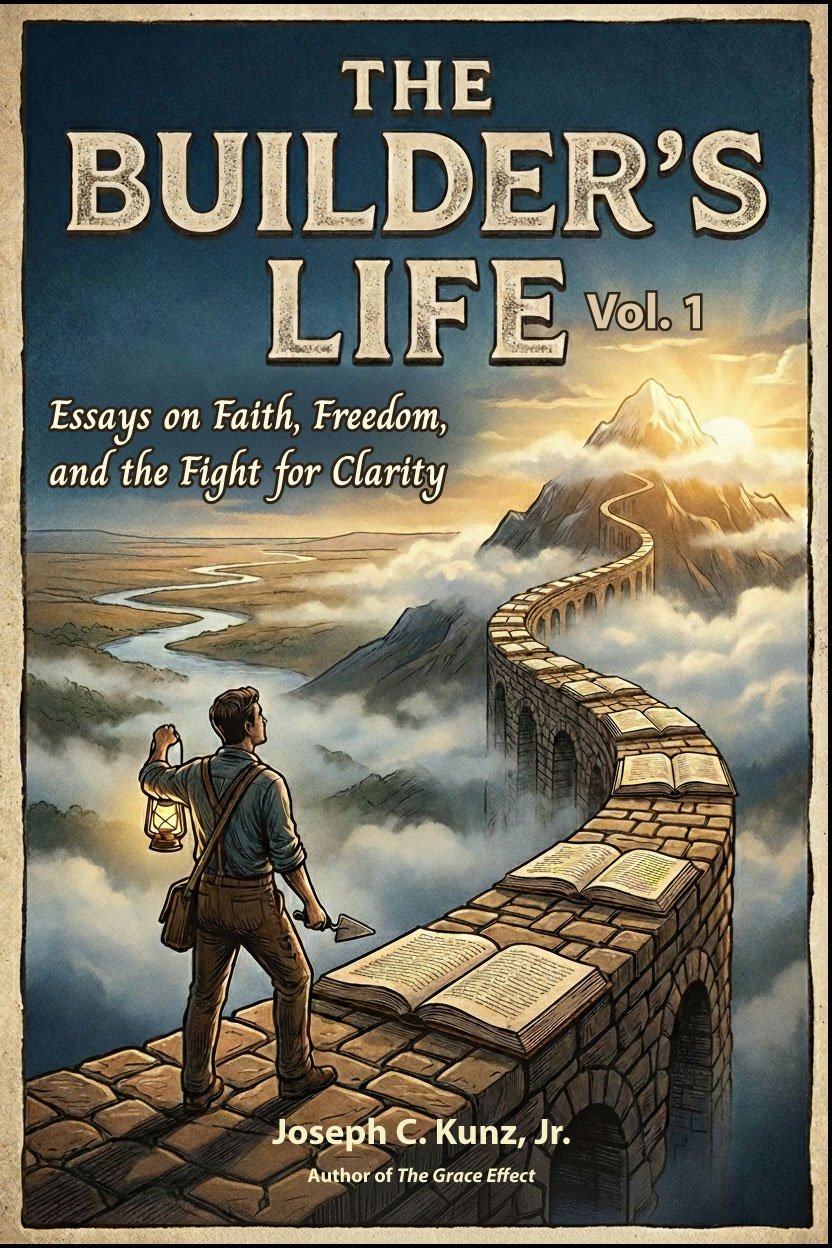
The Builder’s Life — Volume I: Essays on Faith, Freedom, and the Fight for Clarity
You don’t stumble into a strong life—you build one.
And if this essay punched you in the chest, that means one thing:
You’re done drifting. You’re ready to build on purpose.
The Four Pillars you just read aren’t theory.
They’re the framework that saved my life, rebuilt my strength, sharpened my faith, and carried my family through every storm that tried to fold us.
If something in you stirred—if you felt clarity, conviction, or even the sting of I should’ve started this years ago—good.
That means you’re awake.
That means you’re hungry.
That means you’re ready for the next step most people never take.
Step into the architecture of a life that actually holds.
Read The Builder’s Life — Volume I: Essays on Faith, Freedom, and the Fight for Clarity (Forthcoming).
This series isn’t self-help.
It’s self-respect.
It’s what happens when a man takes responsibility for his soul, his strength, his work, and his legacy—and refuses to apologize for it.
If the Four Pillars opened your eyes,
The Builder’s Life will give you the tools, the clarity, and the courage to build the life you’ve been avoiding, craving, or pretending not to want.
Start here.
Start now.
Before another year slips through your fingers.
The Builder’s Life (4-Volume Series) — Forthcoming
Because your life deserves a structure strong enough to carry everything God called you to build.