The Anchor’s Script: When Truth Becomes Just Another Role

When news becomes performance and conviction gives way to contracts, corruption isn’t hidden—it’s broadcast in plain sight. —Joseph C. Kunz, Jr.
How Corruption Hides Behind Cameras, Contracts, And Comfort
By Joseph C. Kunz, Jr.
Synopsis
We’re told the news is “information,” but too often it’s performance—polished faces reading lines, selling narratives, and cashing contracts like actors who never admit they’re acting. In this essay, Joseph C. Kunz, Jr. argues that modern corruption isn’t always hidden in backrooms and envelopes—it’s broadcast in plain sight, dressed in studio lighting and justified by million-dollar paychecks. When truth becomes negotiable and conviction becomes a job requirement instead of a moral anchor, culture doesn’t just get misled—it gets poisoned.
Kunz exposes the mechanics of this kind of corruption: the money temptation, the excuses (“I’m just doing my job”), the self-justification that gets louder as guilt leaks through, and the cultural fallout that follows—division, weakened convictions, and lies repeated until they feel like reality. But he doesn’t end with rage. He argues the responsibility ultimately falls on the public to stop confusing theater for truth—testing what we hear, anchoring ourselves in faith and conviction, and responding with both moral clarity and forgiveness. Because the danger isn’t just their performance. It’s how easily any human being can be bought if they aren’t anchored to something higher.
When truth is just another role, corruption becomes the script. –JCK
I. Introduction
Every day, millions of Americans tune in to news channels and hear anchors or politicians say things that cut deep: attacks on our country, our Church, our values, even open calls to division and violence. And every time I watch it, one thought echoes in the back of my mind: They’re making millions of dollars to say this.
That kind of money can tempt anyone. And if you’ve ever wondered how someone could say things that outrageous with a straight face, maybe the answer is simple: they don’t really believe what they’re saying. They’re just playing a part.
Like actors on a stage, they justify it by telling themselves it’s all a role, all performance. The problem is, unlike actors, they pretend it’s reality—and the public pays the price.
II. The Actor Behind the Anchor Desk
Turn on the news and you’ll see a polished anchor reading lines into a camera. The set is pristine, the graphics gleam, the delivery is flawless. But behind the performance, how much conviction is really there?
I suspect less than we think. Many of these anchors likely treat their job like a role in a film. The script changes depending on the producer, the ratings, or the political winds. They deliver the lines, cash the check, and move on.
Actors admit they’re pretending. Anchors and politicians don’t. They insist they’re telling the truth—even when they know they’re selling spin.
III. The Money Temptation
Let’s be honest: the money is irresistible. News anchors on major networks make millions of dollars a year. Politicians, even if their official salaries aren’t as high, rake in book deals, speaking fees, and insider perks that most Americans can’t imagine.
That kind of income makes it easy to compromise. It makes it easy to tell yourself:
• I’m just doing my job.
• I’m just giving the people what they want.
• If I didn’t say it, someone else would.
But those aren’t reasons—they’re excuses. And they’re the same excuses corrupt people have used for centuries to justify selling out truth.
IV. The Justification Game
What makes this kind of corruption especially poisonous is the way it’s justified. Anchors and politicians may not even believe the things they say on air. That almost makes it worse.
Because at least if someone believes what they’re saying, they’re wrong but sincere. But if you don’t believe it, and you still say it—for the paycheck, for the power—that’s cynicism at its ugliest. It’s looking at the public and saying: “I don’t believe this garbage, but I’ll feed it to you anyway, because it pays.”
That’s not journalism. That’s not leadership. That’s corruption dressed in makeup, tailored suits, and studio lighting.
V. Convincing Themselves to Believe
There’s another reason some anchors and politicians seem so adamant—sometimes even crying on air. I don’t think it’s always passion. Sometimes it looks more like guilt.
Deep down, they know they’re making an obscene amount of money to push narratives that tear at the fabric of our country, our faith, and our families. They know they’ve sold something precious—their integrity—for a contract.
And because they can’t live comfortably with that truth, they do what human beings always do when faced with guilt: they try to convince themselves they’re the good guys. They shout louder. They act more outraged. They cry on cue. They rehearse their lines until they almost believe them.
It’s not conviction—it’s self-justification. The louder they shout, the more it looks like guilt bleeding through the mask.
VI. A New Form of Corruption
When most people think of corruption, they picture shady deals, envelopes of cash, or backroom handshakes. But this modern form of corruption is more dangerous because it looks respectable.
It’s not hidden—it’s televised. It’s not whispered—it’s broadcast. And it doesn’t just pad the pockets of the powerful—it poisons culture itself.
This isn’t corruption in the shadows. It’s corruption in plain sight, with a contract, a studio, and a million-dollar paycheck attached.
VII. The Cost to the Public
The fallout is obvious. Families divided. Faith mocked. Values undermined. Violence encouraged.
Anchors and politicians may think of themselves as performers, but the audience isn’t watching a play. They’re living with the consequences. Words matter. Lies repeated enough start to feel like truth.
And when those lies are delivered with professional polish night after night, the damage is lasting. Culture bends. Convictions weaken. Division deepens.
VIII. The Plain Truth
The plain truth is this: these anchors and politicians have sold out. They’ve traded conviction for contracts, truth for ratings, and integrity for influence. And the public is paying the price.
But here’s the irony: the very people who seem to hold so much power are actually slaves—slaves to ratings, to networks, to donors, to money. They may sneer at faith, family, and tradition, but deep down, they know they’ve lost something more valuable than money can ever buy: their own integrity.
IX. Conclusion
Not all anchors or politicians are corrupt. But too many have become actors in a performance where the script is written by money and power, not conviction. And when that happens, truth becomes expendable.
I don’t watch the news to be entertained. I don’t look to politicians for theater. I want truth. I want conviction. I want leaders who don’t play parts for a paycheck but live their beliefs with integrity.
At the end of the day, America doesn’t need actors in front of cameras—it needs men and women who believe truth matters more than ratings and conviction matters more than contracts.
But let’s be real: the amount of money these anchors and politicians make is so obscene, most of them will never walk away. The temptation is too strong. The machine is too powerful. That’s why the responsibility falls on us—the public—not to believe the performance, not to be entertained by the theater, but to filter what we hear, to test it against truth, and to live by conviction ourselves.
And here’s the harder truth: these anchors and politicians are not aliens from another planet. They are us. They are human beings who face temptations that most of us, if offered the same fortune and fame, might not resist either. That doesn’t excuse their corruption. But it should remind us to temper our anger with forgiveness. Because if faith teaches us anything, it’s that even those who’ve lost their way aren’t beyond redemption.
Maybe their role in our world is to remind us just how easy it is for any of us to become corrupt. Their corruption is a warning. If fame, money, and power can bend them, it can bend us too—unless we do our best to anchor ourselves in faith, conviction, and truth. In that sense, they’re not just a problem to condemn, but a lesson to heed.
The corruption we see on camera isn’t foreign—it’s human. And that’s why we must respond with both conviction and forgiveness. –JCK
Related Essays: For Readers Who Still Believe Truth Matters
If this essay struck a chord, these will sharpen your conviction even further.
1. Faith Isn’t a Crutch — It’s a Competitive Edge
Discover how faith sharpens clarity, resilience, and courage when others fold.
Reader Comment: This essay reminded me that my faith isn’t weakness—it’s the reason I can keep going when life gets tough.
2. The Mirage of Judgment: Why Other People’s Opinions Aren’t the Truth
Learn how to stop living for applause and start living for conviction.
Quote: Conviction outlasts opinion every time. –JCK
Related Book: Stop Letting Actors Define Your Reality
If anchors and politicians are just playing roles for contracts, then the only question left is—who’s writing your script?
Here’s the blunt truth: the corruption on camera is a mirror. It shows us how easy it is to sell out conviction for comfort, to trade faith for applause, to perform instead of believe.
And unless we do our best to anchor ourselves in something stronger—faith, grace, truth—we’ll end up no different than the actors we despise.
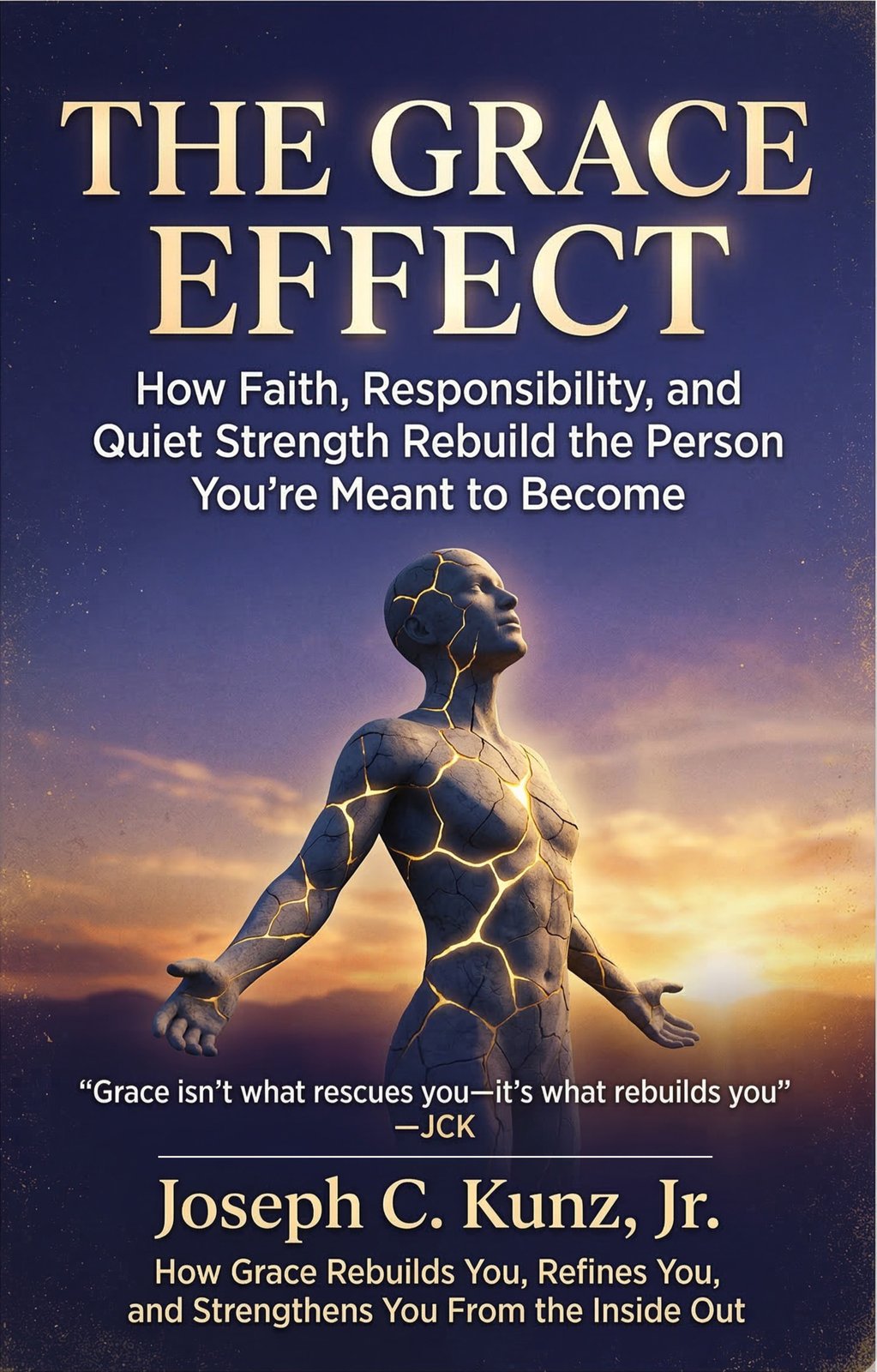
That’s why I wrote The Grace Effect. It’s not a book about abstract virtue—it’s a survival manual for the soul. It shows how grace isn’t weakness, it’s power: the power to resist the lies, stand firm when culture bends, and live a life that isn’t for sale at any price.
Don’t let the performance swallow you whole. Don’t let the script be written by ratings and contracts. Choose the road of conviction. Choose grace.
Read The Grace Effect today and discover how to live with strength, purpose, and quiet conviction in a world built on noise. Stay tuned.