Manning Up

This essay explains why real manhood means expecting adversity, taking responsibility, and moving forward without excuses—no matter how hard life hits. —Joseph C. Kunz, Jr.
The Strength Every Man Is Expected to Carry
By Joseph C. Kunz, Jr.
Synopsis
Modern culture treats adversity like an emergency—and excuses like a human right. In this essay, Joseph C. Kunz, Jr. argues that “manning up” isn’t bravado—it’s responsibility: the discipline to act instead of complain, adapt instead of collapse, and carry your weight without demanding sympathy or applause. Setbacks aren’t a tragedy. They’re the terrain. A man’s job is to expect them, prepare for them, and keep moving when they arrive.
Kunz challenges the soft culture of blame and emotional outsourcing, and he defends an older standard of manhood: steady, competent, mission-driven strength. Not loud. Not performative. Just reliable. Because a man isn’t defined by the hit he takes—he’s defined by how quickly he stands back up and gets to work.
A man isn’t defined by the hit he takes — he’s defined by how quickly he stands back up and gets to work. —JCK
Introduction: When Life Stops Asking and Starts Testing
Every man eventually reaches a point where life stops negotiating and starts testing.
Not with theory, not with talk, but with real blows—rejection, failure, loss, humiliation, unfairness, betrayal, and the sudden collapse of things you thought were stable.
Some men fall apart.
Some drown in self-pity.
Some spend years explaining why life didn’t treat them the way they wanted.
But other men—adult men, responsible men, mission-driven men—respond differently.
They shift gears. They adapt. They move. They carry their weight without expecting applause or sympathy.
This essay is not about a “lost” form of masculinity—because it isn’t lost.
Millions of men still do this every day.
I’ve done it for more than fifty years.
What is disappearing is the cultural expectation that men should respond to adversity with strength, responsibility, and motion. What’s disappearing is the understanding that setbacks aren’t cosmic punishments; they’re normal terrain.
And so this essay is a reminder, not a relic.
A reminder that manhood isn’t a performance, a feeling, or a stereotype.
It’s a way of moving through the world—with discipline, preparation, responsibility, and the quiet confidence of a man who knows that hardship is part of his job description.
This is an essay about the men who don’t break when life hits them…
because they always expected to be hit, and they built their lives accordingly.
I. Manning Up: The Strength Every Man Is Expected to Carry
“Manning up” isn’t a lost art.
Plenty of men—real men—have been living it quietly for decades.
I’ve been carrying my own weight for more than fifty years, and I’m not alone.
What’s changed is not the existence of strong men.
What’s changed is the culture that used to reinforce, expect, and respect this kind of responsibility.
Today, instead of praising resilience, we praise excuses.
Instead of celebrating discipline, we analyze feelings.
Instead of expecting men to handle adversity, we coddle them for collapsing under it.
But real men know better.
Setbacks aren’t tragedies.
They’re normal.
Predictable.
Expected.
And when they come, you do what men have always done:
You shift gears.
You adjust.
You carry the weight.
You keep going.
No whining.
No blaming.
No collapsing.
Just the steady work of a man who refuses to surrender his agency.
II. Setbacks Aren’t Special Events—They’re Part of the Terrain
For boys, adversity is shocking.
For men, it’s Tuesday.
This is why “manning up” doesn’t begin when something goes wrong—it begins with the understanding that things will go wrong.
A mature man doesn’t crumble when a job falls through, a customer leaves, a girlfriend walks out, or a company fires him to satisfy a quota. He doesn’t interpret difficulty as injustice or destiny.
He interprets it as the next obstacle in a life he is already prepared to navigate.
A boy is surprised by hardship.
A man expects it.
And because he expects it, he’s ready for it.
III. Real Men Don’t Narrate Pain — They Solve Problems
Modern culture encourages men to narrate their injuries:
“I was wronged.”
“I didn’t deserve this.”
“It’s not my fault.”
All of it may be true.
None of it is useful.
Real men don’t turn their struggles into stories for sympathy. They turn them into action plans.
A builder doesn’t sit around describing how the storm knocked down his shed.
He grabs the lumber, tightens the bolts, and rebuilds the roof stronger than before.
No speeches.
No drama.
Just responsibility.
This isn’t cruelty.
It’s adulthood.
You see this same truth in what Tyrus said recently on the Fox News show Gutfeld! when talking about setbacks in his own life. As he put it, If I had accepted ‘no’ every time someone didn’t believe in me or didn’t like me, I’d probably still be in Massachusetts right now. That’s a man refusing to let rejection become an identity.
And in the same breath, he added something every adult man should memorize: I never got to the point where I would attack people—like if I didn’t fit in the airplane, I didn’t blame the manufacturer of the airplane. That’s responsibility in its clearest form—no whining, no blaming, just the steady habit of fixing what you can fix and moving on from what you can’t.
IV. Victimhood Destroys Men From the Inside Out
The fastest way to weaken a man is to convince him he’s a victim.
Not because harm isn’t real, but because victimhood convinces him he’s powerless. And a powerless man stops trying, stops building, stops striving, and eventually stops respecting himself.
The truth is simple:
No one respects a man who blames.
Not his peers.
Not his family.
Not his employer.
Not himself.
“Manning up” isn’t pretending nothing hurts.
It’s refusing to let the hurt determine who you become.
V. Life Is a Construction Site — Not a Cradle
Life isn’t a soft place designed to comfort you.
It’s a job site designed to refine you.
It’s loud.
Messy.
Unpredictable.
Demanding.
There will be collapses, detours, and failures that make your stomach drop. But men are not forged in comfort. They are forged in the rebuilds.
Responsibility is the weight that shapes a man’s spine.
Resilience is the muscle that strengthens his character.
When life knocks you flat, you don’t cry about the fall.
You choose a response that reinforces who you are:
Whining or wisdom.
Paralysis or perseverance.
Why me? or Watch me.
A real man chooses the second path—every time.
VI. Real Men Expect Setbacks — And Prepare Long Before They Arrive
This is the part modern culture never talks about, because it requires discipline:
A grown man should not be surprised by adversity.
He should be preparing for it daily.
That’s what men have always done.
You don’t wait until your roof collapses to learn carpentry.
You don’t wait for a layoff to build your skills.
You don’t wait for a crisis to start saving money.
You don’t wait until someone betrays you to learn discernment.
You don’t wait for loneliness to realize you neglected relationships.
“Manning up” happens long before the setback shows up.
A responsible man:
• Builds skills because he knows opportunity comes to the prepared.
• Builds his investment portfolio because financial resilience is moral resilience.
• Builds relationships because isolation makes setbacks heavier.
• Strengthens his body because physical discipline fuels mental discipline.
• Guards his reputation because integrity compounds over time.
• Saves money because rainy days are guaranteed.
• Creates options because the man with options never stays down long.
This isn’t paranoia.
This is adulthood.
Preparation is not fear—it’s foresight.
And foresight separates men from boys.
VII. Action Is the Antidote to Everything Weakening Modern Men
Depression.
Anxiety.
Hopelessness.
Overthinking.
Apathy.
All of them share the same enemy:
Action.
A man who moves, improves.
A man who builds, strengthens.
A man who takes responsibility, regains control.
A man who chooses motion over emotion, escapes the quicksand of self-pity.
“Manning up” isn’t emotional suppression—it’s emotional leadership.
It’s choosing to act before you feel ready, stable, or confident.
Your feet lead.
Your confidence follows.
Conclusion: Stand Up, Step Forward, and Build Again
A man’s life is a long road, and setbacks are the tolls you pay along the way.
No man escapes them—not the strong, not the wealthy, not the disciplined, not the lucky.
But the difference between men who spiral and men who rise isn’t fate.
It’s how they respond.
“Manning up” doesn’t mean suppressing your emotions, pretending you’re invincible, or carrying the weight of the world without ever feeling it.
It means owning your response, preparing for hardship, and refusing to surrender your agency, even when things get unfair, ugly, or exhausting.
It means planning before the storm, not panicking during it.
It means getting back up without expecting applause.
It means building, fixing, strengthening, investing, saving, learning, and growing—not because life is easy, but because you are responsible.
Life will always test a man.
But a prepared man—a disciplined man, a principled man, a self-reliant man—cannot be broken by the same things that destroy weaker men.
In the end, “manning up” is not a slogan.
It’s a posture.
A discipline.
A lifelong habit of acting instead of blaming, building instead of complaining, and moving forward instead of folding inward.
You don’t do it to impress anyone.
You don’t do it to look tough.
You do it because you are a man with a mission—
and missions don’t pause for feelings, setbacks, or excuses.
Keep moving.
Keep building.
Keep carrying your weight.
And keep proving—quietly, steadily—that some men still know exactly what to do when life hits hard.
Real manhood isn’t loud or theatrical. It’s the quiet discipline of showing up, taking responsibility, and carrying your weight without waiting for applause. —JCK
Related Essays: For Men Building Strength, Clarity, and Direction
If this essay sharpened your edge, these will push you even further.
1. Becoming the Man You Needed as a Boy
Learn how to grow into the steady, disciplined, principled man your younger self was silently hoping you’d one day become.
Reader Comment: This one hit me hard—it reminded me of the man I always wanted to become but kept postponing.”
2. Mindset, Grit, & Personal Responsibility — Why Success Is Rooted in Daily Discipline
A no-nonsense breakdown of why grit, accountability, and disciplined thinking remain the foundation of every man’s strength, success, and stability.
Quote: Discipline isn’t punishment—it’s the quiet power that turns chaos into direction and effort into legacy. —JCK
The Book Behind This Idea: If You’re Still Standing, You’re Not Done Yet
Most men aren’t defeated — they’re just tired.
Tired of being told to soften.
Tired of being told strength is optional.
Tired of being lectured by people who couldn’t carry their own weight if it came with handles.
But here you are.
Still reading.
Still standing.
Still trying to become the man you’re called to be.
That tells me something:
You’re not done.
You’re not broken.
And you damn sure haven’t peaked.
If this essay hit you in the chest — good.
Some blows aren’t meant to bruise.
They’re meant to wake something up.
And if you’re ready to build not just toughness, but grace, clarity, and the inner armor of a man who refuses to fold, then the next place you need to go is here:
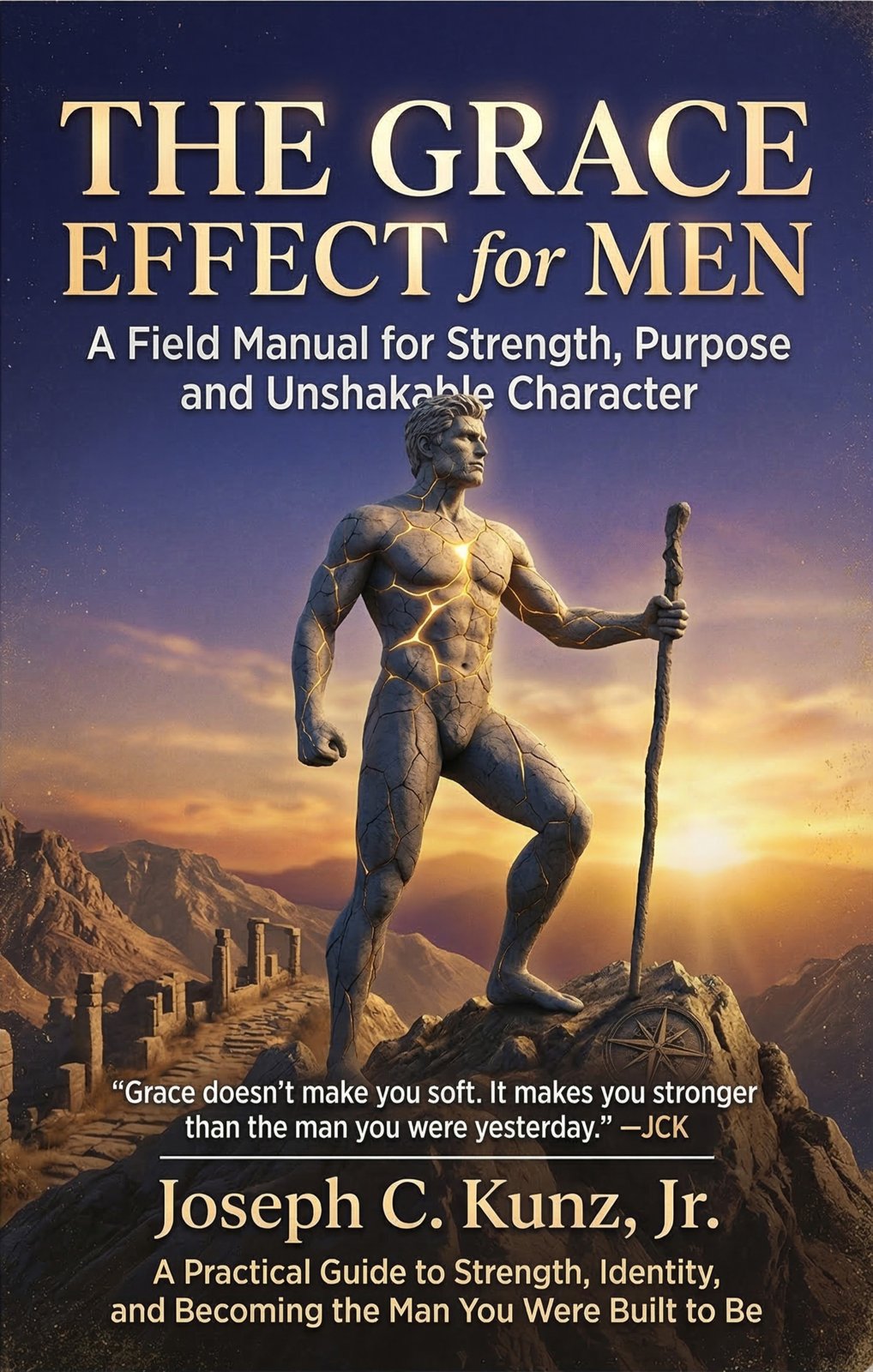
Read The Grace Effect for Men.
(It’s not a book. It’s a blueprint for the man you promised yourself you’d become.)
Don’t drift.
Don’t stall.
Don’t wait for “the right moment.”
Men who wait for perfect conditions never build anything worth remembering.
You’ve already survived every bad day you’ve lived.
Now build the life that proves it.
Keep going.
Keep building.
And don’t apologize for your strength.
Forthcoming. Prepare yourself.