Life Is Too Short for Small Philosophies
A humorous, high-road critique of the modern secular worldview that insists the universe is smaller, colder, and flatter than any real human life could ever be. —Joseph C. Kunz, Jr.
A Christian’s Response to the Sam Harris–style Worldview
By Joseph C. Kunz, Jr.
Synopsis
Modern secularism shrinks reality to what can be measured, weighed, graphed, and peer-reviewed—and then acts surprised when life feels thin. In this essay, Joseph C. Kunz, Jr. argues that the Sam Harris–style worldview reduces the human person into a manageable object: biology plus brain chemistry plus clever language. It can analyze behavior, label impulses, and map neural activity, but it cannot account for the things that actually make life worth living—meaning, conscience, sacrifice, awe, dignity, evil, love, and moral responsibility.
Kunz takes the high road while exposing the limits of reductionism: when a philosophy explains everything except the most important things, it isn’t “brave” or “rational”—it’s incomplete. He offers a builder’s reminder that human beings aren’t problems to be solved but souls to be formed—and that reality is larger than any one-channel explanation.
When a worldview explains everything except the things that matter most, it’s not profound—it’s incomplete. —JCK
I. Introduction: The World According to One Channel
I recently listened to Sam Harris speak with the certainty of a man who thinks the entire universe runs on a single operating system—and he happens to have the password.
He talks about consciousness as if he discovered it last Tuesday. He speaks about morality as though centuries of human wisdom were simply a misunderstanding waiting for his clarification. And he describes the human soul the way a dentist describes plaque buildup: unfortunate, unnecessary, and best removed.
Again—this isn’t malice. It’s simply a worldview shaped by reduction.
Everything must be explainable, calculable, diagrammable, predictable, and preferably peer-reviewed. If a thing transcends measurement, the problem is not the worldview—it’s the thing.
The trouble is simple:
Life is too big for philosophies that small.
And human beings are too extraordinary to fit inside a worldview that insists they are accidental, temporary, and fundamentally meaningless.
II. The False Choice Between Reason and Faith
One of the oldest and slickest tricks in the secular-materialist playbook is setting up a false choice:
Choose:
• Your brain or your soul.
• Evidence or belief.
• Science or God.
This assumes that human beings must live in a one-story house when they were clearly designed for two.
And the hilarious part? The people who actually work in reality know better.
Nurses, doctors, surgeons, first responders, soldiers, engineers— none of them wake up in the morning thinking,
“Today I must choose between reason and faith.”
They use both because reality requires both.
Reason solves the problem. Faith strengthens the person who must solve it.
C.S. Lewis warned that modernity often confuses novelty with wisdom. Newer is assumed smarter. Believers are assumed naïve. Skeptics are assumed superior.
Lewis called this “chronological snobbery,” and it remains the most popular intellectual hobby of the modern secular mind.
III. When a Philosophy Shrinks, Life Shrinks With It
Materialism reduces everything to the smallest possible parts—and then mistakes the parts for the whole.
It explains love as:
• neuron firing patterns,
• chemical bonding,
• reproductive strategy.
And then wonders why modern people feel lonely.
It explains morality as:
• social evolution,
• herd survival,
• cooperative advantage.
And then wonders why society is confused.
It explains hope as:
• cognitive coping mechanisms.
And then wonders why despair is rising.
When your worldview has no category for transcendence, everything becomes:
• technical,
• clinical,
• mechanical,
• and vaguely disappointing.
You’ll hear phrases like:
“Meaning is an illusion.” “Free will is a trick your brain plays on you.” “Morality is a convenient fiction.” “The self is an error.”
And you’re expected to smile politely as your entire existence is reclassified as a clever hallucination.
At some point you must ask:
Is this wisdom—or is this a man reading a map and insisting the map is larger than the world?
IV. The Arrogance Born of Uncertainty
One of the strangest psychological combinations in the modern secular worldview is:
intellectual insecurity + tone of absolute certainty.
They are unsure about meaning, but very sure that you shouldn’t be. They can’t explain consciousness, but insist you stop asking about the soul. They don’t know why morality exists, but they’re positive God has nothing to do with it.
This is not confidence. It’s the kind of bravado you see in poker when a guy bets big because he’s holding a weak hand.
The volume goes up when the foundation goes down.
When a worldview cannot carry the weight of the human heart, its defenders compensate by sounding authoritative. Certainty becomes a shield. Condescension becomes armor. Dismissiveness becomes the sword.
But beneath all of it is a very human thing: a fear that the world might be bigger than the theory.
V. Rebellion Disguised as Enlightenment
There is an emotional subtext to modern secular criticism that deserves attention.
It often feels like:
• rebellion,
• not reflection;
• reaction,
• not reason;
• negation,
• not discernment.
It’s the intellectual version of adolescence:
“Whatever the adults believed, we will not.” “Whatever tradition taught, we must reject.” “Whatever faith proclaimed, we must dismantle.”
This is not philosophy—it’s posture. It’s identity-through-opposition.
It’s the teenager rolling his eyes at every sentence simply because he didn’t say it first.
But just like adolescence, it collapses under real hardship.
When suffering enters the room, clever rebellion cannot hold. Pain has a way of stripping philosophies down to their load-bearing beams.
A worldview built on contradiction has no beams at all.
VI. Ordinary Americans Are Not Impressed
There is one thing the secular “enlightened class” cannot seem to grasp:
Normal people know when a worldview is too small.
They feel it instantly.
A nurse holding a patient’s hand at 3 a.m. knows more about the human soul than a thousand people debating consciousness on a podcast.
A father who works two jobs to support his family understands moral responsibility better than a theorist explaining why “free will is an illusion.”
A grandmother praying for her grandchildren possesses more spiritual clarity than a dozen academic conferences on “the neuroscience of meaning.”
Ordinary Americans live too close to reality to be impressed by philosophies that shrink it.
They intuitively understand that a worldview that cannot explain love, sacrifice, suffering, meaning, purpose, beauty, or conscience… cannot explain human life.
VII. Meaning Without the Maker
The secular project tries to pull off a magic trick:
Keep:
• morality,
• dignity,
• meaning,
• ethics,
• purpose,
• love,
• and transcendence—
while removing God from the story.
It’s like trying to keep the beam while removing the pillar. It collapses every time.
Lewis said it plainly:
A river cannot rise above its source.
If everything is random, then nothing is meaningful. If everything is accidental, then nothing is sacred. If everything is physical, then nothing is moral.
You can’t downgrade the foundation and expect the house to stay standing.
VIII. Real Life Breaks Small Philosophies
I learned this personally.
When I faced brain surgery, the stakes were not theoretical. There was nothing abstract about it. The body was on the table. The fear was real. The uncertainty was suffocating. The future was unclear.
Science kept me alive. Faith kept me human.
Science explained my condition. Faith explained my purpose.
Science helped repair the body. Faith helped rebuild the man.
A worldview that has room for only one of those is too small for real life, too small for real suffering, and certainly too small for the human soul.
IX. Choose the Larger Story
This isn’t about Sam Harris. He’s just the loudest voice representing a very old idea: that life can be shrunk to what we can measure.
But human beings are not laboratory phenomena. We are:
• moral,
• relational,
• spiritual,
• responsible,
• creative,
• broken,
• beautiful.
We don’t fit inside a materialist box because the box was never designed for people—only for theories.
The truth is straightforward:
• Faith expands the horizon.
• Materialism narrows it.
• Faith deepens life.
• Materialism flattens life.
• Faith reveals the soul.
• Materialism denies it.
Life is too short—and far too meaningful—to waste on a philosophy that explains everything except the things that actually matter.
X. Conclusion: The High Road Is the Only Road
A critique of a worldview is not a condemnation of its adherents. People can be intelligent and sincere—and still be working with a map that’s too small for the territory.
The goal is not derision. It’s clarity.
Not anger. Understanding.
Not mockery. Meaning.
When you build your life on faith, courage, gratitude, purpose, sacrifice, and love, you naturally outgrow worldviews that insist you are an accidental byproduct of meaningless forces.
Growth is the best rebuttal. Flourishing is the best argument. A meaningful life is the best critique.
And that is why, in the end:
Life is simply too short for small philosophies.
A small philosophy can make you sound smart, but only a large one can make you live well. —JCK
Related Essays: For Readers Who Refuse to Live in a Flat, Shrinking Universe
If this essay gave you more oxygen, these will open the windows even wider.
1. The Adolescent Atheist: Why Rebellion Disguised as Reason Leaves the Soul Malnourished
A sharp but compassionate look at why today’s secular “enlightened” stance often collapses into adolescent opposition rather than mature conviction.
Quote: Rebellion feels powerful at eighteen—but without truth, it runs out of gas by midlife. —JCK
Reader Comment: This one hit me hard. I finally understood why I spent years rejecting my own beliefs without ever examining them.
2. The Illusion of Control: Why Modern Success Still Feels Empty
When control becomes a false god, even achievement feels hollow—until faith reframes strength, limits, and meaning around something steadier than self-will.
Reader Comment: I didn’t realize how much of my life I spent gripping the wheel with white knuckles. This essay made me breathe again.
Related Book: If You’re Done Living Small, Read This Next
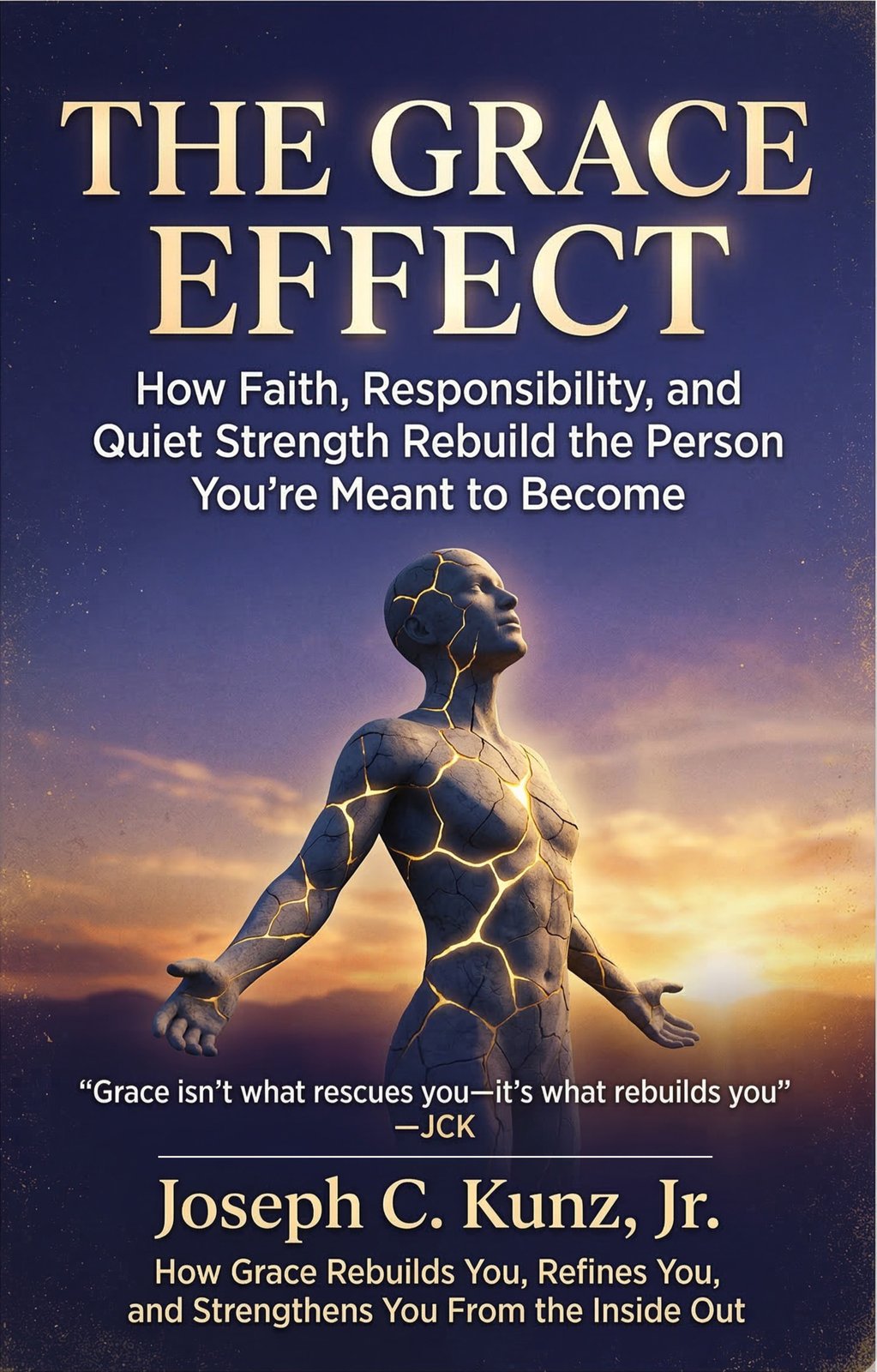
A high-voltage invitation to the book that will rebuild your courage, your compassion, and your backbone.
If this essay stirred something in you—if a part of you finally got tired of being squeezed into a philosophy too small for your soul—then you’re ready for the next step. Not more information. Not another “self-help” sugar high. You’re ready for transformation.
That’s exactly why I wrote The Grace Effect: How Courage and Kindness Can Transform Your Life (and the World).
Because here’s the truth nobody on the “we’re-all-atoms-and-accidents” team wants to admit:
Grace is power. Courage is fuel. Kindness is a weapon. And together, they turn ordinary people into world-shakers.
This book isn’t about being polite, soft, or “spiritual” in the trendy, Instagram-approved way. This is about becoming the kind of person who can walk into the storms of life without folding. A builder. A protector. A healer. A leader in your family, your work, and your community.
And yes—a person whose life flat-out contradicts every small philosophy trying to shrink you.
You don’t need permission. You don’t need perfect conditions. You don’t need the world’s approval. You need grace, courage, and the gritty willingness to live like your life actually matters.
You’re here, reading this, because you know it already does.
If you’re ready to live larger, deeper, stronger—start with The Grace Effect. Your life is too big for any philosophy that can’t hold the weight of your soul. Let grace show you how big you really are.
Read the book that will make you dangerous in all the ways that matter: The Grace Effect: How Faith, Responsibility, and Quiet Strength Rebuild the Person You're Meant to Become
Coming Soon.