Just Believe Is Not Enough

A faith that never asks me to surrender control may comfort me, but it has not yet converted me. —Joseph C. Kunz, Jr.
Why real faith requires trust, surrender, obedience, and the courage to let God be God
By Joseph C. Kunz, Jr.
Synopsis
This isn’t an attack on simple faith, sincere encouragement, or ordinary people who use short phrases to point others toward God. In this essay, Joseph C. Kunz, Jr. argues that the phrase “Just Believe” can be true only if belief means more than agreement, optimism, religious language, or emotional reassurance. Christian belief must become trust, surrender, obedience, repentance, humility, and allegiance to Jesus Christ.
Kunz makes the case that this distinction is especially difficult for self-built men, providers, fathers, builders, workers, and survivors who learned early in life to carry responsibility, solve problems, and stay in control. Control can begin as duty, but it can quietly become a false foundation when a man starts living as if everything finally depends on him. The central tension is not between faith and responsibility, but between faithful responsibility and the illusion that responsibility gives us final authority.
The conclusion is simple: belief in God is not the same as surrender to God. A man can admire Jesus, respect moral order, work hard, provide well, and still resist the deepest demand of Christian faith: to stop treating himself as the foundation and let God be God.
Belief becomes real when the man who knows how to carry weight finally admits he was never meant to carry God’s place. —JCK
I. Introduction: The Sign on the Truck
I saw a sign on a truck with a picture of praying hands and two words:
Just Believe.
My first reaction was not anger.
It was discomfort.
Not because the phrase is completely wrong. It is not completely wrong. There are moments in life when a person does need to hear something simple. Do not despair. Do not give up. God is real. Trust Him. Keep going. Believe.
There is a kind of mercy in simple encouragement.
But there is also a danger in it.
Because when belief in Jesus Christ is reduced to a phrase, a slogan, or a spiritual mood, something essential can be lost. Christianity becomes easier to say than to live. Faith becomes a bumper sticker instead of a foundation. Trust becomes a feeling instead of a surrender. Belief becomes a word we use to comfort ourselves while quietly keeping control of everything we are afraid to hand over to God.
That is what troubled me.
The words were not false.
They were incomplete.
And sometimes an incomplete truth can become misleading if we treat it as the whole truth.
II. Belief Is Not Mere Agreement
A person can believe that God exists and still not trust Him.
A person can believe that Jesus lived and still not follow Him.
A person can believe that faith is important and still not be formed by it.
A person can respect religion, admire moral order, defend Christian civilization, and still resist the deepest demand of Christian faith.
That demand is not merely that I admit God exists.
It is that I let God be God.
That is where belief becomes serious.
Christian belief is not just agreement with a doctrine. It is not merely saying, “Yes, I believe there is a God.” It is not simply feeling comforted by religious language. It is not the same as being optimistic, positive, patriotic, conservative, respectful, traditional, or morally serious.
Those things may matter.
Some of them matter a great deal.
But they are not yet surrender.
Real belief means trust.
Real belief means obedience.
Real belief means repentance.
Real belief means humility.
Real belief means that Jesus Christ is not merely a figure I admire, a teacher I respect, a moral symbol I appreciate, or a religious answer I find useful.
He is Lord.
That word changes everything.
Lord means authority.
Lord means claim.
Lord means I do not get to keep a private room in my life where God may advise me but not command me.
That is the part I keep having to face.
III. Why Self-Built Men Struggle Here
I understand why this is hard for men like me.
I do not say that as an excuse. I say it because it needs to be named honestly.
Some men are formed by comfort. Others are formed by pressure.
Some men grow up assuming that help will arrive. Others learn early that help may not come in the form they need, when they need it, or from the people who should have given it.
So they become strong.
They learn to work.
They learn to prepare.
They learn to solve.
They learn to carry.
They learn to watch the angles, think ahead, protect the family, pay the bills, fix the problem, absorb the blow, and keep moving.
Much of that is good.
A man should carry responsibility. A husband should not drift. A father should not collapse under pressure if he can stand. A worker should not be lazy. A builder should not blame the world for everything he failed to build. Faith should not make a man passive, sentimental, or soft-minded.
But there is a hidden danger in strength.
The very habits that help a man survive can become the habits that make surrender difficult.
The man who learned to control everything because no one else was coming may struggle to trust God when God does not explain Himself.
The man who built a life through discipline may struggle to receive grace because grace cannot be earned like wages.
The man who solved problems for decades may struggle when prayer does not feel like a strategy.
The man who protected his family may struggle to accept that there are things he cannot finally protect them from.
The man who carried weight may begin to believe that carrying weight is the same as being the foundation.
It is not.
That is where strength becomes spiritually dangerous.
Not because strength is bad.
Strength is good when it is rightly ordered.
But strength becomes a barrier when it makes a man allergic to dependence, suspicious of surrender, and quietly unwilling to be governed by anyone but himself.
IV. Control Often Wears the Clothes of Responsibility
Control rarely introduces itself honestly.
It does not usually say, “I want to be God.”
It says, “I am just being responsible.”
That is what makes it hard to detect.
Responsibility plans.
Control panics.
Responsibility prepares.
Control cannot rest.
Responsibility carries duty.
Control tries to carry destiny.
Responsibility acts faithfully within the limits of human stewardship.
Control resents the limits.
Responsibility says, “I must do what is mine to do.”
Control says, “Nothing can happen unless I manage it.”
That difference matters.
Christian surrender is not irresponsibility. It is not laziness dressed in spiritual language. It is not sitting back, refusing to work, refusing to decide, refusing to build, and then calling the result faith.
That is not faith.
That is evasion.
But control is the opposite error.
Control is when responsibility becomes ultimate. It is when a man takes a real duty and inflates it into final authority. It is when he starts living as if his vigilance, planning, effort, discipline, money, intelligence, and toughness are the deepest things holding the world together.
They are not.
They matter.
They are not God.
That is the line I keep needing to learn.
V. The Builder’s Temptation
Builders understand foundations.
We understand structure.
We understand weight.
We understand what happens when something is poorly framed, poorly anchored, poorly maintained, or built on soft ground.
That is why builder language helps me think about faith.
A life needs a foundation.
But the builder’s temptation is to confuse his work with the foundation itself.
I can build a business.
I can build habits.
I can build systems.
I can build a home.
I can build financial strength.
I can build a body of work.
I can help build a family culture.
I can build a reputation for discipline, clarity, and responsibility.
But I cannot build myself into God.
That sentence is easy to write and hard to live.
Because the builder’s life rewards effort. It rewards discipline. It rewards planning, sacrifice, restraint, and careful action. Over time, a man can begin to think that everything real must be built by him, secured by him, protected by him, and explained by him.
Then faith becomes difficult.
Not because he lacks seriousness.
Because he has too much confidence in the wrong final support.
A builder may understand God as order, law, intelligence, design, justice, and reality. He may even feel close to God when he sees the structure of creation, the moral law, the beauty of family, the dignity of work, and the consequences of foolishness.
But Jesus Christ confronts the builder at a deeper level.
Jesus does not merely confirm that the universe has order.
He asks for the man.
He asks for the heart.
He asks for the will.
He asks for the hidden room.
He asks for the right to govern what the man has spent a lifetime trying to control.
That is where the struggle begins.
VI. “Just Believe” Must Become “Trust and Surrender”
If “Just Believe” means “believe harder that things will work out,” it is too thin.
If it means “stay positive,” it is too thin.
If it means “use religious optimism to quiet your fear,” it is too thin.
If it means “God exists, so stop thinking deeply,” it is too thin.
If it means “say the right words and everything will become easy,” it is false.
But if “Just Believe” means trust Jesus Christ with the life you are afraid to release, then the phrase becomes much stronger.
If it means believe enough to obey when obedience costs you, then it has weight.
If it means believe enough to repent instead of defend yourself, then it has teeth.
If it means believe enough to stop treating anxiety as wisdom, then it becomes medicine.
If it means believe enough to submit your plans, your family, your suffering, your future, your body, your work, your money, your legacy, and your death to God, then it becomes Christian.
But then it is no longer simple in the shallow sense.
It is simple the way a load-bearing wall is simple.
It is plain, but not light.
It is direct, but not easy.
It is clear, but costly.
VII. Surrender Is Not Collapse
This is the distinction that matters most for men who are afraid of surrender.
Surrender to God is not collapse.
It is not weakness.
It is not passivity.
It is not the abandonment of responsibility.
It is not turning into a man who stops planning, stops working, stops thinking, stops protecting, stops building, or stops caring about consequences.
A surrendered man still works.
He still leads.
He still provides.
He still disciplines himself.
He still tells the truth.
He still makes decisions.
He still carries what is his to carry.
But he does not confuse his stewardship with sovereignty.
That is the difference.
Stewardship means I am responsible for what has been entrusted to me.
Sovereignty means I am the final ruler of reality.
I am not.
A Christian man must learn to live inside that truth without using it as an excuse.
That is difficult.
It is easier to be controlling than surrendered.
It is also easier to be passive than responsible.
The Christian life allows neither escape.
It does not let the strong man worship control.
It does not let the weak man hide in passivity.
It calls both men to obedience.
For a builder, that means I keep building, but I stop pretending I am the foundation.
VIII. What This Looks Like in Real Life
This cannot remain an idea.
That is another temptation for men like me. We can understand something intellectually and mistake that understanding for transformation.
But knowing the difference between belief and surrender is not the same as surrendering.
The real test comes in the ordinary places.
It comes when I pray before I have already decided what I want God to do.
It comes when I ask whether my plan is faithful, not merely effective.
It comes when I admit fear without baptizing it as prudence.
It comes when I listen to correction from people who love me.
It comes when I stop rehearsing every possible disaster as if worry were a form of leadership.
It comes when I make the call, do the work, carry the duty, and then release the outcome I cannot control.
It comes when I accept that my children and grandchildren belong to God before they belong to me.
That one is hard.
A father wants to protect.
A grandfather wants to hand forward wisdom, strength, clarity, faith, responsibility, and a life that holds. That desire is good. It is part of love.
But love can become anxious possession if it forgets God.
My children need my witness.
My grandchildren need my witness.
My family and friends need to see more than my opinions. They need to see what it looks like when a man who has spent his life building and carrying still bows before God.
Not theatrically.
Not perfectly.
Honestly.
They need to see me struggle with surrender and keep returning to it.
They need to see that faith is not a slogan I place on other people’s lives. It is a truth I am trying to let govern my own.
That may be one of the most important parts of legacy.
Not pretending I never struggled.
Showing how I struggled faithfully.
IX. The Witness of an Unfinished Man
There is a kind of false witness that comes from acting as though faith has made every hard thing easy.
I do not believe that helps people.
It may impress them for a while, but it does not form them.
A better witness is honest strength.
I believe.
I also struggle.
I trust God.
I also try to take back control.
I know Christ is Lord.
I also discover, again and again, hidden places where I still want to be in charge.
That is not hypocrisy if I bring the struggle into the light and keep submitting it to God.
It is hypocrisy only if I pretend the struggle is not there.
A man does not honor God by pretending surrender is easy when it is not.
He honors God by returning to surrender after every act of self-rule reveals itself.
That is where faith becomes more than language.
Faith is not the absence of struggle.
Faith is the refusal to let the struggle have the final word.
A man can spend decades learning strength and still need to learn surrender.
A man can build a life and still need to be rebuilt.
A man can teach responsibility and still need grace.
A man can write about faith and still be corrected by the very faith he writes about.
That is not failure.
That is formation.
X. Why This Matters Now
We live in an age filled with slogans.
Political slogans.
Spiritual slogans.
Therapeutic slogans.
Motivational slogans.
Branding slogans.
Identity slogans.
Even faith can get turned into a slogan if we are not careful.
But slogans cannot carry the weight of reality.
They cannot carry suffering.
They cannot carry guilt.
They cannot carry death.
They cannot carry fatherhood.
They cannot carry marriage.
They cannot carry failure.
They cannot carry the fear that comes when a man realizes he cannot finally control the people he loves, the future he wants, the body he lives in, or the outcome he prays for.
Only real faith can carry that.
And real faith is not shallow.
It is not fragile optimism.
It is not religious decoration.
It is not a mood.
It is not a social identity.
It is not a spiritual accessory added to an otherwise self-governed life.
Real faith goes beneath the life.
It becomes the foundation.
That is why “Just Believe” is not enough if belief remains only a word.
Belief must become the ground under the man.
It must become the authority above him.
It must become the formation within him.
It must become the witness that outlives him.
XI. Conclusion: Let God Be God
I am still learning this.
That is the honest truth.
I am not writing from the mountaintop as a man who has conquered control. I am writing as a husband, father, grandfather, businessman, writer, Christian, and builder who knows how deeply control can hide inside responsibility.
I know how easily faith can become something I respect without fully obeying.
I know how easily prayer can become a request for God to bless the plan I already made.
I know how easily strength can become self-protection.
I know how easily a builder can keep building while quietly refusing to be rebuilt.
That is why this matters to me.
I do believe.
But I want belief to become more than belief in my head.
I want it to become surrender in my life.
I want my family to see that struggle honestly.
I want my children and grandchildren to know that faith is not pretending to have no fear. It is bringing fear under God’s authority.
I want my readers to know that a serious Christian life is not built from slogans. It is built from truth, repentance, obedience, surrender, responsibility, grace, and the daily decision to let God occupy the place I keep trying to take back.
So yes, believe.
But do not stop there.
Trust.
Obey.
Surrender.
Repent.
Receive grace.
Carry your responsibility without worshiping your control.
Build what you are called to build without pretending you are the foundation.
The conclusion is simple: belief becomes Christian when the man who wants control finally bows before the Lord who already has it.
The builder does not become weaker when he surrenders to God. He finally stops asking his own strength to do what only grace can do. —JCK
Related Essays: When Belief Has to Go Deeper
These essays continue the argument that faith is not merely agreement with God’s existence, but a deeper surrender to Jesus Christ, grace, and real formation.
1. Belief in God Is Not Yet Christianity
Belief in God, moral seriousness, and reverence are not yet the full heart of Christianity until God is received through Jesus Christ as mercy, reconciliation, and new life.
Reader Comment: Read this next because it makes the theological distinction behind this essay sharper: believing in God is not the same as receiving Christ as Lord, Savior, mercy, and authority.
Quote: A man can believe in God and still resist the grace that would save him from himself. —JCK
2. When Strength Becomes a Barrier
Disciplined self-reliance can point a man toward God, yet still keep him from grace, surrender, and the new life found only in Jesus Christ.
Reader Comment: This is the closest companion essay because it goes directly after the builder’s deepest temptation: mistaking strength for surrender and responsibility for final authority.
Quote: Strength is a gift when it serves God. It becomes a wall when it keeps grace outside. —JCK
Related Book: Faith Strong Enough to Break the Grip of Control
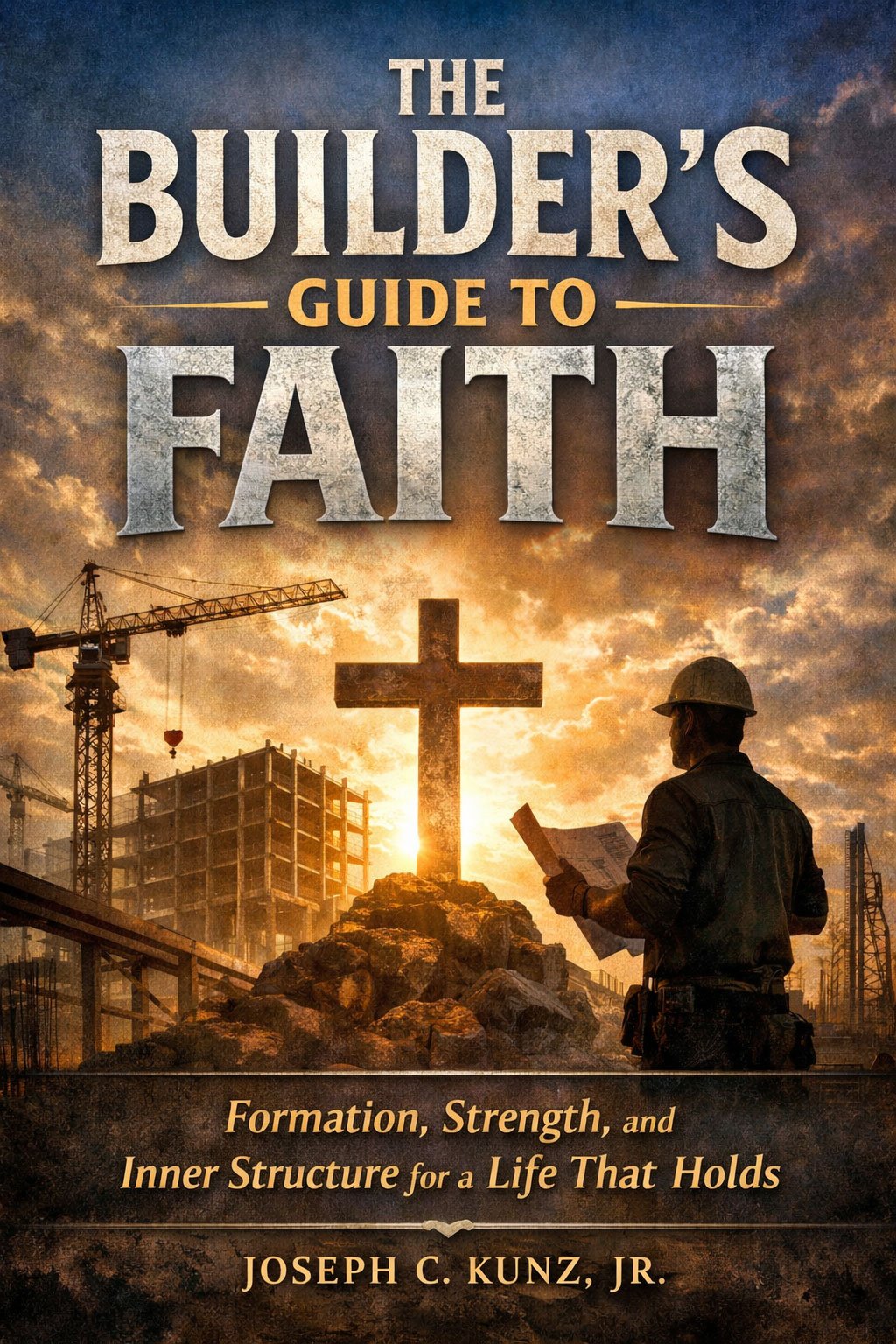
A lot of men do not reject God because they are weak, lazy, or unserious. Some resist God because they are strong in the wrong way. They know how to work, provide, endure, solve, and carry. But they do not know how to surrender without feeling as if they are betraying everything that made them strong.
That is why I am writing The Builder’s Guide to Faith. This is not a soft devotional for people who want religious comfort without transformation. It is a builder-minded book about faith as foundation, surrender as strength, responsibility under God, and the inner structure needed to live a life that holds when control fails.
This book is not about sounding spiritual.
It is about being formed.
It is about faith that can govern ambition, fear, money, work, family, suffering, and legacy.
It is about learning how to build without worshiping the builder.
If you are tired of religious slogans that collapse under pressure, this book is for you.
If you have carried responsibility for years but still struggle to release control, this book is for you.
If you want a faith that does more than decorate your life — a faith that rebuilds the man living it — this book is being built for exactly that purpose.
Being Built to Hold: The Builder’s Guide to Faith