Grace Is Not Weakness
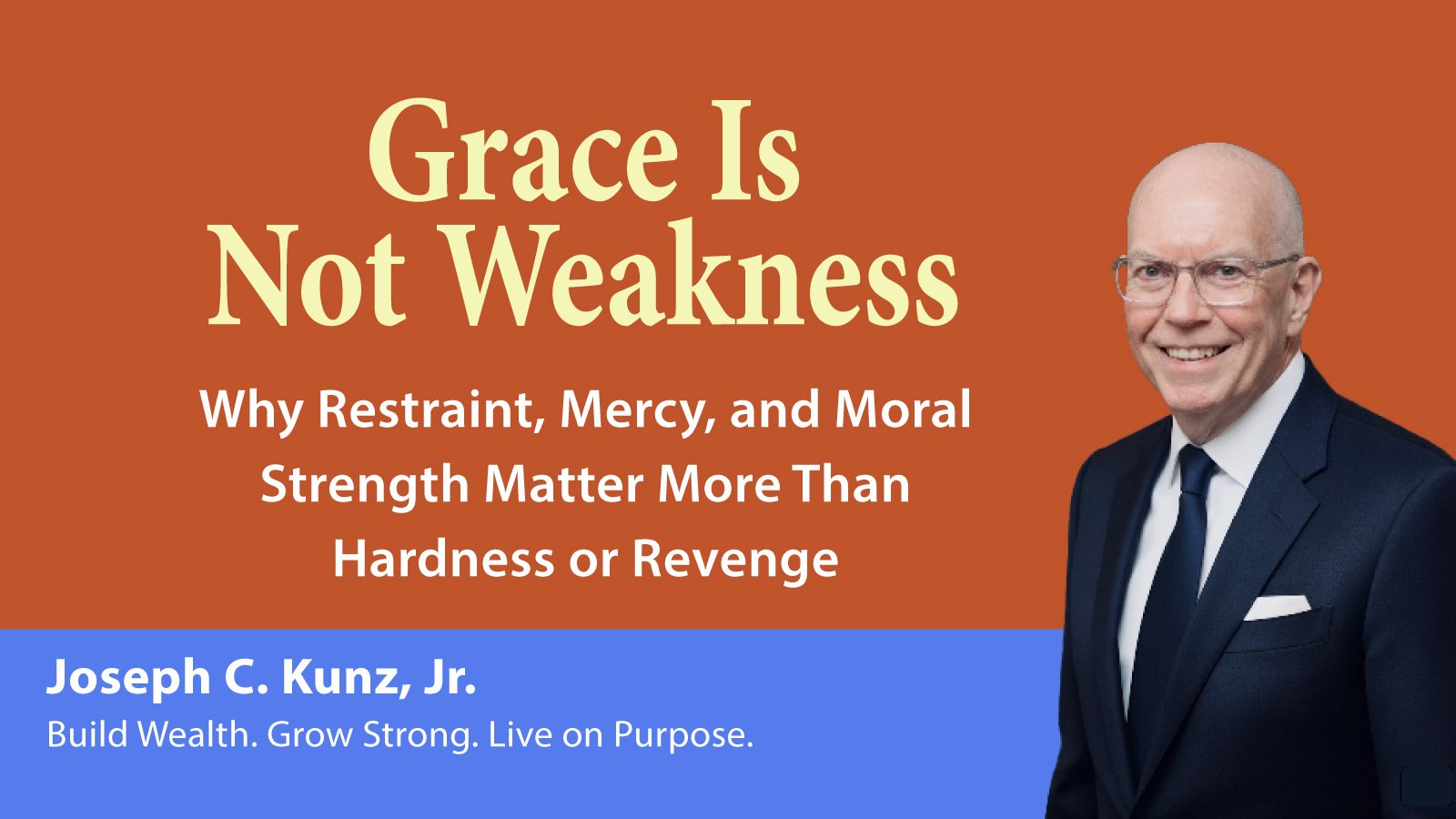
Grace is not the refusal to confront what is wrong, but the refusal to become cruel while confronting it. —Joseph C. Kunz, Jr.
Why Restraint, Mercy, and Moral Strength Matter More Than Hardness or Revenge
By Joseph C. Kunz, Jr.
Synopsis
This is not another sentimental reflection about being nice, staying positive, or smoothing over pain with polite religious language. In this essay, Joseph C. Kunz, Jr. argues that grace is one of the most misunderstood virtues in modern life because people often confuse it with passivity, indulgence, emotional fragility, or the refusal to confront what is wrong. But real grace is not weakness in soft clothing. It is moral strength under control—the kind that tells the truth without becoming savage, extends mercy without abandoning standards, and remains steady when wounded pride demands retaliation.
Kunz makes the case that grace becomes most visible not in easy moments, but in the heat of conflict, failure, disappointment, humiliation, and ordinary human friction. He explains why harshness is often mistaken for strength, why bitterness can masquerade as honesty, and why many people would rather feel powerful than be governed by mercy. Grace, rightly understood, is not the denial of consequences, the lowering of standards, or the sentimental excuse-making that modern culture often celebrates. It is the disciplined refusal to let pain, ego, anger, or resentment turn you into a smaller person.
The conclusion is simple: grace is not weakness because it demands far more than cruelty ever will. It requires self-command, humility, courage, and the willingness to remain human when life gives you every reason to harden. Because anyone can lash out, withdraw, or make a performance out of being wounded—but it takes real strength to stay honest, stay steady, and keep your soul from being deformed by the blows you take.
Grace does not make a person weaker. It proves he is strong enough to carry truth, pain, and mercy without dropping into cruelty. —JCK
I. Introduction: The Problem with the Word “Grace”
Grace is one of those words that sounds beautiful until it is tested.
People like the word in theory. It sounds warm, civil, forgiving, spiritual, refined. But once grace moves from poetry into real life, many people no longer want it. They want vindication. They want emotional release. They want to make the other person feel what they felt. They want to win the moment, not redeem it.
That is where the confusion begins.
Because grace is often spoken of as though it were weakness. As though it were the virtue of people who cannot fight back, cannot think clearly, or cannot bear the full weight of reality. In some circles, grace sounds like surrender. In others, it sounds like naivete. In still others, it has been softened so much that it means little more than being pleasant.
That is not grace.
Real grace is much more demanding than that. It is not sentimental. It is not flimsy. It is not decorative language for people who are afraid of conflict. Grace is one of the hardest virtues in the world because it requires a person to remain morally awake without becoming morally vicious.
That is rare.
It is easier to harden.
Easier to sneer.
Easier to retaliate.
Easier to justify cruelty by calling it honesty.
Easier to protect pride by pretending bitterness is strength.
Grace asks more than all of that.
It asks whether a person can stay truthful without becoming harsh, stay wounded without becoming poisonous, and stay strong without needing to dominate. That is not weakness. That is discipline at the soul level.
And in a culture that often mistakes aggression for power and indulgence for compassion, grace deserves serious rescue.
II. Grace Is Not Passivity
Let us clear away the first distortion.
Grace is not passivity.
It is not the refusal to act. It is not lying down under abuse. It is not surrendering judgment, erasing boundaries, or pretending that evil, betrayal, dishonesty, irresponsibility, or injustice do not exist. Grace does not require a person to become gullible, spineless, or morally confused.
A man can be gracious and still say no.
A woman can be gracious and still confront.
A parent can be gracious and still discipline.
A leader can be gracious and still demand standards.
A wounded person can be gracious and still tell the truth about what happened.
Grace is not the absence of strength.
It is strength governed by something higher than ego.
That distinction matters because many people reject grace for the wrong reason. They think grace means becoming permissive. They think it means letting people off the hook. They think it means weakening moral seriousness in the name of emotional comfort. So they swing the other direction and choose hardness, severity, distance, or contempt.
But grace does not require moral confusion. In fact, grace often depends on moral clarity. You cannot extend real grace unless you know what is broken, what is owed, what is wrong, and what would be deserved apart from mercy.
Grace is not pretending there is no debt.
It is responding to debt without becoming ruled by vengeance.
That is very different.
III. Why Harshness Is So Often Mistaken for Strength
One reason grace is misunderstood is because harshness is easier to admire from a distance.
Harsh people can look strong. They speak quickly. They judge confidently. They project certainty. They appear unbothered by nuance, sorrow, or compassion. In a confused culture, that can look like courage.
Sometimes it is courage.
Often it is armor.
A great deal of what passes for strength in modern life is simply unresolved pain with good posture. It is fear disguised as hardness. It is insecurity disguised as certainty. It is ego disguised as principle. It is the desperate need to never appear vulnerable, wrong, or merciful.
That kind of strength impresses people for a while.
But it does not build much worth inheriting.
Harshness can command a room.
It cannot heal one.
It can win a moment.
It cannot build trust.
It can protect pride.
It cannot form character.
This is why grace is so often underrated. Grace does not always look dramatic. It does not shout. It does not need a performance. It often shows up in restraint, tone, timing, patience, and the refusal to let anger become identity.
And because it is quieter, weaker souls often mistake it for weakness.
They are wrong.
It takes far less strength to explode than to remain measured.
Far less strength to humiliate than to correct.
Far less strength to cut someone down than to leave room for repentance and repair.
Anyone can become sharp when hurt.
Not everyone can remain whole.
Grace is one of the ways a person remains whole.
IV. Grace and the Temptation of Pride
At its deepest level, grace threatens pride.
That is why so many people resist it.
Pride wants superiority. It wants a clean moral ladder where you stay higher and someone else stays lower. It wants to be right without being humble. It wants justice mainly when justice humiliates the other person and flatters the self.
Grace disrupts that.
Grace reminds you that you are unfinished too.
That your own life has needed mercy.
That your own failures, blind spots, compromises, and weaknesses have not disqualified you from continuing.
That if your life has ever been sustained by anything better than your own perfection, then you are in no position to worship your own moral advantage.
This does not mean there are no real wrongs.
It means you are not God.
That is one of grace’s hardest lessons.
It forces a person to deal not only with the offense in front of him, but with the vanity inside him. It exposes the ugly pleasure people sometimes take in being the wounded one, the innocent one, the one who now gets to punish. It questions whether what we call righteousness is always as pure as we would like to believe.
Often it is not.
Grace does not deny that other people have failed.
It denies you the luxury of becoming self-righteous in response.
That is why grace is humbling.
And humility is almost always harder than revenge.
V. Grace Is Not the Removal of Consequences
This needs to be said clearly.
Grace is not the elimination of consequences.
That confusion has damaged a lot of people. Some hear the language of grace and assume it means that standards no longer matter, boundaries no longer matter, and outcomes no longer matter. But grace does not erase reality. It does not cancel cause and effect. It does not magically undo damage, betrayal, irresponsibility, or foolish decisions.
Grace is not denial.
A person may be forgiven and still lose trust.
A person may be shown mercy and still have to rebuild.
A person may be loved deeply and still have to face what he broke.
A person may receive undeserved kindness and still carry scars from what happened.
That is not a failure of grace.
That is reality.
What grace changes is not always the consequence itself, but the spirit in which the consequence is met. Grace allows truth to be faced without despair, discipline to be given without cruelty, and brokenness to be named without reducing a person to his worst moment.
That matters.
Because without grace, people tend toward one of two errors:
They either become soft and excuse everything, or they become hard and redeem nothing.
Grace avoids both.
It tells the truth about what happened.
It preserves standards.
It allows repair where possible.
And it refuses to make destruction the final word.
That is mature.
That is moral.
That is strong.
VI. Grace in the Heat of Ordinary Life
People often associate grace with dramatic moments—major betrayal, tragedy, enormous failure, deep repentance. But most grace is needed in smaller places.
In marriage.
In family life.
In business.
In work.
In friendship.
In ordinary friction.
In a tired tone of voice.
In a misunderstanding.
In a repeated irritation.
In the thousand daily opportunities to become less kind than we think we are.
That is where grace quietly proves whether it is real.
Grace is answering carefully when you could win cheaply with one sharp sentence.
Grace is remembering that fatigue can distort tone and perception.
Grace is refusing to turn every disagreement into a trial.
Grace is not weaponizing someone’s weakness because you know exactly where to land the blow.
Grace is choosing proportion.
Grace is leaving room for humanity.
In family life especially, grace is indispensable. No home can survive on standards alone. Standards are necessary, but without grace the home becomes a courtroom. Every mistake becomes a record. Every weakness becomes evidence. Every person begins defending himself instead of growing.
That kind of environment may look serious.
It is actually brittle.
A strong home needs truth and grace.
A strong marriage needs truth and grace.
A strong business needs standards and grace.
A strong soul needs repentance and grace.
Otherwise everything becomes too tense to heal.
VII. Why Grace Requires Strength
Grace requires strength because grace always costs something.
It costs the satisfaction of immediate retaliation.
It costs the emotional thrill of feeling morally superior.
It costs the ego’s demand to make someone pay in full.
It costs the pleasure of hardness.
It costs the illusion that pain gives you permission to become cruel.
That is expensive.
And it is exactly why weak people often avoid grace. They do not have the inner structure to absorb pain without immediately throwing it somewhere else. They do not know how to carry disappointment without turning it into accusation, contempt, or performance. They need to discharge their hurt fast. So they call that honesty. Or standards. Or realism. Or strength.
Often it is simply lack of self-command.
Real grace is not spineless because it has enough spine to absorb tension without collapsing into rage or sentimentality. It can stand inside moral seriousness without becoming vindictive. It can hold pain without making pain sovereign.
That is one of the marks of inner maturity.
A childish soul says, “I was hurt, so now anything I do in response is justified.”
A mature soul says, “I was hurt, and I still answer to something higher than my wound.”
That is grace.
And it is one of the clearest signs that strength has become character instead of mere force.
VIII. Grace Toward Yourself
There is another place grace is often misunderstood: the inward life.
Some people extend grace outward more easily than inward. They forgive others, comfort others, and leave room for others to be human—but when it comes to themselves, they become prosecutors.
They replay failures.
They obsess over regrets.
They weaponize memory.
They keep reopening the case.
They punish themselves long after the lesson has already been learned.
That too is a form of pride.
Not the loud pride that boasts, but the inward pride that cannot accept being unfinished. The pride that would rather keep condemning itself than receive mercy and continue the work. The pride that mistakes relentless self-accusation for moral seriousness.
But self-hatred is not holiness.
And endless self-punishment is not maturity.
Grace inward does not mean self-excusal. It means telling the truth, repenting honestly, learning the lesson, making repairs where possible, and then refusing to make your failure your permanent identity.
That is difficult.
It feels easier, in a strange way, to remain the accused one forever. It gives the illusion of seriousness. But real grace requires movement. It asks whether you are willing to be humbled, forgiven, corrected, and then sent back into life to become better rather than merely more ashamed.
That is not weakness.
That is courage.
Because some people can survive criticism from others more easily than mercy for themselves.
Grace asks them to accept both truth and restoration.
IX. Grace in a Culture Addicted to Outrage
Grace is harder now because modern culture rewards its opposite.
Outrage gets attention.
Contempt gets applause.
Humiliation gets clicks.
Merciless certainty gets mistaken for authenticity.
And a great many people have learned that the fastest route to feeling powerful is to publicly despise the right targets.
That atmosphere deforms the soul.
It trains people to be reactive instead of serious, theatrical instead of discerning, punishing instead of principled. It rewards moral display over actual formation. It encourages people to perform righteousness without ever learning mercy, humility, restraint, or self-government.
That is not strength.
It is emotional exhibitionism dressed as courage.
Grace looks different.
Grace is slower.
Grace is cleaner.
Grace is less addicted to spectacle.
Grace asks harder questions.
Grace does not confuse public cruelty with moral seriousness.
Grace is capable of judgment without becoming possessed by the pleasure of judging.
This makes grace countercultural in the strongest sense.
It is not weak because it refuses the cheap forms of power the age celebrates.
It is strong because it answers to a higher standard than applause.
And in an age of noise, that kind of strength is increasingly rare.
X. Grace as a Builder’s Virtue
For builders, grace is not optional.
A builder who lacks grace becomes harsh with people, rigid with setbacks, impatient with growth, and often unbearable in close relationships. He may still accomplish things. He may still produce. He may still impress from the outside. But the life he builds will often feel colder, narrower, and more exhausting than it should.
That is because builders need more than standards. They need the wisdom to work with flawed material.
And flawed material is not just out there.
It is in us.
Grace is what keeps a serious life from becoming a punishing life.
It is what lets builders remain demanding without becoming destructive.
It is what lets a father correct without crushing.
It is what lets a husband lead without hardening.
It is what lets a wife bring strength without bitterness.
It is what lets an employer uphold standards without treating people like disposable parts.
It is what lets a person rebuild after failure instead of concluding that one bad chapter defines the whole story.
Builders know something important: perfection is not the condition of meaningful work. If it were, nothing worth building would ever get built. Homes, businesses, marriages, families, character, legacy—none of them are created from spotless material. They are built through patience, correction, endurance, and repair.
Grace belongs in that process.
Not as softness.
As wisdom.
Not as permissiveness.
As moral proportion.
Not as weakness.
As disciplined strength under control.
XI. Conclusion: Strength That Refuses Cruelty
Grace is not weakness, passivity, indulgence, or the sentimental refusal to confront what is real.
It is not the lowering of standards.
It is not pretending no harm was done.
It is not erasing consequences.
It is not surrendering boundaries, truth, or judgment.
Grace is stronger than that.
It is strength under control.
It is mercy without moral confusion.
It is truth without savagery.
It is humility without collapse.
It is the refusal to let pain, pride, ego, or outrage turn you into a crueler version of yourself.
And in a world that increasingly mistakes hardness for power and public contempt for courage, grace remains one of the clearest signs of true inner strength.
Because anyone can strike back.
Anyone can harden.
Anyone can make a performance out of being wounded.
But it takes a stronger soul to stay honest, stay steady, and refuse to let the blows you take deform the person you are becoming.
Grace does not make a person weaker. It proves he is strong enough to carry truth, pain, and mercy without dropping into cruelty. –JCK
Related Essays: For readers who know strength means more than hardness
If this essay exposed the difference between real strength and performative toughness, these two go deeper into the inner discipline and mercy that keep a soul from turning cruel.
1. Grace Isn’t Weak—It’s Self-Control in the Heat of Battle
Real grace is not softness or retreat, but the hard-earned self-command to stay measured, truthful, and morally awake when anger is begging to take over.
Reader Comment: This one made me realize that restraint is not weakness at all—it is often the clearest proof that strength is finally under control.
2. The Hardest Person to Forgive Is Yourself—Do It Anyway
True grace must eventually turn inward too, because a soul that cannot receive mercy for itself will often confuse endless self-punishment with seriousness.
Quote: Grace is strongest where pride wants punishment most. —JCK
Related Book: Hardness Is Cheap. Grace Costs Blood.
Anybody can get mean.
Anybody can harden.
Anybody can clap back.
Anybody can call cruelty “honesty,” call contempt “strength,” and call revenge “standards.”
That is easy.
That is lazy.
And in this culture, it gets applause.
But grace?
Real grace?
That costs something.
It costs your pride.
It costs your ego.
It costs the sick little thrill of making someone hurt because you were hurt.
It costs the right to turn pain into permission and bitterness into personality.
That is why grace is not weakness.
It is one of the strongest things a human being can do.
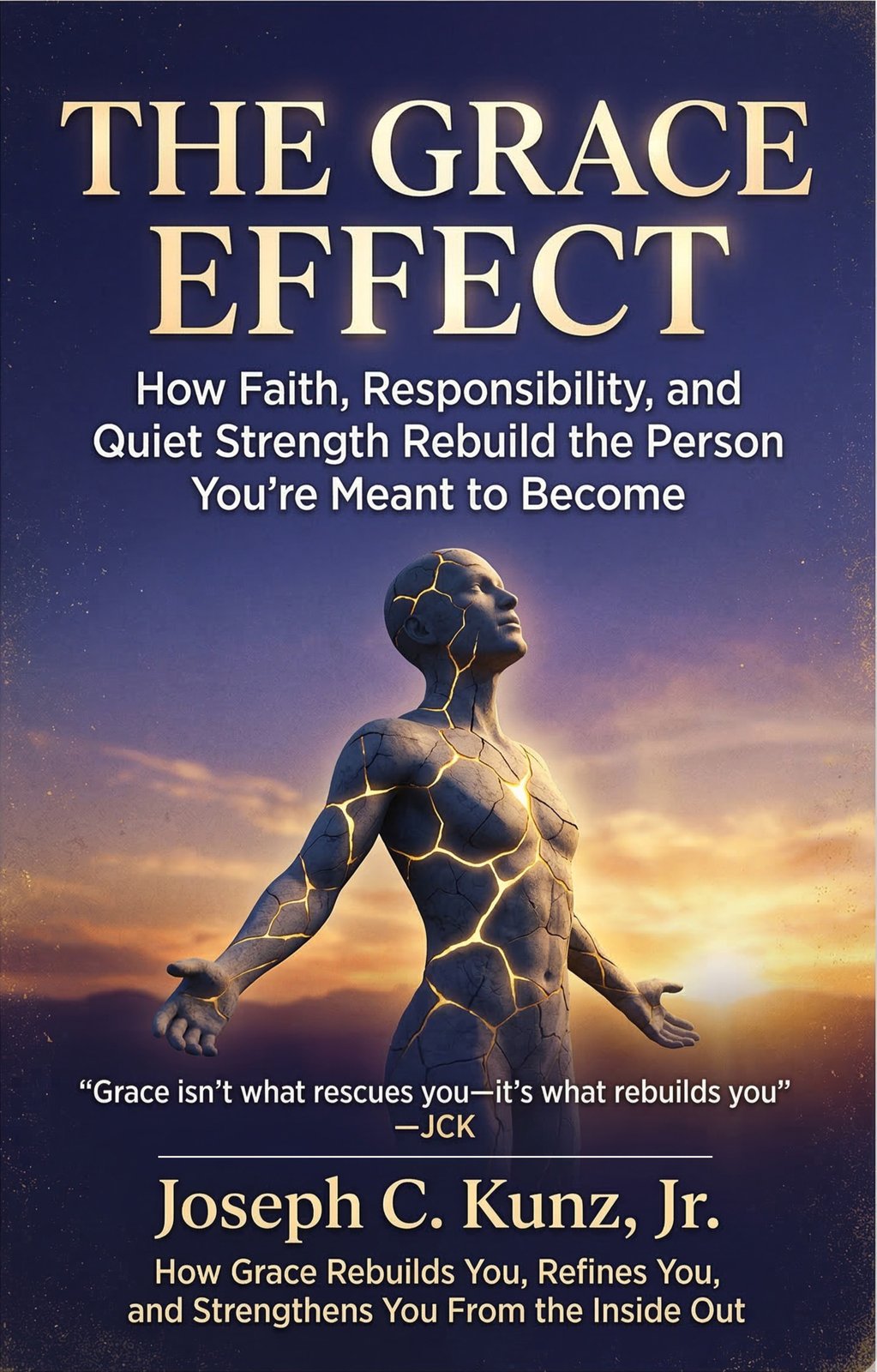
That is exactly why I wrote The Grace Effect.
This book is not about being soft, fake, “nice,” or spiritually decorative. It is about what happens when grace becomes a governing force in a serious life—when it enters your marriage, your parenting, your wounds, your regrets, your leadership, your anger, and the private places where your soul either grows up or turns ugly.
Because if you do not learn grace, pain will discipline you instead.
And pain is a brutal teacher.
Read more about The Grace Effect and learn the kind of grace strong enough to keep your soul from turning hard.
Forthcoming.