Faith Is Not a Mood
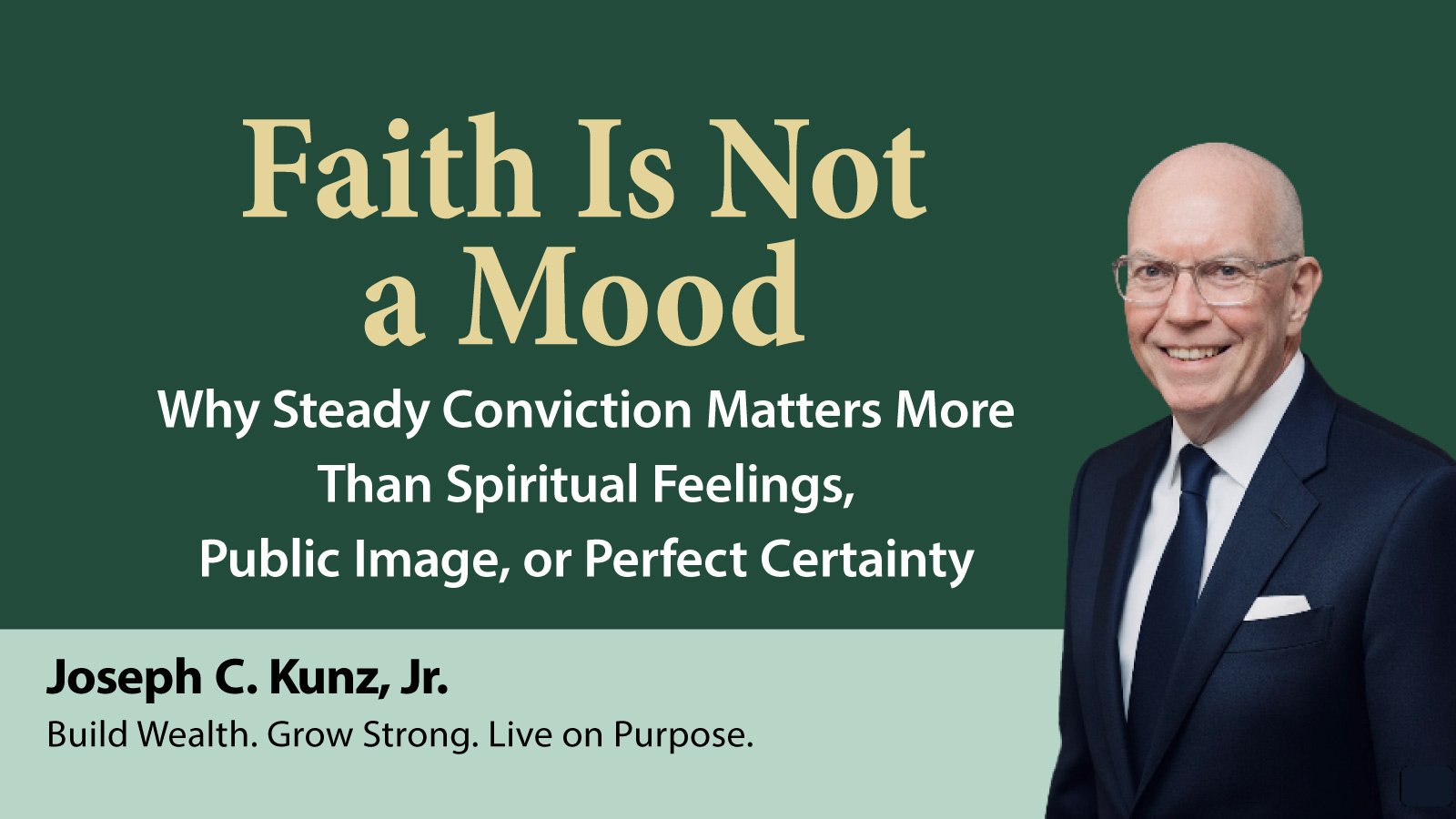
Real faith is not spiritual atmosphere or performance, but lived conviction—the kind that keeps a person standing when life stops cooperating. —Joseph C. Kunz, Jr.
Why Steady Conviction Matters More Than Spiritual Feelings, Public Image, or Perfect Certainty
By Joseph C. Kunz, Jr.
Synopsis
This is not another vague encouragement to “have faith” or a sentimental appeal to religious feeling. In this essay, Joseph C. Kunz, Jr. argues that faith has been badly reduced in modern life—either to emotional uplift, public performance, inherited vocabulary, or blind optimism dressed up as conviction. But real faith is not a passing feeling or a spiritual accessory for easier times. It is a steadier and more demanding reality: an inner structure of trust that helps a person remain grounded when life becomes painful, unclear, unfair, or impossible to control.
Kunz argues that faith is most often misunderstood precisely because people keep looking for it in the wrong places. They mistake emotional intensity for depth, certainty for maturity, and outward display for inward substance. He explains why moods cannot carry the weight of a serious life, why suffering exposes the difference between borrowed belief and earned conviction, and why faith does not require the absence of doubt so much as the refusal to let doubt, pain, or delay become final authority. Real faith is not fragile because it was never meant to rest on atmosphere. It was meant to hold under pressure.
The conclusion is simple: faith is not a mood, a performance, or a shortcut around suffering. It is a way of standing firm in truth when the inner weather changes and the outer world refuses to cooperate. Because when a man builds his life on feelings, he becomes unstable with every storm—but when he builds it on faith, he gains a foundation strong enough to carry the weight of real life.
A man who builds his life on feelings will live at the mercy of weather. –JCK
I. Introduction: The Problem with the Word “Faith”
Faith is one of those words people use easily and understand poorly.
Some people hear the word and think of church language, religious habits, or family tradition. Others hear it and think of blind belief, emotional comfort, or sentimental slogans people repeat when they do not have real answers. Still others think faith is a personality style—a soft, hopeful way of looking at life when things are going well.
That is part of the problem.
A word that should carry tremendous depth has been reduced, in many cases, to either marketing language or emotional decoration. For some, faith has become performance. For others, it has become embarrassment. For many, it has become so vague that it means almost nothing at all.
But real faith is neither shallow nor vague.
It is not what a person says when life is easy. It is what holds when life stops cooperating.
That is where faith becomes real—not in theory, but in friction.
Faith matters because every human being will eventually face moments that cannot be solved by personality, planning, intelligence, money, or momentum alone. There will be seasons when outcomes are unclear, strength is low, and the usual explanations no longer seem big enough. In those moments, what a person truly believes about God, suffering, truth, responsibility, and hope stops being an abstract matter. It becomes structural.
That is why faith deserves serious treatment.
Not as a cliché.
Not as a slogan.
Not as a religious accessory.
But as one of the load-bearing forces in a life that holds.
II. Faith Is Not a Mood
Let us start by clearing away the confusion.
Faith is not a mood.
It is not the lifted feeling a person gets after hearing an inspiring message. It is not the emotional warmth of a meaningful moment. It is not the comfort of familiar language, and it is not the temporary confidence that comes when circumstances seem to be working in your favor.
Moods rise and fall.
A person can wake up grateful one day and discouraged the next. Strong one hour and uncertain the next. Full of conviction on Sunday morning and exhausted by Tuesday afternoon. That is part of being human. Emotions matter, but they are unstable. They make terrible architects.
If your faith depends entirely on how you feel, then your faith will be strong only when your emotions cooperate. And that means it will fail you at the exact moment you need it most.
Real faith needs to be deeper than that.
It must survive fatigue.
It must survive disappointment.
It must survive unanswered questions.
It must survive pain.
Otherwise, it is not faith. It is atmosphere.
And atmosphere does not hold up much weight.
A well-built life cannot rest on passing emotion. It must rest on something steadier than internal weather. Faith, rightly understood, is not emotional intensity. It is settled orientation. It is the deep conviction that reality is not random, that truth still matters, that God is not absent, and that your duty does not disappear simply because the road became difficult.
That kind of faith may have emotion in it. It may even produce strong feeling at times. But it is not made of feeling.
It is made of commitment, trust, and obedience under pressure.
That is different.
And it is much stronger.
III. Faith Is Not Performance
Another distortion of faith is that it becomes public theater.
Some people do not practice faith so much as display it. They know the language, the posture, the signals, and the script. They can talk about faith in ways that sound polished, familiar, and socially approved. But polished language is not proof of deep conviction.
A person can speak fluently about faith and still collapse under the slightest pressure. A person can project spiritual confidence and still be inwardly ruled by fear, vanity, resentment, or drift. A person can surround himself with all the right symbols and still have no real anchor at all.
This is one reason thoughtful people often become suspicious of religious talk. They have seen too much of the performance version. Too much noise. Too much image management. Too much public confidence with too little private depth.
And honestly, they are not wrong to be suspicious.
Faith that exists mainly to be seen is not faith. It is branding.
Real faith is quieter than that.
It shows up in restraint.
In endurance.
In humility.
In honesty.
In course correction.
In the decision to keep doing what is right when nobody is clapping.
A man with real faith does not need to advertise it every five minutes. He lives from it. It shapes how he carries disappointment, how he speaks to his family, how he handles money, how he responds to hardship, how he treats people who cannot benefit him, and how he stands when life refuses to reward him on schedule.
That is what makes faith credible.
Not the volume of a person’s claims, but the steadiness of a person’s life.
IV. Faith Is Not the Absence of Doubt
This matters too.
Many people assume that faith means having no doubts, no hard questions, no internal struggle, and no moments of fear. That standard sounds impressive, but it is not realistic, and it is not how real human beings live.
The truth is that faith and uncertainty often occupy the same room.
A person can believe and still wrestle. A person can trust and still ache.
A person can pray and still feel the weight of not knowing.
A person can move forward while still carrying unanswered questions.
Doubt does not always mean rebellion. Sometimes it means you are awake. Sometimes it means you understand the seriousness of the situation. Sometimes it means you are not hiding from reality.
The issue is not whether a person ever struggles. The issue is what a person does inside that struggle.
Does he surrender truth because clarity feels delayed?
Does he abandon duty because certainty feels incomplete?
Does he turn pain into cynicism?
Does he make confusion his identity?
Or does he keep standing?
That is where faith becomes visible.
Faith does not require a person to pretend everything makes sense. It requires him to refuse the lie that confusion gives him permission to drift. It requires him to keep walking in the direction of truth even when the full map is not yet visible.
That is not blindness. That is maturity.
A child thinks certainty must always feel immediate. A grown man learns that some of the deepest convictions in life are lived before they are fully explained.
V. What Faith Actually Is
So what is faith?
Faith is steady trust in what is true, even when the immediate evidence is incomplete, the outcome is uncertain, and the emotional reward is absent.
Faith is not pretending reality is easy. It is facing reality without surrendering your soul to fear, bitterness, or chaos.
Faith is a form of inner structure.
It is what keeps a person from collapsing into panic every time life becomes unpredictable. It is what gives suffering context instead of letting suffering become the final authority. It is what allows a person to keep moving with honesty and courage when he cannot control the timing, shape, or explanation of what is happening.
In practical terms, faith means:
Trusting that truth is still true even when culture mocks it.
Trusting that your duty still matters even when it feels costly.
Trusting that pain is not pointless even when it feels unbearable.
Trusting that God is not absent simply because He is not performing on command.
Trusting that a meaningful life can still be built through obedience, humility, repentance, patience, and courage.
Faith is not magic. It does not remove difficulty. It does not guarantee comfort. It does not exempt anyone from sorrow, responsibility, or consequences.
What it does is give a person a place to stand.
That is a lot.
In fact, it is everything when life gets serious.
VI. Faith in Ordinary Life
One reason people misunderstand faith is because they imagine it belongs only to dramatic moments.
But faith is not just for hospitals, funerals, crises, and catastrophes. Faith is also for Tuesdays. For workdays. For family strain. For financial pressure. For moral fatigue. For private discouragement. For long seasons when nothing feels especially dramatic, but the weight of ordinary life is still real.
That is where faith quietly proves its worth.
Faith helps a husband stay loyal when the culture teaches him to chase novelty.
Faith helps a wife remain strong and tender in a world that confuses hardness with strength.
Faith helps parents keep planting values they may not see blossom for years.
Faith helps a worker stay honest when shortcuts would be easier.
Faith helps a business owner endure dry seasons without compromising everything he once claimed to believe.
Faith helps a suffering person resist self-pity and choose dignity, truth, and perseverance.
In other words, faith is not merely a belief system. It is a way of carrying reality.
That is why it belongs in every serious discussion about how to build a meaningful life. A person who lacks faith may still achieve outward success for a time. He may earn money, attract attention, and project confidence. But when life stops rewarding him, what then? What keeps him from collapse, drift, despair, or self-destruction?
At some point, every life reveals what it was really built on.
And that revelation is often much less dramatic than people think. Sometimes it shows up in a marriage. Sometimes in illness. Sometimes in loss. Sometimes in the slow emotional erosion that happens when a person achieves what he wanted and still feels empty.
Faith does not eliminate those moments.
It gives them somewhere to go.
VII. Faith, Suffering, and the End of Pretending
A shallow faith can survive comfort. A real faith has to survive suffering.
That is where many illusions die.
Suffering has a way of stripping away borrowed language. It exposes what was merely inherited, imitated, or performed. It forces a person to discover whether his faith was built on convenience or conviction.
This is not pleasant work, but it is clarifying work.
When life wounds you, humbles you, scares you, or changes you, you eventually stop asking whether your beliefs sound impressive. You begin asking whether they hold.
Can they carry grief?
Can they withstand fear?
Can they endure delay?
Can they tell the truth about pain without becoming hopeless?
Can they keep you from becoming hard, bitter, dishonest, or spiritually numb?
That is the test.
Not whether your faith makes you look strong.
Whether it helps you remain human.
Real faith does not turn a person into a religious actor. It turns him into a steadier man. Often a humbler one too. He becomes less impressed with image, less dependent on applause, less intoxicated by control, and less surprised by hardship.
Not because suffering is good in itself.
But because suffering forces serious questions, and faith—real faith—refuses shallow answers.
A person who has lived long enough learns that life is not managed by slogans. Some seasons can only be carried by conviction. And conviction only becomes trustworthy when it has been tested.
That is why earned faith speaks with a different voice than borrowed faith.
Borrowed faith sounds polished.
Earned faith sounds grounded.
Borrowed faith talks big.
Earned faith stands firm.
Borrowed faith disappears when life gets expensive.
Earned faith becomes more honest, more durable, and more necessary.
VIII. Why Faith Makes a Life Stronger
Faith strengthens a life because it strengthens the person living it.
It teaches restraint in a culture of impulse.
It teaches patience in a culture of speed.
It teaches humility in a culture of self-display.
It teaches courage in a culture of comfort.
It teaches obedience in a culture of self-invention.
In that sense, faith is not one private compartment of life. It shapes everything. It influences how you interpret success, how you respond to failure, how you treat others, how you define freedom, and how you measure whether your life is actually going well.
Without faith, people often become vulnerable to two equally dangerous errors.
The first is arrogance: the illusion that they are fully self-made, fully self-guided, and fully sufficient. That works only until life reminds them they are not.
The second is drift: the loss of direction that comes when a person has no stable authority above appetite, fear, trend, or mood.
Faith corrects both.
It reminds a person that he is not God.
And it reminds him that he is not nothing.
That is a stabilizing truth.
It places life in a moral frame. It tells a person that his choices matter, his soul matters, his conduct matters, and the small decisions of daily life are not small in the long run. It gives ordinary life weight and dignity.
And that is one of the great hidden gifts of faith: it rescues life from meaninglessness.
Not by making life easy.
By making it intelligible.
IX. What Happens When Faith Is Missing
When faith is missing, people do not become neutral. They become vulnerable.
They put ultimate weight on things that cannot carry it.
Approval.
Politics.
Money.
Pleasure.
Identity.
Achievement.
Control.
Romance.
Attention.
None of those things can bear the full weight of a human soul. Yet people keep trying. They ask temporary things to do eternal work, and then wonder why they feel anxious, angry, brittle, restless, or chronically disappointed.
A person without faith may still sound confident. He may even sound liberated. But underneath, he is often more fragile than he appears because he has no sturdy answer to suffering, no enduring reason for restraint, and no stable ground beneath his inner life.
This is why a faithless age tends to become both arrogant and emotionally weak at the same time.
It has lost transcendence, so it turns inward.
It has lost reverence, so it chases stimulation.
It has lost moral seriousness, so it becomes theatrical.
It has lost durable hope, so it becomes angry when comfort fails.
That is not freedom. That is instability dressed up as autonomy.
Faith gives a person something better.
Not a fantasy.
A foundation.
X. Faith as Orientation, Not Ornament
The deepest way to understand faith is this: faith is orientation.
It tells you where you are, who you are, what matters, what does not, and how to move when the road is dark.
That is why faith is not ornamental. It is not a lifestyle accessory for people who like spiritual language. It is not one more identity marker to place on top of an otherwise unchanged life.
Faith is meant to order a life.
It reorders the heart.
It reorders priorities.
It reorders ambition.
It reorders suffering.
It reorders success.
It reorders time.
And once faith becomes that kind of orientation, it stops being fragile.
A person with real faith may still grieve. He may still get tired. He may still face fear, frustration, unanswered prayer, and long stretches of uncertainty. But he is not rootless. He is not spiritually homeless. He knows where to stand, even when he does not know what comes next.
That kind of steadiness is rare now.
Which is exactly why it matters so much.
XI. Conclusion: Faith That Holds Under Pressure
Faith is not a mood, a style, a performance, or a shortcut around pain.
It is not pretending to be certain when you are hurting.
It is not speaking in polished religious phrases.
It is not emotional uplift, social identity, or spiritual branding.
Faith is steadier than that.
It is a lived trust in what is true.
It is an inner structure that holds under pressure.
It is the refusal to let fear, confusion, suffering, or delay have the final word.
It is what allows a person to keep walking in truth when life offers no applause and no easy explanation.
And in a world ruled by moods, noise, and image, that kind of faith is not simplistic. It is radical.
Because the man who lives by mood will always be at the mercy of weather.
But the man who lives by faith can endure storms without becoming one.
Faith is not the absence of struggle. It is the refusal to let struggle have the final word. –JCK
Related Essays: For the Reader Who Wants the Foundation, Not the Fluff
If this essay clarified something deep, these two will take you further into the architecture beneath it.
1. Faith Isn’t a Feeling — It’s a Discipline A sharp, practical essay showing that faith is not emotional atmosphere but a trained inner standard that holds when comfort, fear, and convenience start making demands.
Reader Comment: This one helped me see that faith is not something I “have” on good days—it is something I practice when life gets hard.
Quote: Faith is not something you admire from a distance—it is something you train into your life until it becomes part of your backbone. —JCK
2. Faith Isn’t a Theory — It’s Training This essay explains why faith is not mainly about abstract belief, but about forming the endurance, restraint, courage, and integrity needed to carry real responsibility.
Reader Comment: This essay made faith feel solid and usable to me—not abstract, not decorative, but like something meant to shape how I actually live.
Related Book: Still Drifting? Then You Don’t Need More Inspiration — You Need Grace That Holds
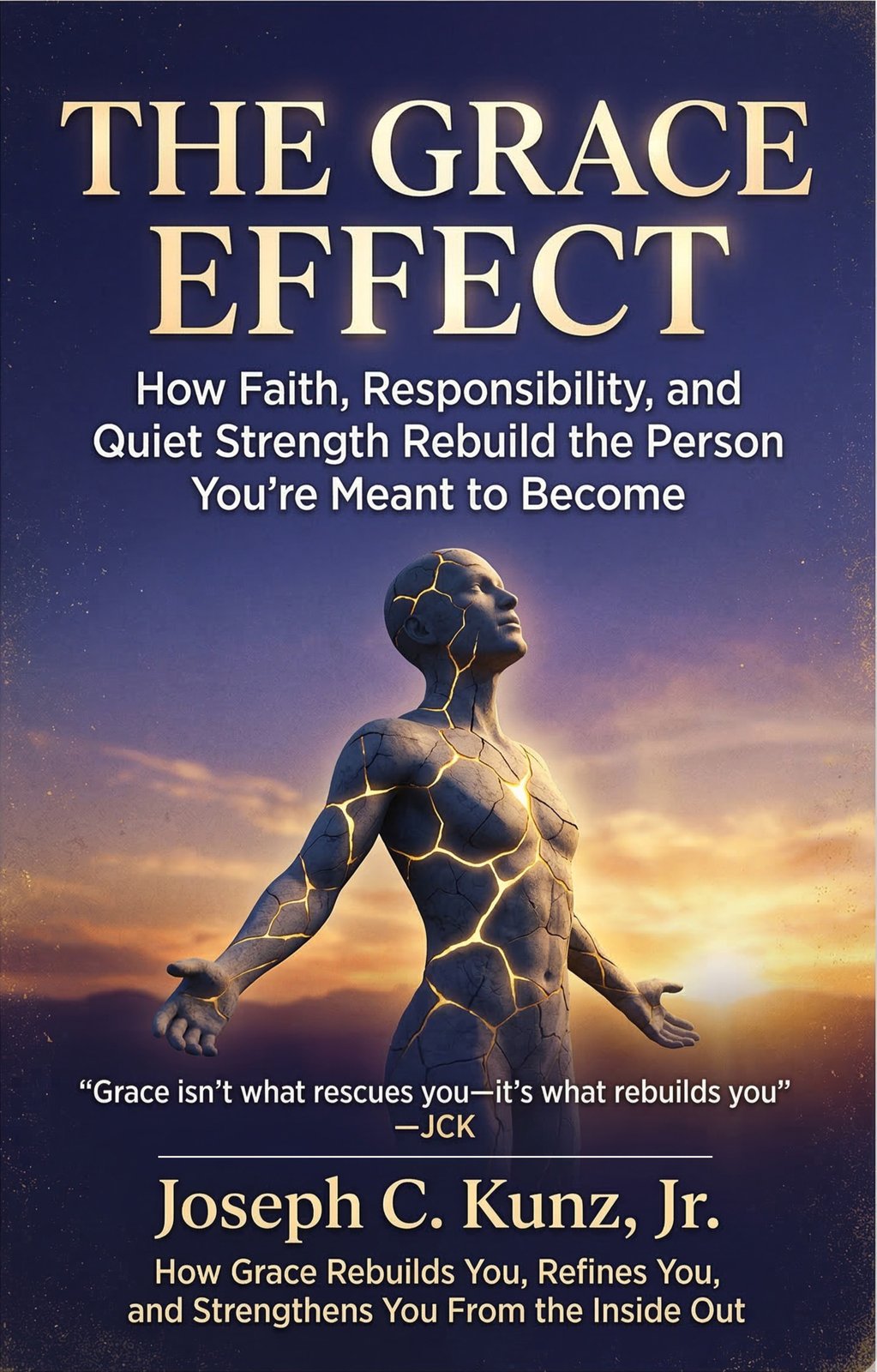
If Faith Is Not a Mood hit you in the chest, good. It was supposed to.
Because a lot of people are not losing their lives in one dramatic collapse. They’re losing them slowly—through drift, emotional weather, private exhaustion, spiritual inconsistency, and the quiet lie that they’ll get serious “later.” Later, when life calms down. Later, when they feel stronger. Later, when faith feels easier.
Later is where a lot of men and women bury the life they could have built.
The Grace Effect was written for that exact moment.
Not for people looking for polished religious talk. Not for people who want another soft little devotional pat on the head. And certainly not for people who confuse inspiration with transformation.
This book is for people who are tired of being ruled by moods, battered by setbacks, and dragged around by the inner chaos of modern life. It is about grace as strength. Grace as structure. Grace as the force that keeps you from folding when life hits hard, when regret gets loud, when your confidence drops, and when your soul starts negotiating with comfort.
Because here is the truth nobody says loudly enough: you do not need a prettier belief system—you need a sturdier inner life.
And that is what this book is built to help you recover.
If you are tired of starting over emotionally… If you are tired of feeling sincere but unstable… If you are tired of knowing better while still living below your convictions…
then stop circling the runway.
Read the book that was written to help you stand back up—with clarity, grit, humility, and grace.
Read The Grace Effect—because a life ruled by moods will always break under pressure, but a life rebuilt by grace can still become strong.
Step into The Grace Effect.
Stay tuned.