Empathy Is Not Weakness
Empathy becomes dangerous when it replaces truth, but truth becomes dangerous when it loses mercy. —Joseph C. Kunz, Jr.
Why Christian Compassion Needs Both Mercy and Moral Backbone
By Joseph C. Kunz, Jr.
Synopsis
This isn’t a defense of sentimental Christianity, emotional manipulation, or the shallow idea that compassion means agreeing with every wound, demand, slogan, or public claim placed in front of us. In this essay, Joseph C. Kunz, Jr. argues that empathy is not weakness, but it must be formed by truth, prudence, responsibility, and moral courage if it is going to become real Christian compassion.
Kunz makes the case that the Christian life cannot be reduced to either softness or hardness. Empathy without truth becomes sentimentality. Truth without mercy becomes cruelty. The mature Christian is called to something harder than both: a heart soft enough to see suffering, a mind clear enough to judge wisely, and a spine strong enough to act without surrendering conscience.
The conclusion is simple: Christianity does not train us to be manipulated by every emotion, but it also does not give us permission to harden our hearts. The way of Christ is not weakness without standards or strength without mercy. It is formed compassion.
Christian compassion is not the surrender of judgment. It is judgment purified by mercy. —JCK
I. Introduction: The Strange New Suspicion of Empathy
Something strange is happening in our public language.
Empathy, once treated as a basic human good, is now being spoken of by some people as if it were a spiritual danger, a cultural disease, or a form of moral weakness.
That deserves attention.
Not panic.
Not outrage.
Attention.
Because when a culture begins to treat empathy itself as suspicious, something deeper is going on than a debate over vocabulary. We are not merely arguing over one word. We are arguing over the kind of people we are willing to become.
For Christians, the issue is even more serious.
We are not simply asking whether empathy is useful in politics, counseling, leadership, family life, public policy, or moral argument. We are asking whether the Christian life requires us to enter, in some real way, into the suffering of another person.
That question cannot be brushed aside.
It also cannot be answered carelessly.
There is a real danger in false compassion. There is a real danger in emotional manipulation. There is a real danger in allowing tears, pain, slogans, or social pressure to replace truth. Every responsible adult knows this.
Parents know it.
Teachers know it.
Nurses know it.
Business owners know it.
Pastors know it.
Anyone who has ever had to make a hard decision for the good of someone else knows it.
Sometimes love says yes.
Sometimes love says no.
Sometimes love comforts.
Sometimes love corrects.
Sometimes love gives.
Sometimes love refuses to enable.
So the problem is not that all warnings about empathy are foolish. Some warnings are necessary.
But there is another danger, and it may be worse.
The danger is that in our effort to avoid emotional manipulation, we begin to train ourselves not to feel at all.
We begin by rejecting sentimentality.
Then we become suspicious of tenderness.
Then we mock mercy.
Then we call hardness strength.
Then we convince ourselves that indifference is moral clarity.
That is not Christianity.
That is a deformation of the soul.
II. Before Empathy Can Be Debated, It Must Be Defined
Before Christians argue about empathy, we have to ask what the word means.
That sounds simple.
It is not.
In our age, many of the most important moral words are no longer used only to clarify. They are used to pressure, shame, signal, recruit, accuse, excuse, and control.
Empathy can be used that way.
So can compassion.
So can justice.
So can love.
So can truth.
So can mercy.
So can Christianity itself.
That is why this discussion becomes so confusing. One person uses empathy to mean the basic human ability to recognize another person’s suffering and try to understand it. Another person uses empathy to mean emotional surrender to another person’s interpretation of reality. One person hears compassion and thinks of mercy. Another hears compassion and suspects manipulation. One person hears truth and thinks of moral clarity. Another hears truth and remembers cruelty dressed up as conviction.
Once words become unstable, arguments become traps.
A Christian cannot afford that confusion.
Words matter because words help form conscience. They help us name sin, mercy, love, duty, forgiveness, courage, humility, and grace. They help parents teach children. They help churches teach believers. They help citizens reason together. They help families speak honestly when life becomes painful.
When moral words are corrupted, people lose more than vocabulary.
They lose tools for becoming better.
That is why empathy has to be defined carefully. Properly understood, empathy is not agreement. It is not affirmation. It is not ideological obedience. It is not the surrender of judgment. It is not allowing another person’s pain to become the final authority over truth.
Empathy is the capacity to notice another person’s suffering and take it seriously.
That is not weakness.
That is part of being human.
But empathy must be formed. It must be governed by truth, prudence, responsibility, and charity. Otherwise it can become sentimentality, manipulation, or moral confusion.
The same is true in the other direction. Truth must also be formed by charity. Otherwise truth can become cold, proud, and cruel.
The purpose of Christian language is not to herd people into political obedience. It is to form the conscience toward truth, mercy, responsibility, and love.
That is why the question is not whether empathy should rule us.
It should not.
The question is whether Christians can see suffering clearly without surrendering truth, and tell the truth clearly without surrendering mercy.
That is the harder task.
That is the Christian task.
III. Empathy Is Not Moral Surrender
With that definition in mind, the next distinction becomes necessary.
Empathy is not moral surrender.
To understand another person’s pain does not mean accepting every conclusion that person draws from the pain.
To recognize suffering does not mean surrendering truth.
To listen carefully does not mean abandoning judgment.
To enter imaginatively into another person’s situation does not mean handing that person control over your conscience.
That is where much confusion begins.
Modern public life often tries to weaponize compassion. The message comes in many forms:
If you really care, you must agree.
If you really love, you must affirm.
If you really have compassion, you must support this policy, this slogan, this identity, this movement, this demand, this redefinition of reality.
That is not compassion.
That is pressure.
It may come dressed in moral language, but it is still pressure.
A Christian should not be naive about this. Emotion can be used to manipulate. Suffering can be used to silence legitimate questions. Good intentions can be used to excuse bad judgment. Public displays of compassion can become a kind of moral theater.
That is why empathy must be formed.
It must be disciplined by truth.
It must be governed by prudence.
It must be placed under charity, not above it.
Charity is not merely feeling with another person. Charity is willing the good of another person.
That matters.
Because the good of another person is not always the same as the immediate comfort of another person.
A father knows this when he disciplines a child.
A nurse knows this when she must do something painful in order to heal.
A teacher knows this when correction is necessary.
A friend knows this when honesty risks the friendship.
A Christian knows this whenever love requires courage.
Empathy, by itself, does not tell us what is good.
It helps us see that someone is hurting.
That is important.
But after we see the hurt, we still must ask: What is true? What is right? What is wise? What is just? What will actually help? What will damage further? What does love require here?
Those are not cold questions.
They are responsible questions.
IV. Sentimentality Is Compassion Without a Spine
The first false path is sentimentality.
Sentimentality is not compassion. It is emotion pretending to be moral authority.
It sees pain and immediately assumes that the sufferer’s interpretation of reality must be correct.
It confuses kindness with approval.
It confuses mercy with permission.
It confuses love with the removal of all discomfort.
It wants to be seen as caring, but it often does not want the burden of wisdom.
Sentimentality is dangerous because it feels virtuous while avoiding the hardest parts of love.
It avoids correction.
It avoids standards.
It avoids consequences.
It avoids judgment.
It avoids the slow, difficult work of formation.
Sentimentality is especially dangerous inside families.
A parent can call it compassion when he refuses to set boundaries.
A spouse can call it love when she avoids telling the truth.
A friend can call it support when he enables self-destruction.
A culture can call it kindness when it removes every standard that might cause discomfort.
But a standardless compassion is not love.
It is abandonment with a softer voice.
Real compassion does not merely ask, “How do you feel?”
It also asks, “What will make you whole?”
Those are different questions.
A child may feel angry at discipline, but discipline may still be love.
A patient may fear treatment, but treatment may still be mercy.
A man may resent correction, but correction may be the only thing standing between him and ruin.
A society may dislike standards, but without standards it cannot form citizens, families, workers, believers, or leaders strong enough to carry freedom.
This is why Christian compassion cannot be reduced to emotional agreement.
Christ did not affirm people into holiness.
He loved them into truth.
He healed.
He forgave.
He welcomed.
He touched the untouchable.
He ate with sinners.
But He also said, “Go, and sin no more.”
That is not cruelty.
That is mercy with a spine.
V. Hardness Is Truth Without a Heart
The second false path is hardness.
This is the equal and opposite error.
Hardness sees the danger of sentimentality and overcorrects. It becomes suspicious of mercy itself. It begins to treat tenderness as weakness, tears as manipulation, compassion as compromise, and pity as a trap.
At first, this can sound strong.
It sounds disciplined.
It sounds serious.
It sounds like moral clarity.
But if it is not careful, it becomes something else.
It becomes pride wearing armor.
The hardened person may tell the truth, but he tells it without tears.
He may defend standards, but he forgets what standards are for.
He may speak of responsibility, but he loses patience with human frailty.
He may talk about sin, but forget that he is also a sinner.
He may say he believes in grace, but only after everyone has cleaned themselves up enough to be respectable.
That is not Christianity either.
Christianity does not teach us to be fools. It does not command us to be manipulated. It does not require us to pretend that sin is harmless, disorder is healthy, weakness is strength, or bad choices have no consequences.
But Christianity also does not train us to despise the wounded.
There is a difference between refusing to be manipulated and refusing to be moved.
A Christian must learn that difference.
The priest and the Levite in the parable of the Good Samaritan may have had reasons to pass by the wounded man. Perhaps they had religious concerns. Perhaps they had safety concerns. Perhaps they had schedules. Perhaps they had obligations. Perhaps they had explanations that would have sounded reasonable in the moment.
But Christ does not make them the heroes of the story.
The neighbor is the one who saw the wounded man and moved toward him.
Not because he had surrendered truth.
Not because he had no standards.
Not because he had no responsibilities of his own.
But because love cannot remain theoretical in the presence of suffering.
The Samaritan’s compassion became action.
He saw.
He stopped.
He bound wounds.
He carried the man.
He paid the cost.
He promised to return.
That is not weakness.
That is strength under command.
VI. The Father Who Ran
The parable of the Prodigal Son deepens the matter.
The younger son is not innocent.
He insults his father, wastes his inheritance, shames his family, and collapses under the weight of his own choices.
A sentimental reading of the story might rush past all that.
A hardened reading might stop there.
Christianity does neither.
The younger son comes home broken. The father sees him from a distance and runs toward him.
That detail matters.
The father does not wait with crossed arms until the son has properly humiliated himself. He does not pretend nothing happened. He does not deny the waste, sin, foolishness, or shame. But he refuses to let the son’s failure become the final word.
The father’s mercy is not weak.
It is costly.
He absorbs the insult.
He bears the shame.
He restores the son before the village can destroy him with contempt.
But the parable also gives us the older brother.
That may be the most uncomfortable part of the story for responsible people.
Because the older brother is not entirely wrong.
He stayed.
He worked.
He obeyed.
He carried duties.
He watched the irresponsible son receive a celebration and felt the wound of unfairness.
Anyone who has tried to live responsibly understands that wound.
The older brother is not a cartoon villain. He is the responsible person tempted to let righteousness become resentment.
He has justice on his side.
But he is outside the feast.
That is a terrifying image.
A person can be right and still be outside the joy of the father.
A person can keep the rules and still miss the heart of the house.
A person can resent mercy because he has forgotten that he, too, lives by mercy.
That parable refuses our easy categories.
It does not flatter the reckless son.
It does not flatter the resentful son.
It reveals the father.
And the father is not sentimental.
He is not hard.
He is merciful.
That is the Christian center.
VII. The Incarnation Is Not Distant Correctness
The deepest Christian argument for empathy is not political.
It is not therapeutic.
It is not fashionable.
It is the Incarnation.
Christianity does not teach that God loved humanity from a safe distance.
God entered the human condition.
Christ took on flesh.
He entered hunger, fatigue, grief, temptation, betrayal, pain, friendship, family, work, tears, wounds, and death.
He did not merely issue correct statements from heaven.
He came among us.
That does not mean God affirmed every human desire. Christ confronted sin. He rebuked hypocrisy. He warned of judgment. He called people to repentance. He overturned tables. He spoke with authority.
But His authority was never cold.
He wept at the tomb of Lazarus.
He had compassion on the crowds.
He touched lepers.
He noticed the widow.
He restored the shamed.
He welcomed children.
He forgave sinners.
He suffered for enemies.
The Cross is not sentimentality.
It is mercy under full exposure to truth.
At the Cross, sin is not denied.
It is carried.
At the Cross, justice is not dismissed.
It is fulfilled.
At the Cross, love is not a feeling.
It is sacrifice.
That is why any Christian argument that trains people to despise empathy must be handled with extreme caution.
The Christian faith does not begin with a hardened heart protecting itself from human need.
It begins with God moving toward the wounded world.
VIII. The Moral Backbone of Compassion
Still, compassion must have backbone.
A soft heart without moral structure collapses under pressure.
It gets pulled wherever the loudest pain points.
It cannot distinguish between mercy and enabling.
It cannot say no.
It cannot protect the innocent from the manipulative.
It cannot defend truth when truth becomes costly.
That is not Christian maturity.
Christian compassion must be strong enough to disappoint people.
It must be strong enough to refuse lies.
It must be strong enough to carry another person’s pain without surrendering conscience.
It must be strong enough to help without feeding disorder.
It must be strong enough to forgive without pretending there was no wound.
It must be strong enough to love the sinner without blessing the sin.
This is where many modern arguments fail.
They assume compassion and judgment are enemies.
They are not.
Judgment without compassion becomes cruelty.
Compassion without judgment becomes chaos.
The mature Christian needs both.
A doctor who refuses to diagnose is not compassionate.
A judge who refuses to distinguish guilt from innocence is not merciful.
A father who refuses to correct is not loving.
A church that refuses to speak of sin cannot speak honestly of grace.
A culture that treats all boundaries as cruelty eventually becomes cruel in another way: it abandons people to their own confusion.
Real compassion has structure.
It has truth.
It has patience.
It has courage.
It has limits.
It has tears.
It has a backbone.
IX. The Household Test
The best way to test an idea is not only to apply it to politics.
Bring it home.
What does empathy mean at the kitchen table?
What does compassion mean in marriage?
What does mercy mean between parent and child?
What does truth sound like when someone you love is breaking down?
What does responsibility require when a family member is suffering but also making destructive choices?
This is where the issue becomes real.
It is easy to perform compassion in public.
It is harder to practice it in private.
It is easy to announce that we care about humanity.
It is harder to be patient with the person sitting across from us.
It is easy to defend truth online.
It is harder to tell the truth without humiliating someone we love.
It is easy to talk about moral courage.
It is harder to keep your heart open after disappointment.
The household reveals whether our convictions have become flesh.
A father who tells the truth without tenderness may raise children who fear him but do not trust him.
A mother who feels every pain but sets no boundaries may raise children who are loved but unformed.
A spouse who avoids hard conversations in the name of peace may slowly build a marriage on evasion.
A family that confuses kindness with permission may eventually call disorder love.
A family that confuses standards with contempt may eventually call hardness strength.
Neither family is healthy.
Neither forms the next generation well.
The next generation does not learn Christianity only from what we say about doctrine.
They learn it from the way we carry tension.
They watch how we respond when people fail.
They watch whether our truth has mercy in it.
They watch whether our mercy has truth in it.
They watch whether our faith makes us warmer, wiser, steadier, humbler, and stronger.
Or colder.
That is the legacy question.
X. Public Life Needs Formed Compassion
A society cannot survive on sentimentality.
But it also cannot survive on contempt.
Sentimentality destroys judgment.
Contempt destroys humanity.
Both are forms of disorder.
A healthy society needs people who can see suffering without being ruled by it, uphold standards without worshiping them, defend truth without enjoying the humiliation of others, and practice mercy without dissolving reality.
That is not easy.
It is much easier to join a tribe.
One tribe says compassion means affirmation.
Another tribe says compassion is weakness.
One side confuses empathy with moral authority.
The other risks confusing suspicion with wisdom.
A Christian should not belong entirely to either temptation.
The Christian should be free enough to say to the sentimentalist: pain does not create truth.
And free enough to say to the hard-hearted: truth does not excuse cruelty.
That freedom matters.
Because once mercy becomes partisan, Christianity is already being reduced.
Mercy does not belong to the left.
Truth does not belong to the right.
Both belong to God.
The Christian task is not to baptize a political temperament.
The Christian task is to be formed by Christ.
XI. What Kind of People Christianity Forms
The real question underneath this whole debate is not, “Is empathy good or bad?”
The real question is: What kind of people does Christianity form?
Does it form people who are easily manipulated by every emotional appeal?
No.
Does it form people who are proud of not being moved by suffering?
No.
Christianity forms people who can stand in the tension.
People who can see the wound and still tell the truth.
People who can name sin without forgetting mercy.
People who can forgive without becoming fools.
People who can protect boundaries without despising the weak.
People who can resist manipulation without closing their hearts.
People who can carry justice and grace in the same soul.
That is not natural.
It is formation.
It is the work of grace over time.
The world does not need Christians who are merely nicer than everyone else.
And it does not need Christians who are merely harder than everyone else.
It needs Christians who have been formed deeply enough to love without lying and tell the truth without cruelty.
That kind of person is rare.
That kind of person is useful.
That kind of person can build something that holds.
XII. Mercy Is Not Weakness
Mercy is not weakness.
Mercy is strength under the government of love.
It takes no great courage to become hard. Life can make anyone hard. Betrayal can do it. Disappointment can do it. Politics can do it. Suffering can do it. Fear can do it. Pride can do it.
Hardness is easy.
Mercy is harder.
Mercy requires memory.
It remembers that we, too, have needed patience.
It remembers that we, too, have been foolish.
It remembers that we, too, have received more grace than we deserved.
Mercy also requires courage.
It does not deny wrongdoing.
It does not erase consequences.
It does not pretend repentance is unnecessary.
It does not call evil good.
But it refuses to let justice become lovelessness.
It refuses to let truth become a weapon for self-righteousness.
It refuses to let pain turn into permanent contempt.
Mercy does not abolish moral backbone.
It gives moral backbone its Christian shape.
Without mercy, backbone becomes steel without a soul.
Without backbone, mercy becomes water without a vessel.
Christian compassion needs both.
XIII. Conclusion: A Soft Heart and a Strong Spine
The answer is not empathy alone.
The answer is not truth alone.
The answer is formed Christian compassion.
A Christian needs a soft heart and a strong spine.
The soft heart sees the wounded.
The strong spine refuses lies.
The soft heart listens before judging.
The strong spine judges when judgment is required.
The soft heart remembers mercy.
The strong spine remembers truth.
The soft heart moves toward suffering.
The strong spine refuses to be manipulated by it.
That is not weakness.
That is not sentimentality.
That is not hardness.
That is Christian maturity.
Empathy is not the enemy of truth. Properly formed, it is one of the ways love first notices where truth and mercy must be brought to bear.
The conclusion is simple: empathy is not weakness. But empathy must become compassion, compassion must be governed by truth, and truth must be carried by love. Anything less is not strong enough to be Christian.
A hard heart may look strong from a distance, but only a formed heart can carry truth without turning it into cruelty. —JCK
Related Essays: Mercy, Truth, and the Discipline of Real Compassion
These companion essays continue the argument that Christian compassion is not softness, sentimentality, or emotional surrender. It is mercy formed by truth, responsibility, and the courage to see people clearly.
1. When Good Intentions Aren’t Enough
This essay argues that sincerity cannot replace reality, and that compassion must be disciplined by truth if it is going to serve what is genuinely good.
Reader Comment: Read this alongside Empathy Is Not Weakness because it explains the danger on the other side of compassion: not coldness, but careless kindness that means well while refusing to ask whether it is actually helping.
Quote: The answer is not to care less. The answer is to care accurately. —JCK
2. Visible Hardship Reveals Invisible Kindness
This essay reflects on how visible suffering can awaken compassion in others, while reminding us that many people carry invisible burdens that still deserve patience, mercy, and human dignity.
Reader Comment: This is the more personal companion to Empathy Is Not Weakness. It shows what mercy looks like when it leaves the argument, enters daily life, and becomes patience, attentiveness, courtesy, and grace toward people whose full story we may never know.
Quote: The kindest people do not wait until hardship becomes obvious. They train themselves to notice, to soften, and to offer mercy before they are asked. —JCK
Related Book: Grace Is Not Soft. It Has a Spine.
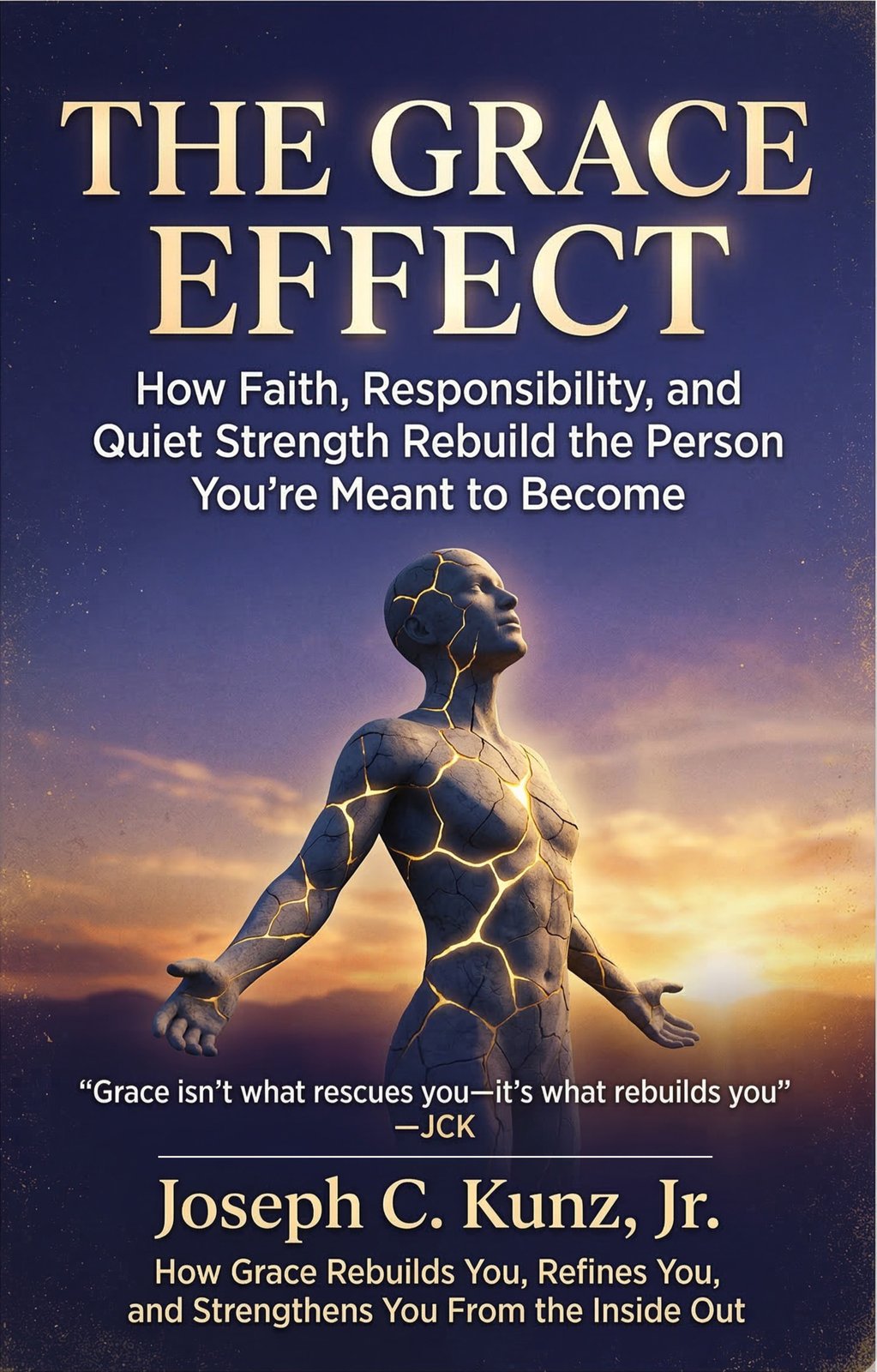
A hard world does not need more sentimental talk about kindness. It needs people formed deeply enough to practice mercy without surrendering truth, and strong enough to tell the truth without becoming cruel.
That is the heart behind The Grace Effect.
This book is being built around one of the most misunderstood truths in Christian life: grace is not weakness. Grace is not denial. Grace is not pretending sin, failure, pain, betrayal, or responsibility do not matter. Grace is the power that enters the wound without losing sight of truth. It forgives without becoming foolish. It restores without becoming sentimental. It carries mercy with moral backbone.
If you are tired of shallow religious language, this book is for you.
If you believe Christian compassion should make people stronger, not softer in the wrong places, this book is for you.
If you want to understand how grace forms the heart, steadies the soul, strengthens the family, and teaches us how to carry truth with mercy, this book will speak directly to that hunger.
The Grace Effect is not about becoming nice.
It is about becoming formed.
In Formation: The Grace Effect