Connecting the Dots
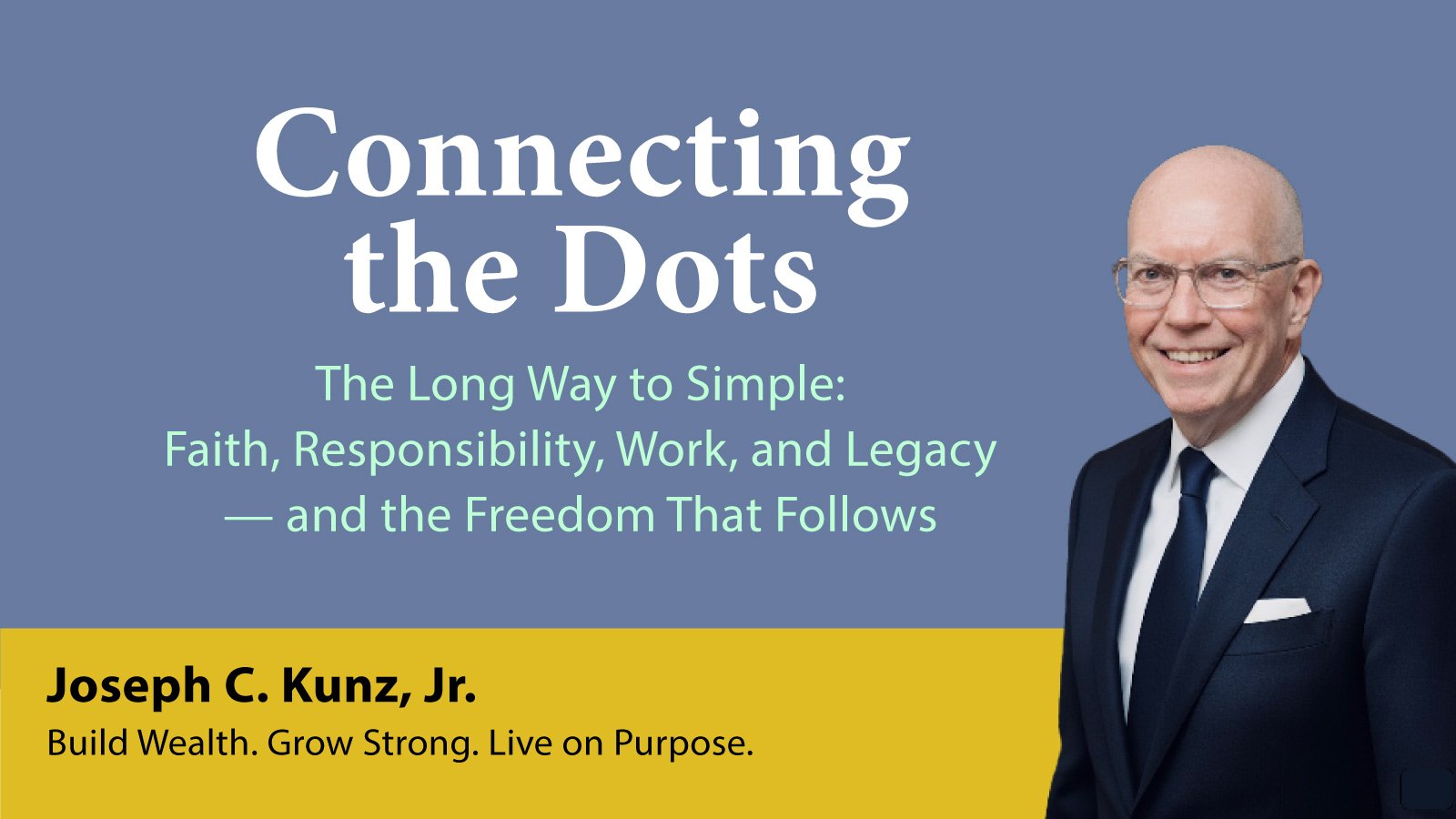
The longer I live, the more clearly I see that faith, family, work, and freedom aren’t separate chapters—they’re the blueprint for a life of strength, purpose, and integrity. —Joseph C. Kunz, Jr.
The Long Way to Simple: Faith, Responsibility, Work, and Legacy — and the Freedom That Follows
By Joseph C. Kunz, Jr.
Synopsis
Most of us live as if faith, family, work, and freedom occupy separate lanes. Real life does not cooperate. Pressure in one area spills into another, and a crisis exposes what we actually believe.
But the answer is not to let everything bleed together. It is integration: one set of convictions governing every part of a life. This essay traces that idea through one small, real decision—a client, a check written for less than the agreed fee, and a choice about how she would be treated afterward.
The payoff is a different understanding of freedom. Not autonomy, but alignment: a life in which what we believe and what we do finally match, provided that what we believe is true.
Freedom is not the absence of limits. It is the presence of integrity. —JCK
I. Introduction: The Illusion of Disconnected Parts
For part of my life, I thought the big pieces—faith, family, work, and freedom—were separate lanes. Each important. Each demanding. Each isolated.
Faith belonged in church. Family belonged at home. Work happened in the trenches. Freedom was political, something bigger than me.
But real life does not respect compartments. A crisis at work exposes what you actually believe. A hard season at home changes how you lead. And freedom, it turns out, is less about what you can do than about who you have become.
You do not get to live four separate lives and stitch them together later. Life stitches them together for you, usually under pressure and usually at a cost.
That was not a lesson I learned in a year. It took decades of building: making payroll, keeping my word, learning the difference between being competent and being clean, watching my children become adults, and realizing that my private habits were quietly becoming someone else’s inheritance.
In the language of the Four Pillars, the order is simple. Faith is the foundation. Responsibility is the frame. Work and wealth are the engine. Legacy is the destination. And freedom is the fruit of living in that order.
Underneath all of it is a truth I could not unsee once I saw it: every man lives under an authority. The only question is whether he chose it or surrendered to it.
II. Integration Is Not the Same as Leakage
Before going further, one distinction matters, because without it this argument can be turned on its head.
When work stress shows up at the dinner table, or tension at home follows a man into the office, that is not integration. That is leakage. Pressure from one part of life is spilling into another. Sensible people respond by building boundaries: leaving work at work, protecting time with family, refusing to let one bad day poison the rest.
Those boundaries are good. Integration does not mean tearing them down.
Integration means something else. It means the same convictions govern every room you walk into. The man who is honest with customers and careless with his wife is not integrated, no matter how well he keeps his calendars separate. The man who keeps his work off the dinner table but brings the same honesty, patience, and faith to both places is.
Leakage is when your pressures cross the boundaries. Integration is when your principles do.
The difference rarely shows up in dramatic moments. It shows up in small ones.
III. One Check, Four Pillars
Here is a small one from my own work.
After our company taught a class, a client’s business manager handed us a check for slightly less than the fee she had been quoted several times. When we questioned the amount, she angrily insisted that the lower figure was correct and walked away rather than correcting the check.
The shortfall was small. We accepted it.
What mattered more was what came next. I made a decision about how we would handle that client from then on, and I can still state it in the words I used at the time: even after that situation, we would never treat her differently in any way under any circumstances.
Looking back, I can see that this was not only a decision about collecting a fee. It was a decision about how we would conduct our business when an interaction turned unpleasant. I could believe the payment was wrong without deciding to treat the person badly.
I did not sit down that day and work through four categories. But when I look at the decision now, I can see every pillar in it.
Faith drew the line between judging someone’s conduct and withholding decent treatment from the person. The first was fair. The second was not mine to do.
Responsibility meant that her behavior did not get to decide mine. How she handled the check was her responsibility. How we handled her was ours.
Work and wealth supplied the concrete stakes: a quoted fee, a completed service, a discrepancy, and a customer relationship worth more than the difference.
Legacy was the standard itself—the kind of business we wanted to run and the kind of example we wanted our family to see.
One boundary should be clear. The lesson is not that a business must accept every underpayment or avoid addressing problems. Some problems must be confronted directly. The lesson is that correcting a transaction and treating a person decently are not competing choices.
It was a modest decision, not a dramatic sacrifice. That is the point. Integration is not proven in the big moments people remember. It is proven in small moments nobody else will ever hear about.
IV. Where the Pillars Get Tested: Home
If work is where integrity gets tested in public, home is where it gets tested without an audience.
At work, you can perform. At home, you are revealed. The people closest to you do not experience your intentions. They experience your tone, your consistency, your patience, and your ability to own your failures without turning them into excuses.
I have had moments I am not proud of—when my tone did damage, when I tried to win instead of lead, when I carried stress home and called it “just being tired.” The cost was not abstract. It showed up in faces I love. That is when responsibility stops being a principle and becomes repentance.
The same convictions that told me how to treat a difficult client also told me how to treat the people I love when I was tired and irritable. That is what integration demands. A standard that holds at the office and collapses at the kitchen table is not really a standard. It is a performance.
If you want to know what you truly believe, do not look at your best day. Look at what your family gets on your tired one.
V. Freedom: Alignment With What Is True
For a long time, freedom sounded like control: my time, my money, my direction.
But lasting freedom comes from something deeper than doing what I want. It comes from alignment. When a man believes one thing, does another, and hides parts of himself just to get through the week, freedom feels distant even when he is technically free. You can own your calendar and still be enslaved to pride, fear, anger, impulse, or the need for approval.
When your inner life and outer life finally match—when your work reflects your values, your home reflects your priorities, and your words match your conscience—that is freedom.
But alignment alone is not enough, and it is worth saying why. A man whose convictions are wrong can live them out with perfect consistency. He is aligned. He is not free. Alignment with a lie is only a more efficient form of bondage.
That is why the order of the pillars matters, and why faith comes first. Human beings do not stop worshiping when they stop worshiping God. As the novelist David Foster Wallace once observed, everybody worships something. If it is not God, it will be something smaller: the self, the crowd, money, status, appetite, or control. And those smaller gods promise freedom and deliver chains.
Faith puts moral law above mood. It gives conscience something true to align with. Freedom is alignment with what is true, and that is a different thing from simply being consistent.
VI. How I Came to See the Pattern
Writing did not change my life. It clarified it.
It slowed me down and made me name what I had been living without fully understanding it. But the pattern began long before I published an essay. It showed up in pressure, in quiet moments, and in decisions like the one about that check—small choices that only later revealed the same convictions at work in every part of life. I have told more of that story in The Inheritance I Never Received Is the One I’m Trying to Leave.
What I learned applies to most people: we are rarely missing meaning. We are missing integration. We already have the dots. We simply have not stepped back far enough to see the map.
VII. Conclusion: Start Connecting Your Own Dots
Life is too short to live in disconnected pieces. Faith, responsibility, work, and legacy are not separate boxes. They are meant to work together and build something that lasts.
Sometimes the people around you can help you see it—the ones who know you well and have watched you lead, serve, endure, and recover. Pay attention to what they see. Then take time to reflect, write, think, and pray.
You do not need a dramatic reinvention. You need honest attention and the courage to build in the right order. Here is a simple map to use this week:
Faith: Where is your conscience trying to correct you right now?
Responsibility: Where are you making excuses instead of taking ownership—at work or at home?
Work and Wealth: What corner are you tempted to cut, and what would “clean” look like instead?
Legacy: What are you teaching by example without meaning to?
Freedom: What habit is quietly owning you, and what would alignment with the truth require?
Start there.
You don’t find the blueprint. You live into it—one clean decision at a time. —JCK
Related Essays: For the Reader Ready to Go Deeper
Want to explore how these values shape the man you become?
1. Becoming the Man You Needed as a Boy
Why strength, presence, and honor are more powerful than status.
Reader Comment: Reading this felt like someone finally naming the standard I’ve been trying to live up to but never had words for. It made me think less about success—and more about responsibility.
Quote: The strongest answer to the boy who once needed a better man is to become that man for someone else. —JCK
2. Why Rich People Think in Terms of Systems, Not Paychecks
A look at how integrated thinking changes your approach to wealth and work.
Reader Comment: This essay shifted how I see money entirely. It wasn’t about getting rich—it was about building a life that actually works over the long haul.
Quote: Paychecks pay the bills. Systems pay for freedom. —JCK
Related Book: The Map Behind the Dots

The Four Pillars of a Well-Built Life
A Field Manual for Faith, Responsibility, Work, and Legacy
This essay asks you to connect the dots of your own life. The Four Pillars of a Well-Built Life lays out the map those dots belong to.
Faith is the foundation. Responsibility is the frame. Work and wealth are the engine. Legacy is the destination. None of them stands alone. Each strengthens or weakens the others, and the freedom most people are looking for turns out to be the fruit of getting their order right.
The book takes that structure out of the abstract and into ordinary decisions: how you work, how you handle money, how you treat the people closest to you, and what you are handing forward without realizing it.
If you sense that the parts of your life are connected but have never seen the pattern clearly, this book is for you.
If you want your convictions to hold in every room you walk into, not just the ones where people are watching, this book is for you.
If you are looking for freedom that lasts, this book is being written to show where it comes from.
Taking Shape: The Four Pillars of a Well-Built Life