A Man of Faith and Philosophy, Not Religion and Politics

Faith gives me a compass. Philosophy gives me a map. Religion can form the soul. Politics can order public life. But neither should replace conscience. —Joseph C. Kunz, Jr.
Why I Build My Life Around Faith, First Principles, and Responsibility — Not Institutional Labels or Party Tribes
By Joseph C. Kunz, Jr.
Synopsis
This isn’t an essay about rejecting religion, dismissing politics, or pretending that institutions have no place in a serious life. In this essay, Joseph C. Kunz, Jr. draws a sharper distinction: his work is not built around institutional labels, party tribes, or borrowed slogans, but around faith, first principles, conscience, and responsibility tested in real life.
Kunz makes the case that faith gives a man direction, philosophy helps him think clearly, and responsibility forces him to live what he claims to believe. The danger begins when religion becomes performance, politics becomes tribal identity, and people outsource their conscience to whatever institution, party, preacher, pundit, or crowd speaks loudest. Faith should form the soul. Politics should serve ordered public life. But neither should replace moral judgment, self-government, or truth.
The conclusion is simple: a serious life cannot be built on labels, slogans, outrage, or applause. It needs faith strong enough to hold under pressure, principles clear enough to guide decisions, and responsibility strong enough to govern the self before judging the world. I am not trying to escape religion or politics. I am trying to keep both in their proper place.
Faith isn’t a banner I wave. It’s a compass I follow — quietly, daily, stubbornly. —JCK
I. Introduction: The Misunderstanding
Every so often, someone tells me I write to push my “religious views” or my “political views.”
I understand why they say it.
I write about faith.
I write about moral order.
I write about responsibility.
I write about family, work, money, freedom, discipline, legacy, and the kind of life that holds when pressure comes.
In today’s world, that is enough to get you shoved into a box.
Religious.
Political.
Conservative.
Traditional.
Old-fashioned.
Moralistic.
Take your pick. The labels are cheap, and people hand them out like coupons.
But the label misses the point.
I am not writing to push a party platform. I am not writing to sell a denomination. I am not writing to win applause from one tribe or irritate another.
I am trying to tell the truth as clearly as I can.
I am trying to take what I have learned from faith, marriage, business, fatherhood, grandfatherhood, suffering, recovery, work, money, and responsibility, and turn it into something useful for people trying to build lives that hold.
That is not mere religion.
That is not mere politics.
That is practical philosophy rooted in faith.
II. Faith: The Compass That Points True North
Faith, for me, is not decoration.
It is not something I pull out for holidays, funerals, public speeches, or moments when I want to sound respectable.
Faith is the foundation.
It tells me that the world has moral structure. It tells me that truth exists whether I like it or not. It tells me that my choices matter beyond my own comfort. It tells me that success without humility becomes pride, wealth without gratitude becomes greed, freedom without virtue becomes chaos, and intelligence without wisdom becomes dangerous.
Faith does not make me naïve.
It makes me harder to fool.
It reminds me that not every loud voice is wise, not every institution is faithful, not every crowd is correct, and not every feeling deserves obedience.
Faith gives me a compass.
And a man without a compass can be very busy, very successful, very opinionated, very educated, and still be completely lost.
III. Philosophy: The Map That Makes Faith Usable
Philosophy is not academic fog.
At least, not the kind I care about.
Real philosophy asks the questions that decide how a man actually lives:
What is true?
What is good?
What is worth building?
What is worth refusing?
What does money serve?
What does freedom require?
What do I owe my family?
What kind of man am I becoming?
What will remain when I am gone?
That is not theory. That is the map.
Faith gives me direction. Philosophy helps me think through the road.
Faith tells me there is a true north. Philosophy asks whether my daily decisions are actually heading there.
This matters because belief by itself can become vague. A man can say he believes in God and still live by appetite, fear, pride, resentment, or convenience.
That is why faith needs thought.
And thought needs faith.
Faith without thought can become shallow.
Thought without faith can become cold.
Together, they can form a life with direction, structure, and moral weight.
IV. Religion: When Formation Becomes Performance
Let me be clear: I am not against religion.
Religion at its best forms people. It teaches reverence. It preserves memory. It gives language to worship, repentance, gratitude, mercy, duty, and hope. It reminds us that we did not invent truth five minutes ago while scrolling through a phone.
A serious religious tradition can steady a family, humble a proud man, comfort the suffering, discipline the selfish, and pass wisdom from one generation to the next.
That is no small thing.
But religion can also be distorted.
It can become performance.
It can become tribal costume.
It can become a way to look righteous without becoming responsible.
It can become a way to repeat words without allowing those words to form the soul.
That is the distinction.
I respect religion when it forms people.
I distrust it when it becomes a substitute for formation.
Because the point is not to wear faith like a badge. The point is to let faith shape how you live when nobody is clapping.
V. Politics: When Public Order Becomes Tribal Identity
I am not against politics either.
Politics matters because law matters, order matters, freedom matters, justice matters, property matters, education matters, family policy matters, and public decisions eventually walk right through the front door of ordinary homes.
Only a fool says politics does not matter.
But politics makes a terrible religion.
When politics becomes a man’s highest loyalty, it does not clarify his conscience. It usually replaces it.
He stops asking, “Is this true?”
He starts asking, “Does my side approve?”
He stops asking, “Is this right?”
He starts asking, “Will this help us win?”
That is how politics poisons the soul.
The party becomes the church.
The pundit becomes the preacher.
The slogan becomes the creed.
The enemy becomes the explanation for everything.
No thanks.
I care about politics because I care about truth, freedom, family, work, responsibility, and the future my children and grandchildren will inherit.
But I refuse to let politics become my master.
VI. Why This Matters in Real Life
This is not abstract for me.
I built a business with Michele.
I helped raise a family.
I have worked with nurses, physicians, students, and professionals for decades.
I have watched people carry pressure, grief, fear, ambition, illness, responsibility, and exhaustion.
I have faced my own health trials and learned that slogans do not hold a man together when his body, face, voice, balance, and identity are shaken.
That is when the difference becomes clear.
A label will not steady you.
A party will not form you.
A slogan will not rebuild you.
A public identity will not carry you through private suffering.
You need something deeper.
You need faith that has been tested.
You need principles that have been lived.
You need responsibility strong enough to govern your habits.
You need work that builds something useful.
You need wealth that serves more than appetite.
You need legacy that reaches beyond your own lifetime.
That is the philosophy behind my writing.
In Money’s Dirty Little Secrets, it means wealth with responsibility.
In The Grace Effect, it means strength guided by mercy.
In The Legacy Code, it means character over applause.
In The Four Pillars of a Well-Built Life, it means putting faith, responsibility, work and wealth, and legacy in the right order.
Faith gives me why.
Philosophy gives me how.
Responsibility gives me the frame.
Work gives me the arena.
Family gives me the reason.
Legacy gives me the long view.
VII. The Call to Think Clearly and Build Honestly
I do not want readers to become less religious.
I want them to become more faithful.
I do not want them to become less politically aware.
I want them to become less politically possessed.
I do not want people to float above institutions as if they are too smart to belong anywhere.
I want them to belong rightly — with conscience awake, judgment intact, humility alive, and truth placed above tribe.
That is the difference.
A serious man does not outsource his soul.
He can respect tradition without becoming a parrot.
He can participate in politics without becoming a puppet.
He can learn from institutions without surrendering his conscience.
He can think freely without becoming arrogant.
He can believe deeply without becoming performative.
That is the ground I am trying to stand on.
VIII. Conclusion: Put First Things First
So when I say I am a man of faith and philosophy, not religion and politics, I am not rejecting religion or politics.
I am putting them in order.
Faith comes first because it tells me what I stand on.
Philosophy helps me think clearly about what faith requires in daily life.
Responsibility forces me to live it instead of merely admire it.
Work gives it a place to prove itself.
Family gives it a human face.
Legacy asks whether any of it will outlive me.
Religion and politics both have their place.
But neither one gets the throne.
Because a life that holds cannot be built on borrowed outrage, inherited slogans, institutional habits, or tribal applause.
It must be built on truth.
It must be tested in real life.
And it must be strong enough to carry weight when the noise stops.
I follow God quietly, think freely, and build deliberately. That is not ideology. That is responsibility. —JCK
Related Essays: For Readers Who Refuse to Settle
1. Faith First: The Real Foundation of Conservative Principles
Discover why true conservatism begins with moral order, not party loyalty.
Reader Comment: This piece made me rethink everything I thought I knew about values and politics.
2. The Moral Order That Built America: Why Faith Balances Justice, Mercy, and Grace
How the Founders used belief and restraint to build a nation strong enough to be free.
Quote: Without faith, justice turns cruel. Without grace, freedom turns wild. —JCK
Related Book: Read the Book That Reclaims Strength Without Losing Grace
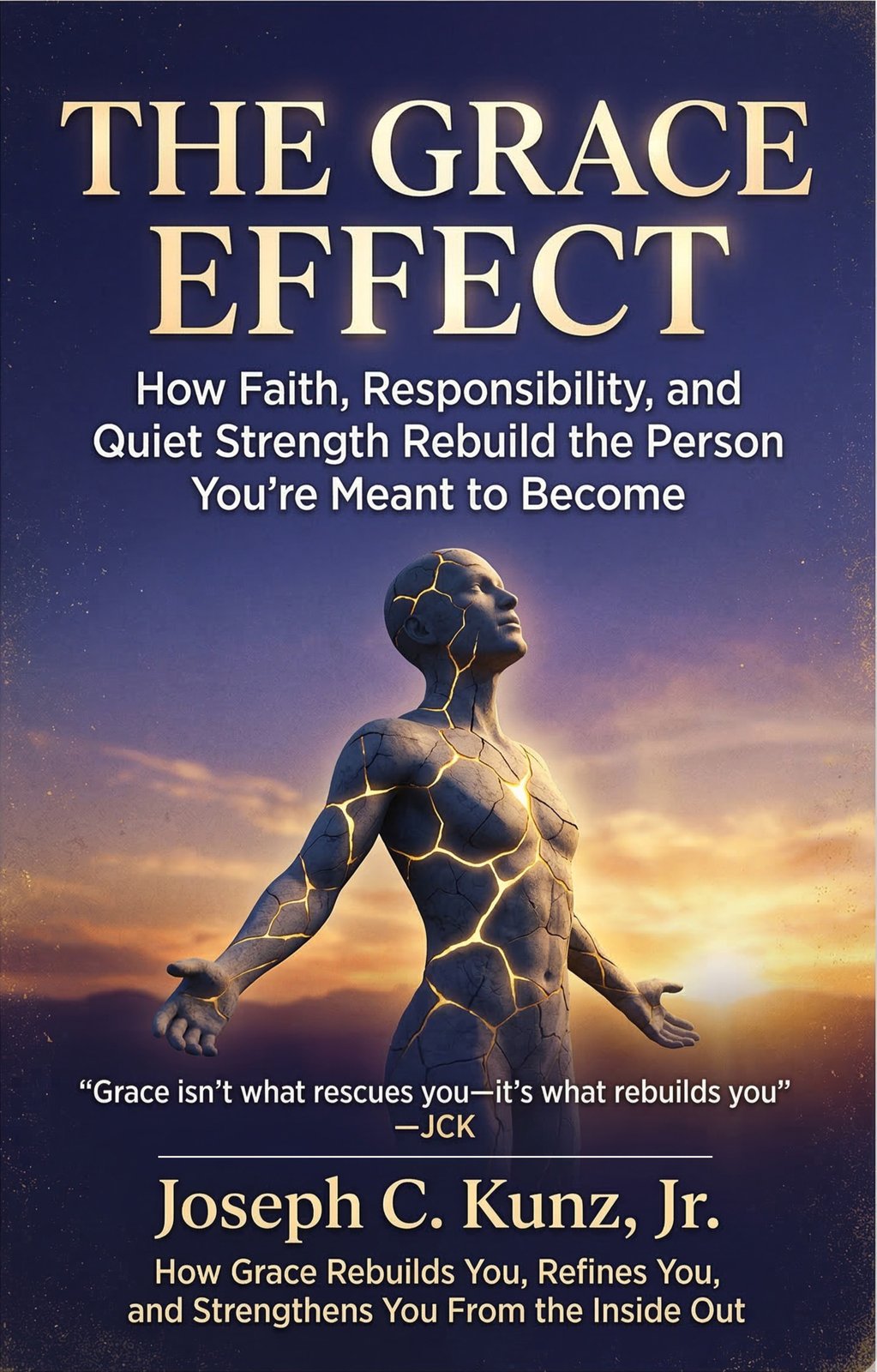
You don’t need another self-help slogan—you need a moral framework strong enough to rebuild your life when everything else collapses.
The Grace Effect is that framework.
It’s not about perfection; it’s about resilience—the kind that comes from faith tested by fire and character proven in motion.
If the world feels unsteady, this book will steady you.
It will remind you that grace isn’t weakness; it’s the quiet strength that rebuilds everything power can’t.
Don’t just read it—live it.
Read more in The Grace Effect.
Coming soon.